10 Best Places for Hot Air Ballooning in Asia
UPDATED: SEPTEMBER 2026
Whenever I travel to a new inland destination in Asia that is scenic, I always try to find out in advance whether hot air balloons are operating in the region. There’s no better way to see such places than from the wicker basket of a balloon drifting quietly over the landscape in the cool morning air.
About 15 years ago I had a short cycling holiday at Yangshuo in southern China’s Guangxi region. The limestone karst scenery around Yangshuo is spectacular and is usually enjoyed whilst on bicycle tours or floating down the Li River or one of its tributaries on a bamboo raft.
On the morning that I left I spotted a hot air balloon in the sky. I had no idea that balloons were operating in the area and was devastated that I had missed the opportunity to see the beautiful scenery from the sky!
So now I always do online research to determine whether there are any opportunities to sightsee from a balloon.
Of course, this only applies to inland destinations because balloons can’t operate near the coast as there is a risk that air currents may carry them out to sea. That’s why countries like the Philippines and Taiwan usually limit balloon flights to short or tethered flights in annual festivals.
Although a few locations offer sunset flights, most confine flights to the early morning when the air near the ground is still, and the winds at higher altitudes are light.
That’s why most hot air balloon flights are billed as sunrise flights. In the late afternoon winds are usually more unpredictable and flights need to land right after sunset because it’s not safe to be landing after dark (because of the difficulty of seeing power lines).
Sunrise is the best time of the day to fly in a hot air balloon. Image: © Francesco Venier
I’ve always loved flying and never feared heights, so jumping into a balloon and soaring into the sky under the power of bursts of propane gas flames never concerned me.
I know that there are many nervous flyers and others who are scared of heights, but many such first-timers whom I’ve met on balloon flights have told me how much they enjoyed their ballooning experience, despite their initial reluctance to go (usually they were egged on by a partner).
Hot air ballooning is no more dangerous than going on a bus trip or a boat charter. It’s one of the safest forms of aviation. Yes, there are occasionally accidents (almost always caused by pilot error) but over the past 50 years the number of people who have died in hot air balloon accidents has averaged only three people per year worldwide.
That’s an incredibly small number given that hot air balloons carry more than a million passengers every year.
Any ‘Top 10’ type destination listing is going to be subjective in the eyes of the author, and many are based only on online research, but in the case of this list most of these flights I’ve done myself (and where I haven’t, I’m familiar with the location) so my ratings are based very much on personal experience.
I’ve also taken cost and value for money into consideration. (Note: prices quoted are in US dollars).
Many people are puzzled as to why balloon flights vary so much in price from one location to another. Aside from the usual factors like how much local competition there is, the cost of getting balloons into and out of a location each year influences the price that balloon operators charge.
At most ballooning destinations in Asia, the balloons can only fly seasonally, and when they can’t fly because of unsuitable weather conditions they are moved to other parts of the world.
Different countries have different rules and different levels of bureaucracy for importing and exporting balloons. In some countries they are taxed, in others they are not.
And the costs of accommodating pilots and support crews have to be taken into account because there are few locations where balloon flights operate all year round. All these factors can influence ticket prices.
1. Cappadocia, Türkiye
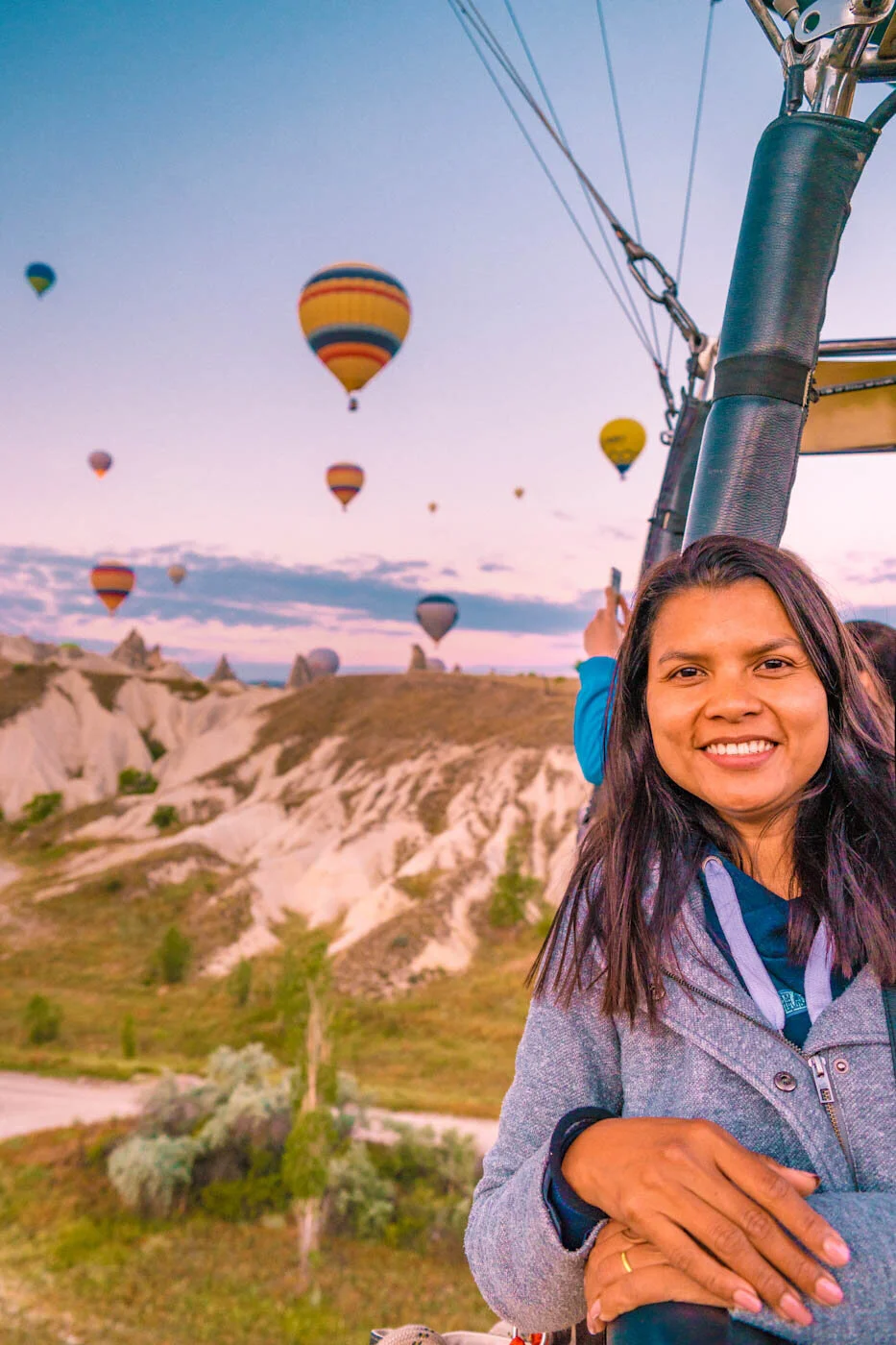
My very first hot air balloon flight was in Cappadocia in the mid-1990s. I flew with Lars-Eric Möre and Kaili Kidner who were two experienced European pilots and who started the first commercial balloon flights in the region in 1991.
In the year that I flew with them, there were about a dozen balloons in the sky each morning, but by 2020 that figure had grown to over 100. Today, Cappadocia is regarded as the ballooning capital of the world.
I’ve been back to Cappadocia three or four times over the past 25 years and flown with different operators and have been impressed by the safety standards that all the operators follow in Türkiye, despite the large number of balloons in the sky.
Some travel writers have reported that in peak season there are more than 150 balloons flying at the same time, but I’ve never counted that many.
Hot air balloons float over cave dwellings in Cappadocia. Image: © Trudi90
But whether it’s 100 or 150, there are few places in the world where sunrise is as spectacular. The balloons create a kaleidoscope of colour in the sky over Cappadocia’s craggy limestone lunar-like landscape.
Whether shooting from the ground or from the sky, it’s a photographer’s delight. The experienced pilots take their balloons down into gorges, around the ancient fairy chimneys and rock dwellings, and skim over the flat roofs of houses where residents are drying apricots.
As there are many balloon operators who fly in Cappadocia, prices are very competitive. They range from $80-$200 per person for standard one-hour flights in big baskets (16-28 passengers) to $150-$300 for deluxe flights in smaller baskets (10-16 passengers). Private VIP flights with only 2-4 passengers are also available but at much higher prices.
The deluxe flights offer a far better experience than the cheaper mass-tourism 28-passenger basket flights because everyone gets a good side view spot rather than being crushed in the middle of the basket.
There are four companies that only operate deluxe flights and are reputed to have the best and most experienced pilots. Those companies are Butterfly Balloons, Turquaz Balloons, Cappadocia Voyager Balloons, and Royal Balloon.
Usually balloon flights need to be booked several days in advance, but during shoulder season months that’s not always necessary. Cappadocia is one of the few places in Asia where balloons operate all year round, but most operate only between April and November.
In winter you will need to rug up well for your flight, but at most other times of the year summer casual clothing is fine with maybe a sweater or shawl if it feels cold when you set out early in the morning. Always take a hat because when the gas burners are ignited to give the balloon a lift, you’ll feel a blast of hot air on your head.
2. Bagan, Myanmar
It was hard to decide whether to put Cappadocia or Bagan first on this list because both are outstanding locations for ballooning, not only in Asia but worldwide. What determined Cappadocia’s first place was its value for money because Bagan is, unfortunately, one of the most expensive places in the world to fly.
At around $350 for a 45 mins flight, it’s more than double the price of most Cappadocia flights.
But don’t let the cost of taking a balloon flight in Bagan put you off doing it. It should be on every travellers’ bucket list because the experience is breathtaking.
Imagine the sun rising over a vast dusty plain dotted with over 2,000 ancient temples and pagodas. And as you slowly drift through this surreal landscape with about a dozen or so other balloons, you’ll get to watch the locals on the ground starting their working day.
Hot air balloons in the sky over Bagan after sunrise. Image: © Nick Fox
As there are fewer balloons in Bagan than in Cappadocia, it’s essential to make a reservation before you arrive. If you leave it until you are in Bagan, you are likely to find the only options available are the premium flights in the balloons with the smaller baskets (they carry only eight passengers) which include champagne breakfasts upon landing.
A great experience but they will take a much larger bite out of your wallet.
The ballooning season in Bagan starts at the beginning of October and runs through to around the first or second week of April.
However, Bagan does tend to suffer more flight cancellations than Cappadocia because of adverse weather conditions, so if you’ve set your heart on a balloon flight at Bagan, it’s worth planning to spend a few days there to give you a better chance of getting rebooked if the weather is unsuitable on your original booking date.
If you do miss out on a flight at Bagan, and are heading over to Inle Lake, on the other side of Myanmar, then one of the Bagan balloon operators also flies balloons there at a slightly cheaper price ($300 for 60-90 mins). They provide a unique and relaxing opportunity to see the stilt villages and floating gardens around the lake from a different perspective.
2026 Bagan Travel Warning
Travel to Bagan for hot air ballooning is not recommended under current security conditions, despite some local tour operators continuing to advertise seasonal flights over the plains.
Many countries currently advise against all travel to Myanmar, and most travel insurance policies are therefore unlikely to cover accidents or disruption while in the country.
Although the archaeological zone itself rarely sees direct infantry fighting, the surrounding region remains highly volatile due to the civil conflict between the military junta and insurgent groups.
Travellers may face unpredictable airstrikes, military checkpoints, rolling power blackouts, and abrupt road or airport closures that could disrupt movement with little notice.
Balloon flights over Inle Lake have also been temporarily discontinued because that region is closer to areas affected by airstrikes and active fighting.
3. Yangshuo, China
As previously mentioned, this was a flight that I missed out on, but I have no hesitation in recommending Yangshuo as the third best location in Asia to fly in a balloon because the scenery is so beautiful—and what better way to enjoy it than from the air.
At sunrise, the limestone karst peaks pierce through a low blanket of river mist, creating a landscape that looks like an ancient Chinese ink wash painting.
Two major waterways snaking through the valley floor act as mirrors for the mountains. The grand Li River is wide and bustling with traditional bamboo rafts, while the tranquil Yulong River winds lazily through the quiet countryside.
Around the time that I did my cycling tour of Yangshuo, it was fast becoming a popular ballooning destination (unbeknown to me at the time) but then an accident in 2009 killed four Dutch tourists and all ballooning operations in the area were suspended.
The balloon was operated by a local company with local pilots and was said to have been operating beyond safety limits. Its gas tank leaked and caught fire, causing the balloon to descend rapidly and crash. Other balloon companies staffed and managed by expatriate pilots didn’t fly that day.
The beautiful karst scenery of Yangshuo seen from a balloon. Image: Blazej Mrozinski CC BY-NC-ND
Ballooning operations have restarted in Yangshuo through a company called Guilin Tianxing, but there are currently only a couple of balloons flying. They only fly at sunrise, but flights will be cancelled if there is fog. The Yangshuo flights are about the same price as flights in Cappadocia.
The ballooning season in Yangshuo has been variable in recent years but there are usually one or two balloons operating from April through to October – an opposite season to Bagan.
For anyone still nervous about taking their first balloon flight, Yangshuo also offers short, tethered flights that rise only 80 – 100 metres (tethered to the ground by a cable) for $20-$25.
They last only 8-10 mins but will give you a bird’s eye view of the scenery, albeit not to the same extent as the free flights that usually fly at around 1,000 – 1,500 metres. The tethered flights operate all year round.
4. Jaipur, India
There are many locations in India where it’s possible to fly in hot air balloons. There’s no big centre of ballooning like there is in Turkey or Myanmar, but many operators flying in different locations. In my view the best location for a balloon flight in India is Jaipur in Rajasthan.
The so-called ‘Pink City’ is on almost every international visitor’s itinerary to India and it’s only from the air that you can appreciate the incredible diversity of the landscape around the city.
Most people who take a balloon flight in Jaipur hope for a fly-past of the majestic Amber Fort on the hill on the north side of the city. Amber Fort (also known as Amer Fort) is one of six ancient hill forts in Rajasthan that are on UNESCO’s World Heritage List.
A fly-past does happen on some days but can’t be guaranteed because the route of the balloons is dependent on the wind direction. Most of the Jaipur flights are sunrise flights, but occasionally sunset flights are scheduled if weather conditions are favourable.
A balloon drifts past an ancient hilltop fort near Jaipur.
The price of a one-hour balloon flight in Jaipur is $325, so it’s nearly as expensive as the Bagan flights. However, Indian nationals get much cheaper rates that are closer to Cappadocia rates. Foreign tourists frequently complain about the logic of the two-tier pricing system, but that’s the way things work in India.
Flights operate from 1 September to 30 April, but there will be some days when flights are cancelled because of weather conditions.
As is standard industry practice in those circumstances, if your flight is cancelled you will have the choice of a full refund or the option to take a free flight the next day that the balloons are flying – and if there are spaces available.
The company that operates the balloon flights at Jaipur, SkyWaltz Balloon Safari, is Indian-owned but employs mostly expatriate pilots. It’s been flying balloons since 2008 with a perfect safety record.
It has four balloons based at Jaipur, one that accommodates up to 22 passengers, another that carries up to 16 passengers, and two smaller ones that can take up to three or eight passengers.
It also operates in other locations around India and recently started flights over the Bandhavgarh National Park and Tiger Reserve in Madhya Pradesh.
5. Dambulla, Sri Lanka
Dambulla is well known for its Cave Temple – a Sri Lankan pilgrimage site for 22 centuries and now a UNESCO World Heritage Site. Dambulla is also one of the three main towns in what is known as the Cultural Triangle, and which encompasses the iconic ‘Lion Rock’ of Sigiriya.
It is the premier inland destination for travellers to Sri Lanka, so it’s not surprising that hot air balloons are operating here.
Although the region is primarily known for its cultural and archeological assets, it’s also a region that has many lakes and a few jungle areas within its dry plains, so there’s a lot of bird life early in the morning which provides an interesting landscape over which to fly in a hot air balloon.
You may also see some monkeys in the trees during low passes over the villages.
A balloon flight from Dambulla can provide a great view of Sigiriya. Image: © kozala
Some flights may include a fly past of Sigiriya but this is dependent on wind direction and weather conditions.
You’ll often find there is a morning mist around the lakes, which adds to the surreal feeling of the flight. The ballooning season in Dambulla is November to April, with the last two months having the fewest number of cancellations because of weather.
There are two balloon operators based in Dambulla—Sunrise Ballooning, a local company with two balloons, and Sri Lanka Balloon, a subsidiary of an international company that has three balloons in Sri Lanka and other ballooning operations in Turkiye and Tanzania.
Both use expatriate pilots with local support teams. Their prices are the same—$250 for a one-hour sunrise flight – and that includes pickup and return to hotels in and around Dambulla, Kandalama, Sigirya and Habarana.
Sunset flights are not available at Dambulla as afternoon weather conditions are rarely suitable.
6. Pokhara, Nepal
There is only one hot air balloon operator in Nepal—Balloon Nepal—and they have three balloons carrying eight, 12 or 16 passengers. The rides are short—only 40 minutes— but Pokhara deserves inclusion in this list because the mountain scenery around the valley with the backdrop of the Himalayas, provides one of the most spectacular balloon flights in Asia.
And Pokhara is one of the few places in Asia where winter flights are offered. You’ll need to rug up warm for those. It doesn’t often snow in Pokhara itself, but there’s plenty of snow on the higher elevations around the valley during the winter, and the white landscape makes for quite a different ballooning experience.
Fishtail Mountain seen from a Pokhara balloon flight. Image: © Arjun Jaisawal
The ballooning season is normally quite long in Pokhara – from September to May – and on many days sunset flights may be offered as well as sunrise flights, but note these are subject to local weather conditions, and may often be cancelled at the last minute.
It’s only during the summer monsoon months of June, July and August that the balloons don’t fly.
Prices in Pokhara, like in India, depend on your nationality. For Nepali citizens it is $83; for Chinese citizens it is $120; and for all other international tourists it is $150. The prices include pickup and return to Pokhara hotels as is the usual industry practice.
7. Siem Reap, Cambodia
The hot air ballooning season in Siem Reap is quite short, from December to March, but if you are in Cambodia during those months it’s worth including a balloon flight to give you a completely different perspective of the Cambodian countryside.
The balloons often used to fly very close to Angkor Wat but in 2013 after a violent crash landing into a nearby village (fortunately there were no fatalities) the Cambodian government prohibited balloon flights near the temple complex in case another crash landing damaged the antiquities.
Today the balloons only fly from near the Balong Temple, 15 kilometres away, and whilst you may get a good view of that temple, you won’t see much of the distant Angkor Wat complex.
There are currently two hot air balloon operators at Siem Reap, but neither have working websites, so bookings need to be made through sites like GetYourGuide or local travel agents. The flight from Balong Temple is quite short – about 30 minutes – and the cost is $175, so it’s fairly expensive.
A hot air balloon aerial view of Angkor Wat. Image: Mark Fischer
Angkor also has a tethered balloon. It’s not a hot air balloon – it’s a helium balloon – which can lift 30 people to a height of 120 metres for about 10-15 minutes to give them a view over the Angkor temple complex. It’s located 800 metres from the Angkor Wat west gate, so it’s still only a distant view.
The tethered balloon operates all year round subject to weather conditions. Between May and October, it operates primarily in the morning, and between November and April in the afternoon. Tickets are $30. However, as the sun rises from behind Angkor Wat, some travellers have complained that it’s hard to see the temple complex at that time of the morning.
8. Chiang Mai, Thailand
The second-ever balloon flight that I did after my first Cappadocia flight was in Chiang Mai. Back then I don’t think there were any big balloon companies based in Thailand.
I flew with an expatriate owner-operator who had recently taken up residence in the area. He had a balloon that would carry up to eight passengers, but on the day that I flew with him there were only three of us.
He said he normally wouldn’t fly with that small a number, but he hadn’t flown for a few days, so I think he was just grateful to find some passengers to help cover the cost of getting back into the air.
The scenery around Chiang Mai is not as spectacular as many other ballooning locations, but the countryside is pretty, and it was very relaxing to be flying over villages, small temples, and monasteries early in the morning and waving to the people below us. We flew for nearly two hours, and then had to wait for another hour for his small chase team to find us because they lost sight of us on the way.
Villagers near Chiang Mai look up to our balloon slowly floating past.
Looking back at my first Chiang Mai flight I now wonder whether the pilot was even licensed to fly in Thailand, given the small scale of his operation. But back then I was so keen to do another balloon flight after my Cappadocia experience, I didn’t think to ask questions.
SInce then, the Thai aviation authorities have clamped down on unlicensed operators and there is now only one company licensed to fly balloons in Thailand called Balloon Adventure Thailand. They operate balloon flights from the Horizon Village & Resort on the northeastern side of Chiang Mai and from Singha Park on the southwestern side of Chiang Rai.
The Chiang Mai flights these days take you closer to the mountains than the flight that I did there because they take off from the northern side of the city (my flight was well to the south of the city which was not so scenic). They operate only at sunrise.
The Chiang Rai flights usually take you over tea plantations (depending on the wind direction of course) with panoramic mountain views. They operate at both sunrise and sunset if weather conditions are favourable.
The company only operates with 8-passenger baskets, and at $270 for a 45 mins flight, they are among the more expensive flights in Asia.
9. Vang Vieng, Laos
When this article was originally published, I hesitated whether to include Vang Vieng because although I’ve been to this backpacker town between Vientiane and Luang Prabang several times, I’ve not taken a balloon flight there because I’ve not been confident about their safety standards.
For many years travel blog posts about ballooning in Vang Vieng highlighted that no safety briefings were given by the local pilots and that passengers are crammed in like sardines.
However that situation changed in late 2018 with the arrival of Above Laos Ballooning Adventures which is a French-Lao joint venture that uses modern French equipment and fully complies with international safety regulations.
Now that safety has been improved, Vang Vieng certainly deserves inclusion in this list it is one of the best places for ballooning in terms of both location, and value for money. The scenery is beautiful, and the flights are the among the cheapest in Asia ($150 for about 50 minutes).
A hot air balloon over Vang Vieng. Image: © Somsanith Chanthaseng
The Vang Vieng flights operate between late September and late March and there are both sunrise and sunset flights available (although the latter are often cancelled because of weather conditions).
From February onwards it’s best to stick with the sunrise flights because once the agricultural burning season starts, the air quality in the late afternoon deteriorates and will spoil the views from the balloon.
10. Dubai, UAE
In Dubai you won’t have to worry about the professionalism of the balloon operators or the safety standards to which they fly, but you won’t see spectacular scenery as you will in all the other places on this list. Yes, you’ll get a great distant view of the city, but for most of the time you’ll be flying over the desert.
Dubai balloon flights tend to be pricey, around Bagan levels, but you will spend longer in the air. And most Dubai operators usually combine their flights with desert wildlife spotting (from jeeps) or deluxe breakfasts in the desert to make the overall package more interesting.
There is also one company offering a combined overnight desert safari with a sunrise balloon flight.
Somewhat surprisingly, the ongoing conflict between the US/Israel and Iran hasn’t curtailed the flights except for a period early in the US bombing campaign. Some visitors may worry about an encounter with a stray missile or drone, but the Dubai balloon flights are conducted well away from the vicinity of the American bases.
A low flying balloon over the Dubai desert looks for wildlife. Image: © Ekaterina Anisimova
The ballooning season in Dubai is from September to March. At any other time of the year, it would be too hot. The best months are December to February, but you’ll need to wrap up warm in the morning when leaving on sunrise flights.
It’s tempting when in the Gulf to take a short flight over to Luxor because the hot air ballooning there over the ancient monuments is nothing short of spectacular and they are amongst the cheapest balloon flights in the world – a third to a half of the price of flights in Asia (aside from Vang Vieng) and usually much longer in duration.
I did that once and flew on two consecutive mornings, but I would not recommend Luxor to others because the safety standards at Luxor are much lower than at most ballooning locations in Asia.
Header image: © Fokke Baarssen