Langtang Valley: A Journey I Didn't Know I Needed
We can plan journeys based on the things we know we want. Or we can get to a new place and be delighted to find that the journey has given us exactly what we didn't know we needed.
My trek through the Langtang Valley in Nepal, for example, taught me that a journey can be as fulfilling as the destination.
The trip was the kind of trip I wanted: one that included mountains, walking trails and the sense of accomplishment that comes with completing a Himalayan trek.
What I didn't know was that the journey would also allow me to slow down and reflect on what I actually enjoy about travelling.
I've always thought Langtang would be an interesting place to trek, but I wasn't looking for an adventure of the kind that would simply get me to a specific destination.
A mountain stream on the Langtang Valley trek.
I wanted to experience the trail. I wanted to know how the landscape around me changed and to get away from the noise of the everyday world for a while.
By the end of the journey, the destination seemed less important than the journey itself.
I booked my trek through a company called Glorious Eco Trek Nepal because they had good reviews and offered treks that are much easier than the more well-known ones like to Everest and Annapurna Base Camps.
The Langtang Valley trek is a 10-day trek and classified ‘Easy’. We had ten participants on our group along with a guide and porter.
Leaving Kathmandu Behind
The trip from Kathmandu to Langtang was an interesting one for me. I'm not sure why I thought it was such an interesting transition, because Kathmandu is exciting and busy compared with the pace of the trail.
Once I got off the bus heading into the mountains, however, I became aware of a change in my surroundings. The road wound its way through hills and streams until I found myself spending a lot of the time simply looking out the window.
I found the view fascinating, and I was glad that I could watch the landscape change without having to do anything other than stare out a window.
The more we travelled, the more the scenery seemed to change, and I started to think of the trip itself as part of the adventure.
The start of the trail was easy walking.
Langtang isn't far from Kathmandu compared with some Himalayan trekking destinations, but it certainly felt further when it came to scenery.
Langtang National Park is home to a region of forests, mountains, wildlife and local communities whose residents have strong Tamang cultural traditions.
I knew all that before I travelled, and it made me want to go. But seeing it all for real was something else again.
Discovering a Different Pace
I was incredibly enthusiastic when the trek began, and I wanted to take it all in - every view, every photo opportunity, every trail. For a while I thought I could go on forever, walking up winding mountain paths.
The mountains soon reminded me that enthusiasm can be fleeting.
As the trail grew steeper, my pace slowed, and it became clear that the bag on my back grew heavier with every step. I started noticing the trail ahead of me, and I spent more time sitting and looking around than focussing on how much further I still had to go.
I think that shift in attitude was one of the most important experiences on my journey.
Beautiful rhododendron flowers along the way.
I'm always thinking about the next thing, and I rarely allow myself to slow right down and simply take in the moment.
My job reminds me that there are always other tasks, messages and responsibilities waiting for me, but the trail showed me that slowing down is the best way to enjoy what's right in front of me.
For those of us who plan meticulously every detail of a trip, the trail was a welcome opportunity to stop and smell the roses.
The Comfort of a Mountain Teahouse
One of the things that has stayed with me most from my trek through the Langtang Valley was the way in which my expectations of comfort changed.
Before the journey, I think most people would describe comfort in terms of convenience and availability. I wanted to stay in nice places, eat well and have an internet connection where I could find it.
After only a few hours on the trail, however, I started finding comfort in simple things.
The comfort of taking my hiking boots off, for example, or putting my bag down for a while. Sitting somewhere warm and drinking something hot could transform an ordinary afternoon into an exciting moment.
Low cloud hangs over a mountain settlement.
A comfortable and filling meal wasn't something I had to look forward to if I was tired at the end of the day. All I had to look forward to was a hot meal of some kind, and I think that's a pretty good standard of comfort when it comes to a trekking adventure.
The mountain teahouses along the trail gave me a chance to meet other people and I found I could share a meal with people I might never have chosen to speak to back home.
There are many teahouses and lodges throughout the Langtang region. For me, they were welcoming places to stop and rest before the next day's adventure.
We met many tourists from other trekking groups along the way. As we spent more time on the trail, we became friendly with them, and all groups enjoyed sharing the journey and spending time together.
When the Mountains Start to Feel Bigger
As we climbed higher and higher, I became more and more aware of the physical aspects of the trail.
The landscape was beautiful, but it was also occasionally challenging. Some parts of the trail were easy, while others seemed to require significantly more effort and determination.
There were times when I revelled in the challenge of the trail, but there were also times when all I wanted was to know how many more hours I had to walk ahead of me.
A trekker crosses a wooden bridge.
Those moments rarely make it into photographs of the Himalayas. When people see photographs of the mountains and the smiling faces of trekkers, they don't see the fatigue in the body after several hours' walk.
They certainly don't see the moments when all I wanted was to sit down and have a rest. But I think those are some of the most important memories I made on my journey.
A trekking adventure doesn't have to be comfortable or straightforward to be enjoyable. In fact, I think the challenge helped make the simple and comfortable moments much more valuable.
Watching Langtang Change
One of the things I found most fascinating about the journey was the chance to see the landscape change as we climbed higher into the mountains.
The low-lying part of the Langtang Valley includes lots of forested areas, while higher up the terrain changes to something more alpine.
The Langtang National Park covers a large range of altitudes and supports a variety of ecosystems and wildlife.
I found myself looking at the landscape more closely than ever before, fascinated by the way in which the trail transformed with every hour. It wasn't just that I saw a different side of the valley; it felt as though I was encountering an entirely new set of mountains every few hours.
Sometimes I was walking through valleys too narrow to see the mountains at all. Other times, they opened up to incredible views of the landscape below and around me.
Rivers carved their way through the valleys beneath me, while forests stretched out for miles and the mountains seemed to grow even bigger.
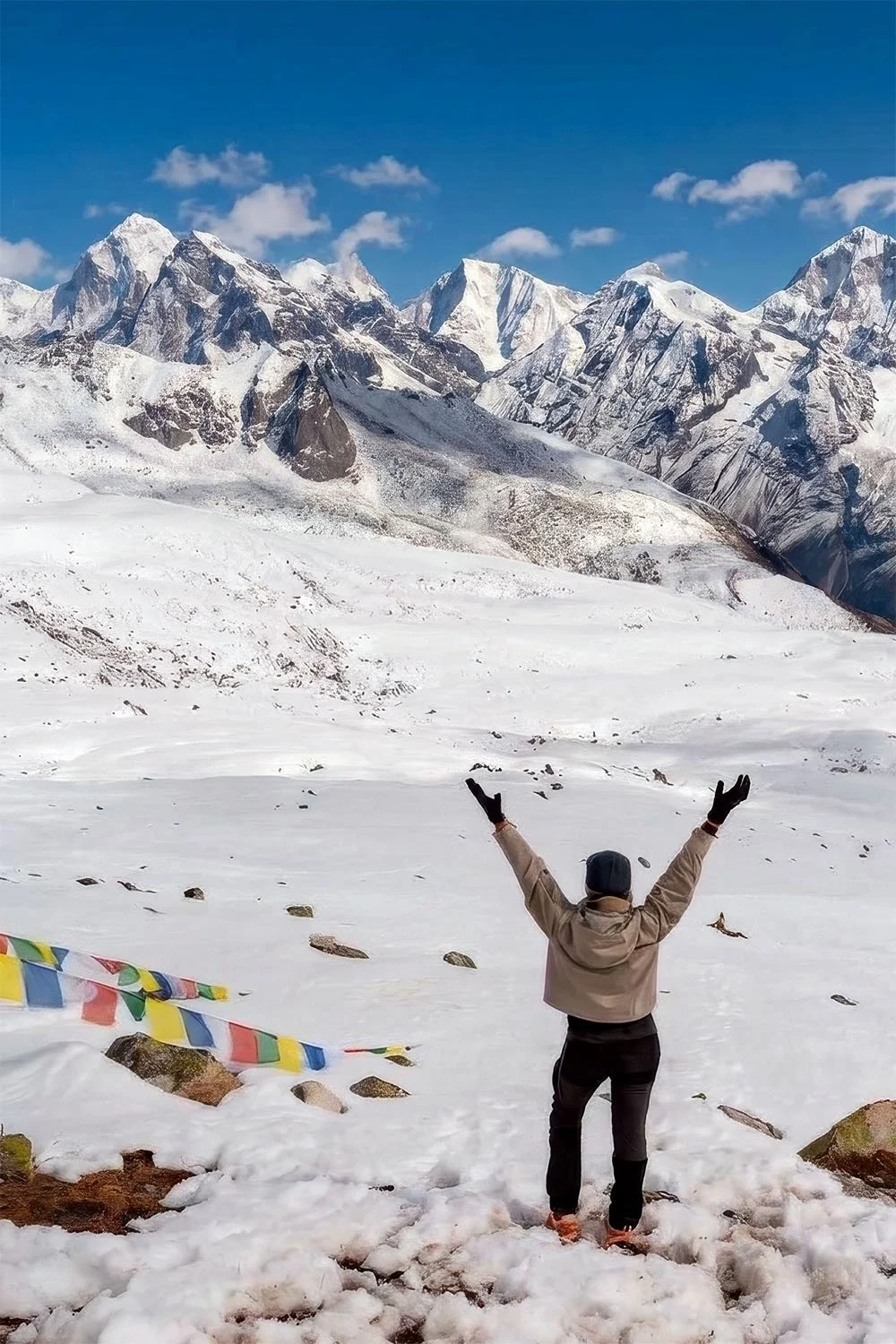
One of the most panoramic views of the trek.
There were times when I simply stopped walking to look.
I think those moments were some of the most important parts of my journey, because it reminded me that I didn't need to hurry. There would always be another part of the trail ahead of me, but this moment was one I wouldn't see again.
Reaching Kyanjin Gompa
Reaching the Kyanjin Gompa monastery was one of the stops I had been looking forward to, but I found that the experience was much more subdued than I expected.
The mountains around me were so big, and after several days on the trail I found myself surrounded by peaks as dramatic as I had ever seen.
I found myself taking photographs, of course. I wanted to capture the moment and the landscape around me, but eventually I put the camera down. There are always those moments when you need to stop and simply be present in the moment.
I couldn't simply capture this moment in a photograph. I had to stop walking and simply look around. For a few minutes, I didn't need to record the experience. I simply wanted to be in it.
It was one of the strongest moments I took with me from my journey.
The Parts You Do Not See in Photos
There were cold nights and tired trails, and sometimes I simply wanted to reach the end of a day's walk. There were times when the physical challenges of the trek seemed to overshadow the beauty of the mountains.
But those moments didn't detract from the journey at all. In fact, I think they were necessary parts of the whole experience.
Magnificent views from the higher elevations.
That is especially true when you're independent or simply enjoying your own company on your travels. It's easy to see online photographs of adventures and then think that every day of somebody else's trip was perfect.
I find real travel rarely works that way, and it was certainly true of my journey through Langtang.
Some days are uncomfortable, and some plans change. Sometimes you're tired at the end of the day when you expected to be filled with energy. Sometimes the weather doesn't cooperate.
But that doesn't mean the journey was any less valuable. It simply means it was a journey rather than an opportunity for a carefully-crafted photograph.
The Moments I Did Not Photograph
When I look back on my time in Langtang, I realised that some of my favourite memories could not be captured in photos.
I remember the sound of the water as I walked along trails in the forest. I remember sitting outside when I wasn't tired after a long day and sharing in conversation with other hikers.
I remember looking at the mountains without a camera in my hands. Those moments were never what I sought out, but they were always ones I cherished.
Trekkers on the upper reaches of Langtang.
I think that is one of the reasons why I have always loved travelling. The experiences I seek are valuable, but the unexpected moments can be the best parts of a trip.
Sometimes it's not the famous viewpoint at the end of a trail that makes the greatest memory.
It's the conversation you had afterwards, the tea you shared while sitting down for a rest or the view that made you want to stop walking just for a few minutes to take it all in.
What I Took Home From Langtang
The journey eventually came to a close, and one part of me was eager to find a hot shower and a comfortable bed. I had spent several days walking through the valley, and the landscape around me was becoming more familiar.
The trail, the villages, the streams and the mountains had become a sort of home for me.
As I walked away, I tried to look back every chance I got. I had photographs, of course, but I find I value the other aspects of my journey much more highly now.
A porter carries kitchen equipment and food supplies.
In some ways, I feel I learned more about what makes a trip important than I may have done without venturing out into the mountains at all.
Part of that was because I thought a mountain trek like this always meant the destination was the highlight. Before visiting Langtang, I think this was always the case with me.
But I left Langtang having found that the journey itself was the most valuable part.
Images: © Susmita Bhattarai