Is the North Coast of Bali a Better Choice for Older Travellers?
Bali has been one of Southeast Asia’s most popular destinations for older travellers for many decades. Warm weather, sandy beaches, scenic mountains, photogenic temples, a vibrant food scene and friendly locals now attract over 15 million tourists a year to the so-called ‘Island of the Gods’.
However, the southern beaches of Bali and the cultural hub of Ubud towards the centre of the island have been suffering from over-tourism for many years now, causing severe traffic congestion and a trash disposal crisis, which has prompted some older travellers to defer return visits to the island in favour of quieter destinations within the region.
Those issues haven’t deterred every older traveller from visiting. I have some friends in Australia who unashamedly refer to themselves as “seniors” who have been to Bali more than 20 times, and they still enjoy partying and shopping in Kuta (despite the crowded beaches) and visiting tourist attractions all over the island. They call Bali their “second home”.
Other friends keep saying head straight to Sidemen near Mount Agung, Amed on the east coast, or Lovina Beach on the north coast to get away from the tourist crowds. xyzAsia contributor, Jillian Huntley, avoids the tourist crowds by staying in home stays in the rice fields near Ubud (read her article on how to support sustainable tourism in Bali here).
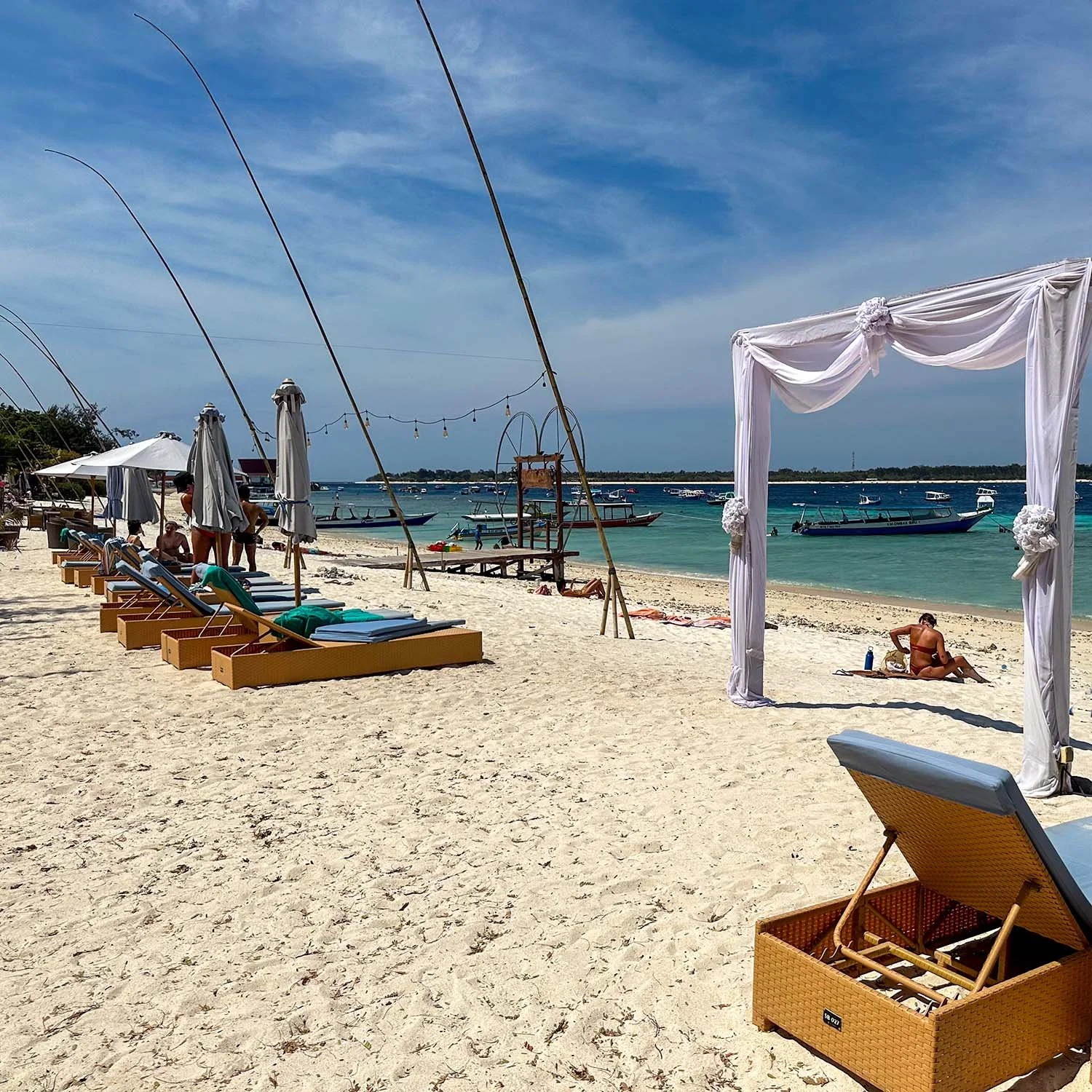
Overcrowding on Bali’s southern beaches.
I’ve previously been to all those locations. Sidemen and Amed are both relaxing spots in different ways (you can read about them here) but for a stay of more than a few days, they are too quiet for me. I like somewhere that’s not overrun with tourists but still has good restaurants, bakeries and coffee shops within walking distance of where I am staying.
I wondered whether Lovina Beach or Singaraja on the north coast might fit the bill. I hadn’t been to the north coast of Bali for more than 50 years. All I could remember about the north coast from my visit back then was that it was a region of black sand beaches and rice fields with virtually zero tourism infrastructure.
I decided it was time to see how much the north coast of Bali had changed in half a century. I booked a pool villa at Lovina Beach online as that seemed to be a fairly central location from which to explore the north coast. It was about 30 percent less than the price of comparable sized pool villas in the southern tourist areas.
We arrived in Denpasar on a flight from Singapore in the late afternoon. I wasn’t keen to drive all the way to Lovina Beach the same day (a 3-4 hours’ drive) so we booked a night at the mid-range Blue Karma Dijiwa Seminyak as that was close to the route that we would be taking to Lovina Beach.
A lovely sunset welcomed us to Seminyak.
We booked the Blue Karma based on the recommendation of an Australian friend who said he always stays there when going to Bali. It’s a lovely hotel right in the middle of Seminyak but surprisingly quiet despite the busy streets behind its lush gardens, and much cheaper than those closer to the beach. We weren’t disappointed as rooms were exceptionally clean and comfortable, the staff extremely helpful, and we were still able to walk to the beach in under 15 minutes.
It was just as well that we decided to stop the night in Seminyak because it took ages for our Grab car to get through the heavy traffic around the airport, so if we’d booked a car directly from the airport to Lovina Beach, we probably wouldn’t have reached the pool villa until well after dark.
And whilst the drive to Lovina Beach the next day was very scenic, the drive down from the mountains to the north coast would have been terrifying at night because the road is narrow in places and visibility poor because of thick cloud fog due to the elevation.
After a good night’s rest in Seminyak we found a lovely restaurant nearby called Milk & Madu for a leisurely brunch and coffee before heading north in a car that we’d booked from the villa owners. The car was tiny compared to the Grab cars that we usually used to on previous trips around Bali, but the driver was careful, didn’t take any risks like the Grab drivers sometimes do, and charged only 650,000 rupiah (less than USD40) for the three-and-a-half-hour trip.
Breakfast at Milk & Madu before leaving for Lovina Beach.
We planned to have a coffee stop about halfway and rather than relying on recommendations from the driver (which rarely turn out to be any good) I checked Google Maps on the way and saw a branch of Black Eye Coffee & Roastery with good reviews almost exactly at the halfway mark.
After we stopped, we discovered that the coffee shop was part of a tourism complex called ‘Secret Garden Village’. We were surprised that we couldn’t go to the coffee shop without paying a 100,000 IDR entrance fee (per person) to the whole complex, but we were informed that 80,000 of that could be used towards purchases in the coffee shop.
As there was no charge for our driver to enter, we worked out that the entrance fee would cover coffee for three and a croissant, so we paid the fee and headed to the cafe. The coffee turned out to be very average despite its good reviews, but the setting was lovely with views over landscaped terraces.
Coffee shop view at the Secret Garden Village.
There’s nothing secret about the complex and it certainly isn’t a village. The complex comprises some minimalist but architecturally impressive modern buildings with a small ‘beauty heritage museum’, a shop selling skin care products and high-end souvenirs, and a large restaurant in addition to the coffee shop. I subsequently saw it described on another travel blog as an “Instagrammable pit stop” and I thought that was a good description.
There were only a few other tourists in the complex, but the restaurant appeared to be getting set up for the arrival of a large tour group for lunch, so we were lucky to have the place mostly to ourselves. The toilets in the complex were like those in a 5-star hotel, so it turned out to be a comfortable toilet stop as well.
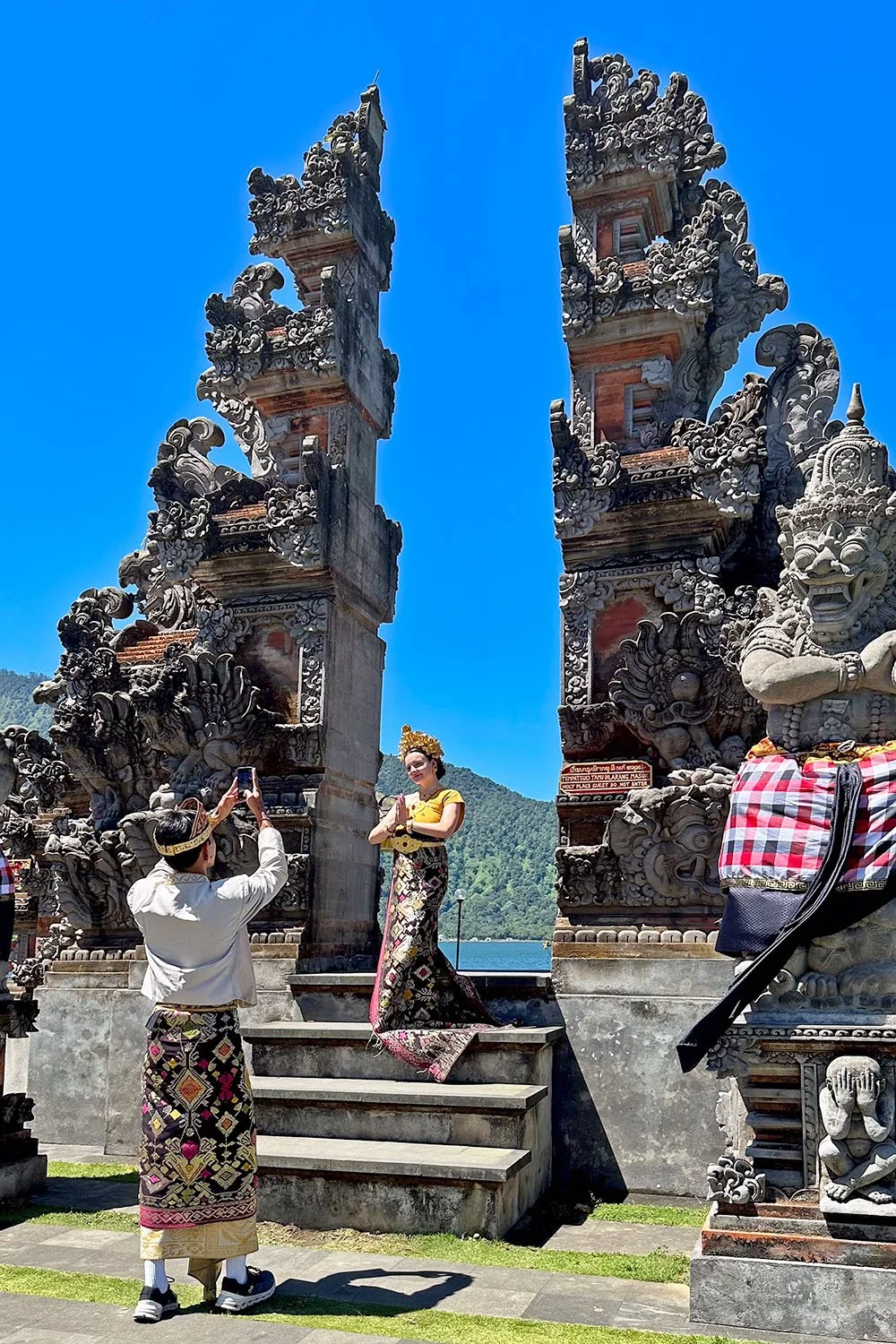
Further north we passed by the iconic Ulun Danu Beratan Temple on the lake at Bedugul, but we didn’t stop because we’d visited it before when we spent a few days staying by the lake and hiking the Bedugul highlands on a previous trip.
The picturesque Ulun Danu Beratan Temple.
If you’ve not been to this part of Bali before, then the temple is definitely worth a stop, and you can pick up fresh strawberries from the roadside stalls at the same time. Bedugul is one of the few places in Southeast Asia where they grow strawberries all year round, although prices vary according to the time of the year (cheapest is peak season, July to September).
After leaving Lake Beratan, which is already 1,200m (4,000ft) above sea level, the road climbs another 200 metres up into the clouds and for the next 20 minutes we were in thick fog. After the Wanagiri Junction there is a steep descent down to Git Git – and this is the part of the highway on which you definitely wouldn’t want to be driving at night.
There are some fleeting but spectacular views of the distant north coast from this section of the highway but unfortunately nowhere safe to stop. After Git Git, it was an easy 40 minutes’ drive to our villa located next to rice fields about 300 metres back from the beach.
The street in Lovina Beach on which our villa was located.
The villa was a little disappointing. It was not as large as it looked on the website through which we had booked it, and it wasn’t as well maintained as other villas in which we had stayed in Bali on previous trips, but the staff looking after the place were friendly, the bed was comfortable and the hot shower worked, so we didn’t complain.
The lack of maintenance turned out to be indicative of the condition of most buildings along the north coast. Although there had been a lot of urban development since my last visit, everywhere had a rundown feeling to it. Despite being considerably less busy than the southern tourist areas, there was still a lot of trash around.
We took a walk down to the beach and then followed a path along the beachfront into the centre of Lovina Beach—a distance of about one kilometre. Some sections of the path were well maintained but others were broken down. Despite being in the early shoulder season, there were very few tourists around. Most shops, bars and restaurants were deserted—such a contrast to the south.
The best section of the path along the beachfront.
As we walked along the beachfront, we were approached many times by boat owners asking if we wanted to book a dolphin watching trip. We hadn’t considered doing that during our stay as we had seen many dolphins in different parts of the world, but I noticed that many of the advertising signs for the boat trips included swimming with the dolphins which sounded interesting.
However, when I started checking reviews for the swimming with dolphins trips after dinner on the first evening, I discovered that there was a lot of online criticism of these tours and that swimming with dolphins is regarded as unethical. Apparently getting that close to them in the wild disturbs their behavioural patterns and can result in young calves getting separated from their mothers.
Marine biologists say diseases can be transmitted between humans and dolphins, and vice-versa, and having crowds of swimmers and boats round them can cause them to get injured by boat propellors. That seems to be even more likely in Lovina Beach where many dolphin-watching trip reviewers have complained about multiple boats chasing pods of dolphins at great speeds when they have been spotted.
Dolphin-watching boats moored at Lovina Beach.
The dolphin watching in Lovina Beach is unregulated (or at least regulations are not enforced if indeed there are any) and boats don’t keep the recommended distances from the dolphin pods because the skippers are trying to satisfy the demands of tourists who want close-up photos and selfies with the dolphins.
Our driver informed us that further west along the coast at Pemuteran, there are several dive shops that run ‘eco-tours’ with quieter four-stroke engine boats to see dolphins—and they do keep their distance from the pods—but as we’d done plenty of dolphin watching tours before, we declined his offer to drive us there.
Aside from dolphin watching, there’s not much to do in Lovina Beach except eat, drink, sit on the black sand beach or have a massage. Like most places in Bali there’s a mix of good restaurants and not so good, but we were fortunate to find one very relaxing place right on the beach called the Sea Breeze and we went there most nights to have a meal and watch the sunset.
Sunset view from the Sea Breeze seafood restaurant.
Every night that we went to that restaurant there was no more than one other table occupied and along the main street we saw bars that were completely empty every night. We were there in the shoulder season, so we weren’t expecting big crowds, but we were surprised as to how few people were there.
Other nights we ate at the Bali Paradise Hotel – Boutique Resort which was just across the road from where we were staying. The food was good and we were the only ones in the restaurant as they didn’t appear to have any guests staying with them. That surprised us because the hotel has good reviews and their shoulder season room rates are only US$30 a night (we wished we had booked there instead).
It was the same with the coffee shops. We found one very good one—Dolce & Caffe on Jl. Mawar—which based on our experience of visiting several others I would rate as probably the best coffee shop in Lovina Beach, but most times we went there we were the only customers.
We found the food quality and prices in all of the places we visited on the north coast to be on a par with southern Bali, so if you are looking for somewhere to just relax and get away from the tourist crowds, then Lovina Beach might just fit the bill for you.
An attractive looking but empty restaurant along Jalan Binaria.
After a couple of days of relaxation, we decided it was time to explore the areas around Lovina Beach. We asked our driver to take us on a full day tour doing a circular route taking in the Git Git Waterfall, the twin lakes up in the mountains on the road to Gobleg, then down to Brahmavihara-Arama (Bali’s largest Buddhist monastery, once visited by the Dalai Lama) and finishing the day at the nearby Banjar Hot Spring.
That’s very much a standard tour of the north coast hinterland without including Lake Beratan which we’d been to before. He said we could do the tour in a clockwise or anticlockwise direction but recommended the former as that would mean we would reach the Git Git Waterfall before any tourist crowds coming up from southern Bali.
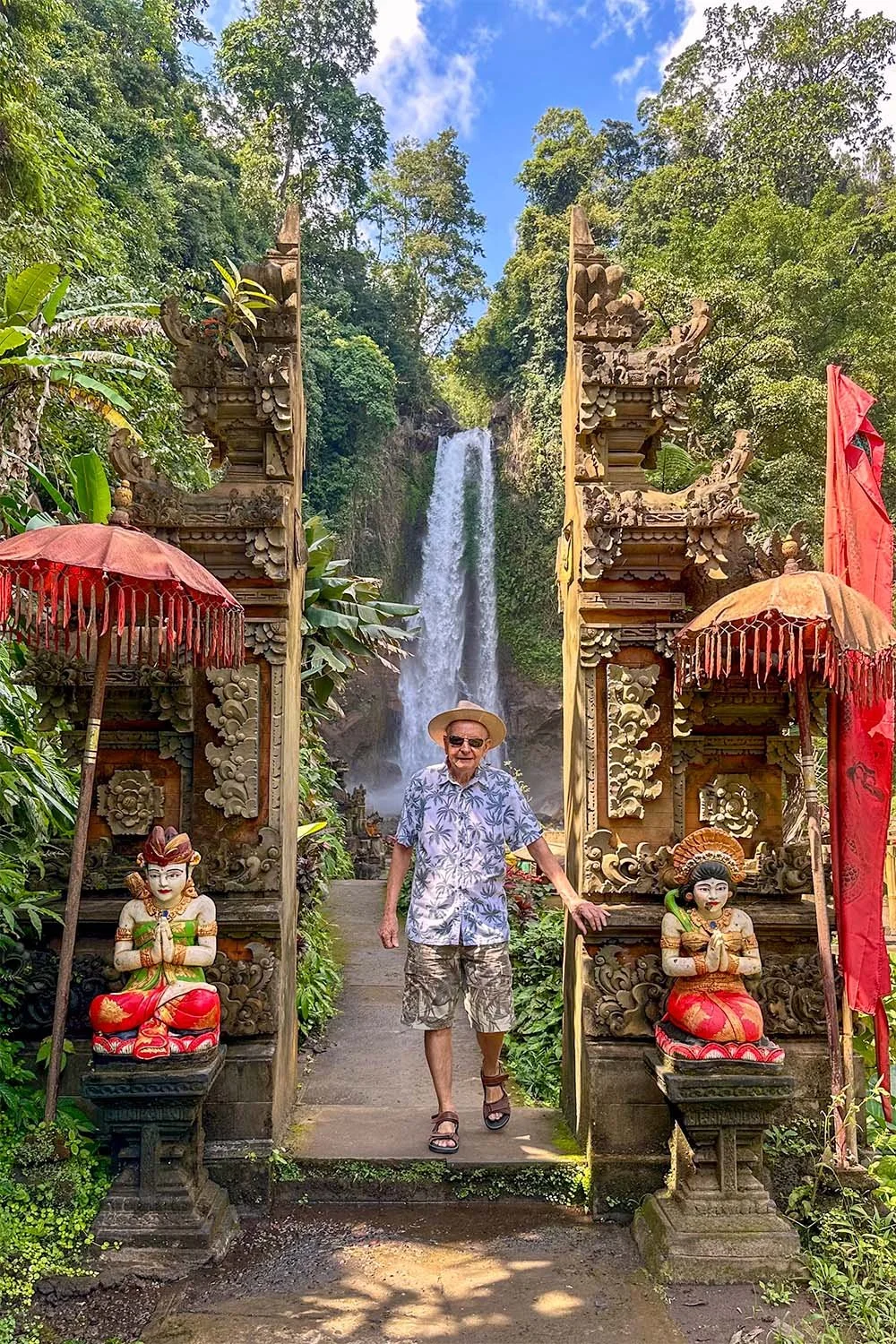
That proved to be good advice because when we reached the ticket office we discovered we were the first arrivals for the day, despite having stopped for coffee at an excellent coffee shop located along the path to the waterfall, not far from the main road where our driver parked and waited for us. Aside from a few local vendors setting up clothes and souvenir stalls along the pathway, we had the whole Git Git Waterfall to ourselves which was an amazing experience.
The Git Git Waterfall that we had all to ourselves.
Git Git is only half the height of Sekumpul—widely regarded as Bali’s most spectacular waterfall—but at 40 metres or so in height it’s still very impressive. And the big advantage of Git Git for older travellers is that it’s a relatively easy 15-20 mins walk along concreted paths with only a few sections of steps, compared to the nearly three-hours strenuous round-trip trek (with about 500 steps) that is required to view Sekumpul.
After Git Git we headed up the main highway (the same highway down which we had driven through thick fog coming from Seminyak) and then right at the Wanagiri Junction to see the twin lakes. We were fortunate not to be in cloud for this part of our journey so were able to enjoy good views from both sides of the road.
The twin lakes of Lake Buyan and Lake Tamblingan were nice to see but nothing extraordinary. However, their geological history is interesting because they used to be one large volcanic crater lake, but back in the early 19th century a massive landslide in the middle split the lakes in two.
A view of Lake Tamblingan from the ridge road.
We asked our driver to stop at a restaurant called The Botanist by Desa Eko for lunch as they have a very interesting menu of organic foods and good reviews online. Our driver tried to convince us to stop at a restaurant called Northview higher up on the range because it had better views (and probably because he would have got a commission for taking us there).
We said no, we wanted to go to The Botanist to sample their menu. I checked the Northview menu online and it looked fairly ordinary. We passed Northview on the way down to The Botanist (which is located on the side of a jungle-clad valley) and I was glad we didn’t stop there because it looked very touristy.
On the drive down to the restaurant our driver had asked whether we wanted to go to the monastery or the hot spring first after lunch, and I told him he monastery because we wanted to finish the day at the hot spring. I apologised to him that this would require a little doubling back because we would pass the hot spring on the way to the monastery.
Valley view from the restaurant where we stopped for lunch.
He replied that we wouldn’t be doubling back because he was intending to take us back down to Lovina Beach the same way we had come up. I told him that I didn’t want to do that. I wanted to continue along the road through the village of Munduk and the small town of Gobleg and down to Banjar from there and do a complete circuit of the mountains. He said he couldn’t do that because the road was too dangerous.
“Okay,” I said, “I can’t make you drive that way if you don’t want to, but the road looked fine to me when I checked the road out on Google Maps Street View.” I think he could tell I was annoyed.
We had a relaxing lunch at The Botanist. The bamboo décor and valley views were calming and the food was excellent—although the coffee was somewhat disappointing. I’d recommend it as a lunch stop for anyone doing a similar tour but not for older travellers who might be a little unsteady on their feet, or have knee problems, because the steps down to the restaurant are very steep with no handrails.
If you are into luxury glamping, then you might want to check out Desa Eko next door. It’s very reasonably priced compared to some other glamping spots in the Balinese highlands. Desa Eko also has some luxury bamboo cabins for those who don’t like the idea of sleeping in a tent but enjoy being close to nature.
A healthy lunch at The Botanist by Desa Eko.
After lunch we climbed back up the steep steps to the road and found our driver. We started driving in the direction of Munduk so I expected him to do a U-turn somewhere along the road and head back down to Lovina Beach, but instead he kept driving along the ridge road that he had told us before lunch was too dangerous. Perhaps he was worried I wouldn’t give him a tip for the day if we didn’t go the route I wanted.
It turned out that there was nothing dangerous about the road at all. It had some narrow sections where you had to slow down and pull over to let vehicles coming in the opposite direction pass, but this was no different to most mountain roads in Bali. It wasn’t a road I would want to drive on in heavy fog or at night, but in good weather it looked perfectly safe for careful drivers and didn’t carry much traffic.
In fact, this was the most interesting part of the drive because aside from the expansive mountain and valley views, we discovered that Munduk is a lovely North Bali destination that few people ever talk about. It reminded me of the Cameron Highlands in Malaysia. For older travellers looking for cooler weather in which to enjoy mountain hikes, Munduk is definitely an alternative to consider.
Munduk has a wide range of accommodation options from upmarket nature retreats and boutique villas down to budget cabins and home stays, some along the ridge road and others down in the valleys. We stopped and checked out one of the mid-range places for future reference. It was called Santrian Villas and the views were absolutely stunning. We added it to our bucket list.
We were advised that total room capacity around Munduk is limited so most places get fully booked in the dry season. Some of the high-end properties get booked out six months in advance.
View of the north coast from the Brahmavihara-Arama monastery.
After passing through Gobleg the road was wider, and after Mayong we joined a busier road for an easy run down to the coast. We passed the road to the hot spring about five minutes before we reached the monastery so I was pleased to see that we would only be doubling back a short distance for our final stop later.
The Brahmavihara-Arama monastery is set on the lower northern slopes of the Bedugul highlands. At 300 metres elevation, it offers panoramic views over the coast which provide a magnificent backdrop to the architecture of the monastery which blends Chinese and Thai Buddhist elements with the traditional Bali stone carvings.
Walking around the gardens surrounding the various shrines, we occasionally detected the scent of jasmine or frangipani flowers mixed with a whiff of smoke from incense sticks drifting through the trees. Aside from the sound of the fountains and a few wind chimes in the distance, the monastery grounds were surprisingly quiet. It was a relaxing experience, so different from the hustle, bustle and noise of southern Bali.
A Borodudur-like structure inside the Brahmavihara-Arama monastery.
After soaking up the serene atmosphere of the monastery for an hour or so, we moved on to our last stop—the Banjar hot spring. It was more crowded than the monastery where we had seen only two other couples in the hour that we were there. The spring water wasn’t as hot (only 38˚C), as other hot springs we have visited and it wasn’t the cleanest hot spring we’d been to, but it is a picturesque spot and still worth a visit.
The mineral content of the spring is high in sulphur and iron, so this gives the water a somewhat murky yellowish-beige colour. It’s known to stain light coloured fabrics, so I changed into a pair of dark swimming trunks before dipping into the top pool—the hottest.
I sat in water for a while enjoying the relief that the warm mineral water brings to tired muscles, but after 10 minutes a small tour group arrived, and they all piled into the top pool at the same time. It’s claimed the Banjar spring water helps relieve many skin diseases so I started wondering what skin infections the newcomers might have, and the whole experience became less appealing.
The author in the top pool at the Bandar Hot Springs.
I didn’t try the lower pools because they weren’t warm enough for my liking. When I go to a hot spring, I like to start at 40˚C and then move up to 42˚C for a good soak, but Banjar doesn’t have any pools that hot.
On our final day we visited the historic port town of Singaraja which was once the capital of Bali. Singaraja was established in the early 17th century as the capital of Buleleng Kingdom but after being conquered by the Dutch East India forces in 1849 it became the capital of the whole of Bali.
It was not until 1958 that the newly-independent republic of Indonesia decided to move the capital to Denpasar to align with its plans to develop that region and build a new international airport on the site of the Tuban Airfield just south of Denpasar which had been established by the Dutch colonial administration in 1931 and used by the Japanese military during World War 2.
The now-disused pier at the Singaraja waterfront.
Prior to 1958, Singaraja was the main maritime entry point to Bali, and even before the town was established in the 17th century this part of the north coast saw the arrival of merchant sailing ships from the Malay Peninsula, China, India and Arabia from as far back as the 10th century.
There are remnants of all these cultures, as well as the Dutch colonial period, all around Singaraja, but most have not been well preserved with the notable exception of the Ling Gwan Kiong Chinese temple down by the waterfront and the old Dutch port office which has been refurbished.
The old Dutch warehouses nearby, which used to store tobacco leaves and coffee and vanilla beans, are still standing, but most are delapidated with only their weathered facades identifying their colonial origins. They have been boarded up because they unsafe to enter. Most of the rest of the harbour area is in a similar state of disrepair with rubbish strewn everywhere. This is such a pity because this area could have become an attractive historical precinct if the government had been prepared to spend money on it.
Colourful interior of the Gwan Kiong Chinese temple.
There are signs that authorities may be taking an interest in recognising the historical importance of Singaraja with new building and landscaping works going on along one of its wide boulevards and around the Singa Ambara Raja Lion Statue as part of a revitalisation project. The project also includes the construction of an art gallery and cultural hub which looked to be about half finished when we were there.
Whilst these works are primarily aimed to improve the walkability and condition of the boulevards and parks around the government offices in the centre of the town for local residents, there is talk of these works being extended down to the harbour area to create a pedestrian heritage street similar to Malioboro in Yogyakarta.
If that happens, and the authorities are also prepared to spend some money on cleaning up the harbour area and preserving more of the historic buildings there, then Singaraja will likely attract more tourists. Currently tourists are few and far between. During our whole day in the town, we saw no other western tourists at all (which is something that may appeal to slow travel aficionados).
The entrance to the small but interesting Buleleng Museum.
When we visited the Gedong Kirtya Manuscript Library next to the Buleleng Museum, the uniformed government official in the ticket office seemed surprised that we wanted to enter. “You want to come inside?” she said, in an almost incredulous tone. After paying our 25,000-rupiah entrance fee, we were required to sign a visitors’ book.
We noted the last visitors were a Brazilian couple three weeks before us, and a Canadian couple three weeks before that. This was quite surprising given that Gedong Kirtya is the only manuscript library in the world with a collection of ancient lontar (palm-leaf manuscripts).
Although it is small, there are some fascinating exhibits of the tools used to write the Balinese script on the palm leaves. You cannot enter the second room where about 4,000 lontar are stored, but you can see them through the doorway.
A magnificent Lembu Suana inside the Buleleng Museum.
There is also a small museum next to the manuscript library that is free to enter with some interesting Balinese exhibits including a large Lembu Suana (a mythical creature that is a symbol of royal power) that was gifted to the King of Buleleng from a sultanate in East Kalimantan as a gesture of friendship between the islands.
We were not able to visit the old palace of the Buleleng royal family next door because our driver said it was closed for a private function, but this didn’t concern us too much because many reviews of the palace said it was “nice but underwhelming”.
Most of the old palace buildings were destroyed when the Dutch invaded Singaraja, and after the capital was moved to Denpasar, the cost of the upkeep of the remaining buildings has been the responsibility of the royal family descendants who still live there. However, we certainly would have liked to have a look had it been open.
The interesting traditional market near the Singaraja waterfront.
The only other place in Singaraja that is currently worth visiting is the traditional market a couple of hundred metres back from the harbour area. This is undoubtedly the most authentic traditional market that we have visited in Bali (no tourist trinkets whatsoever) and was the highlight of our visit aside from the excellent coffee shop we discovered nearby.
As we sat sipping our espressos and flat whites in Abuela Coffee, our driver told us that we had seen everything worth seeing on the north coast. At that point we concluded that we probably wouldn’t be making another visit to this part of Bali, with the possible exception of the retreats up in the mountains around Munduk.
But then we got chatting to two Brazilian women who told us they had been staying at a place called Villa Patria up in the hills behind Lovina Beach. They described it as a “heaven on earth” and said they had only left it twice in the five days since arriving (once to visit the monastery and then on the day that we met them to visit the traditional market on Singaraja) because the food was so delicious at Villa Patria they had been eating all their meals there.
They told us the views from Villa Patria were as good as those from the Brahmavihara-Arama monastery, and their gardens were on a par too. They had a large pool up there and could see the sunsets, so saw no need to go down to the coast. Later that evening I checked out Villa Patria on Google Maps and was instantly captivated by the beautiful Balinese heritage design of the small resort.
One of the four well-furnished rooms available at Villa Patria.
Browsing further, I discovered that there were many more resorts and villas tucked away up in those hills. There are dozens of villas—some for less than US$100 per night—and several upmarket resorts like The Damai which during the shoulder season was still priced at less than $US200. Then expanding my search a little further along the coast east of SIngaraja, I saw more than a hundred decent accommodation options along the northeast coast—an area that I had wrongly assumed was undeveloped as far as tourism was concerned.
These accommodation options range from budget homestays through a wide range of mid-range options up to more luxurious places like The Jing at Tejakula (a highly rated wellness resort) and Louka Beach Bali, an adults-only 5-star resort where guests are accommodated in nine beautifully restored 18th-century Joglos imported from Java.
At that point I realised we had only scratched the surface of what the north coast of Bali had to offer. Our coffee shop chat with the Brazilian women and my subsequent searches on Google Maps had revealed that there was still much to explore. Our next trip to Bali will definitely be to the northeast coast.
Images: © David Astley