Beyond George Town: Balik Pulau’s Overlooked Nutmeg Heritage
Most visitors to Penang begin with George Town, and for good reason. Its shophouses, clan temples, street art and food stalls provide one of Southeast Asia’s most rewarding urban experiences. Yet this island changes character once the road crosses the central hills.
On the western side, traffic thins, villages replace city blocks and orchards spread across the slopes. This is Balik Pulau—literally, the ‘back of the island’—and one of the best places to discover a quieter part of Penang’s identity.
Durian now attracts much of the attention here, especially during the fruiting season. But another crop carries an older and more complicated story.
Nutmeg, familiar to many travellers only as a brown seed grated over desserts or warm drinks, once stood at the centre of global rivalry. In Balik Pulau, it remains part of a living agricultural tradition rather than a museum exhibit.
A spice with a Penang history
Nutmeg is native to the Banda Islands in present-day Indonesia. For centuries it was traded across Asia, the Middle East and Europe, valued for its flavour and for medicinal uses attributed to it at the time. European competition for the spice eventually became violent, and control of its supply was treated as a source of enormous commercial power.
Orchards and farms in rural Balik Palau.
After the British established a settlement on Penang in 1786, colonial administrators encouraged spice planting on the island. Their ambition was partly strategic: they hoped crops such as nutmeg and cloves could reduce dependence on the Dutch-controlled Spice Islands and help cover the cost of administering Penang. By the early nineteenth century, ordered spice plantations had transformed parts of the island’s landscape.
The experiment did not deliver the lasting fortune its promoters expected. Cultivation was vulnerable to changing world prices, labour shortages, disease and the practical difficulty of transferring agricultural knowledge from one environment to another. By the 1860s, Penang’s nutmeg boom had largely collapsed. Yet the crop did not disappear. Trees continued to grow in smaller orchards and mixed farms, particularly around Balik Pulau, where families found local uses for the fruit beyond the international spice trade.
The fruit behind the spice jar
Seeing fresh nutmeg for the first time is a small revelation. The fruit is oval and yellowish when ripe. As it matures, it splits open to reveal a glossy dark seed wrapped in a vivid red, lace-like covering. That covering is mace, a separate spice with a warm but more delicate character. The seed itself is dried and sold whole or ground as nutmeg.
Cut ripe fruit showing the vivid red mace.
In many Western kitchens, only the seed is familiar. Balik Pulau’s food culture makes use of much more of the fruit. The pale flesh can be pickled, preserved with sugar, made into juice or processed into syrups and other preparations. Fresh nutmeg has a tart, aromatic quality that is quite different from the warm sweetness of the dried spice. Tasting it helps explain why local producers treat the crop as a fruit first and a spice second.
This whole-fruit approach is important. It reflects practical knowledge built around avoiding waste and adapting a once-export-driven crop to local tastes. A jar of preserved nutmeg or a chilled nutmeg drink therefore tells a broader story about how communities keep an agricultural tradition relevant after its original global market has changed.
Where the heritage survives
Balik Pulau does not present its nutmeg history through one grand attraction. The story is scattered across orchards, small processing businesses, markets and roadside stalls. That modest scale is part of its appeal. Travellers may see fresh fruit in season, learn how the seed and mace are separated, or encounter products that rarely appear in George Town’s souvenir shops.
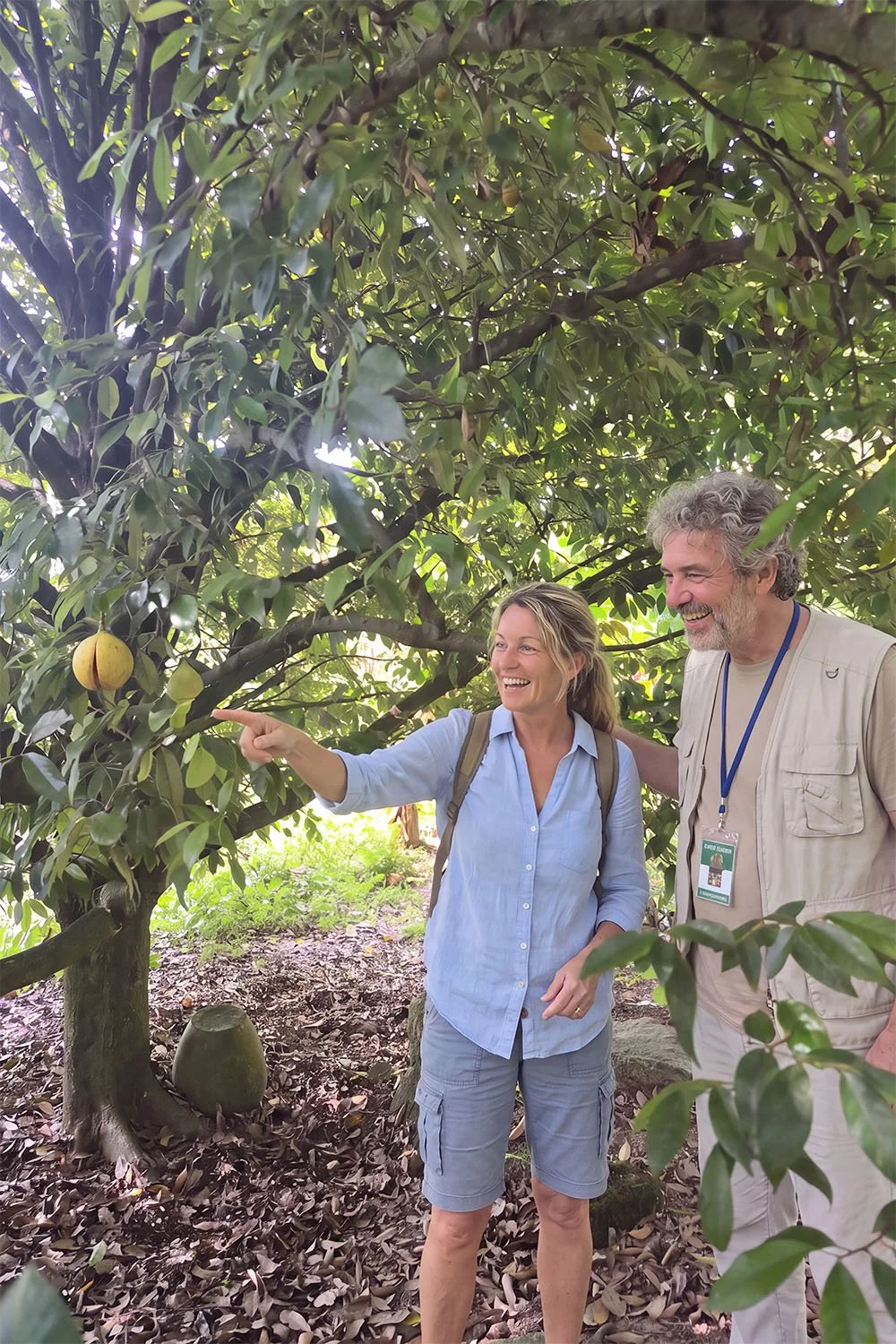
The author with a ripening nutmeg fruit on the tree.
A useful stop is one of the long-established nutmeg outlets around the district, where growers or sellers can often explain the fruit and its uses. Opening hours can be informal, so it is sensible to check ahead rather than build an entire day around an unconfirmed visit. The Tropical Spice Garden near Teluk Bahang offers a more structured introduction to tropical spices and can be combined with a drive towards Balik Pulau.
The district is also worth exploring beyond nutmeg. Balik Pulau town has a local market, traditional food shops and its own style of assam laksa. The surrounding countryside includes paddy fields, fishing villages and fruit orchards. Taken together, these places show that Penang’s heritage is not confined to colonial architecture. It also survives through cultivation, recipes and knowledge passed between generations.
A slower day beyond the city
Balik Pulau works best as a half-day or full-day outing rather than a rushed stop. The drive from George Town crosses hilly roads, and travel times vary with traffic. Hiring a car with a driver or arranging return transport in advance is often easier than relying on finding a ride at every rural stop. Travellers who prefer a gentler pace should limit the itinerary to a market, a nutmeg stop and a relaxed meal rather than attempting to cover the entire western side of the island.
A ripe nutmeg fruit ready to be picked.
An early start brings cooler conditions and a better chance of seeing local markets in operation. Light clothing, sun protection and drinking water are useful even when little walking is planned. Some orchard paths and roadside areas can be uneven, particularly after rain, so comfortable footwear is preferable. Those buying juices or preserved products should ask about storage, as freshly prepared items may need refrigeration.
Season also shapes the visit. Durian activity is strongest around the middle of the year, bringing more traffic and livelier roadside stalls. Nutmeg products can be found beyond the fresh-fruit season, but visitors hoping to see ripe fruit should contact a farm or producer beforehand. Balik Pulau rewards flexibility: the experience is less about ticking off landmarks and more about noticing how the island’s agricultural side still functions.
Why this quiet heritage matters
George Town’s international success has made Penang one of Asia’s most recognisable heritage destinations. The risk is that the island’s rural stories become secondary or invisible. Nutmeg offers a link between Penang’s colonial history, the wider Asian spice trade and the everyday ingenuity of growers who continued using the crop after plantation ambitions faded.
A nutmeg cocktail gift pack to take home.
Preservation does not always require turning a working landscape into a museum. Sometimes it means keeping an ingredient useful—through familiar products, new recipes and responsible small-scale enterprise—while remaining honest about where it comes from. Readers interested in the ingredient itself can find an illustrated background guide to Balik Pulau’s nutmeg heritage and the different parts of the fresh fruit.
A journey beyond George Town therefore adds more than scenery to a Penang visit. Behind the hills is a landscape shaped by orchards, village food and a spice that once influenced empires. Balik Pulau’s nutmeg story may be quieter than the attractions on the eastern coast, but that is precisely why it deserves to be noticed.
Images: © Owen Poh
Where to Stay in Balik Palau
BUDGET: There are a wide range of homestays in and around Balik Palau. The best rated is Homestay De Village Lodge. The rooms are simple but clean and it’s located right in the middle of town (but far enough back from the main road not to be noisy). There’s a coffee shop nearby and two food courts. The staff are friendly and helpful.
MID-RANGE: The rustic Nature Fruit Farm - Farmstay about 2km out of town is the best mid-range option if you are looking for an opportunity to be immersed in nature. Prices are only a little higher than the budget accommodation options. Breakfast is included along with free fruit-tasting.
UPMARKET: There’s no upmarket accommodation in Balik Palau but if you have a rental car you can stay at the Lexis Suites Penang which is only 10km from Balik Palau. Lexis Suites is on the south coast of the island and markets itself as a 5-star property, but its rates are mid-range. Many guests say maintenance of the property could be improved but it’s very good value for money.
LUXURY: There are no luxury hotels or resorts on the western side of the island. If you are looking for a luxury resort from which you can easily access the Balik Palau area, then your best option would be the Angsana Teluk Bahang Penang on the north coast. It’s a 20km drive down to Balik Palau but there are lots of durian and other tropical fruit farms on the way.