A Return Visit to Penang After 15 Years
The island of Penang, off the northwest coast of Malaysia, has long been a favourite destination for older travellers in Southeast Asia.
Its natural beauty, cultural heritage and food scene are some of the reasons that make it perfect for either a weekend getaway or a week of relaxation.
We had visited Penang many times prior to 2010 but our recent visit in early April was our first time back in more than 15 years, so we were looking forward to seeing how much things had changed.
Our first impression was not a good one. Arriving at the airport on a short flight from Phuket, it took nearly two hours to get through Immigration. There were seven immigration booths marked as open with green lights, but only three were manned. Even after Immigration there were more long queues for Customs.
The long queue at Customs on arrival in Penang.
Our flight had been delayed by two hours, so with the two-hour wait at Immigration we were arriving four hours behind schedule and feeling hungry. Instead of going straight to our accommodation in Gurney Bay, we took a taxi to an Indian restaurant that had been recommended to us by friends, and which was located about halfway between the airport and the city.
That was a good decision (despite the taxi driver grumbling about the traffic all the way) as the food was good and inexpensive. For those who might find themselves in a similar situation, the name of the restaurant is Passions of Kerala @ Brown Garden. We had their daily banana leaf special, and it was very tasty.
After finishing dinner, we booked a Grab to Gurney Bay where we had booked an ocean view room in the Ascott Gurney Penang. We had originally planned to stay in George Town as we wanted to spend at least a day exploring this historic UNESCO World Heritage listed city, but too many of the hotel reviews mentioned disturbed sleep because of traffic noise and thin walls in heritage buildings.
That turned out to be another good decision on our part because Gurney Bay is a lovely upmarket residential area with many good restaurants and coffee shops, and much quieter than George Town, but only a 10 mins Grab ride away. We had the added bonus of access to the Ascott’s impressive rooftop infinity swimming pool where we were able to cool off after a long day of sightseeing.
George Town
We spent the whole of our second day exploring George Town. We’ve always preferred George Town to Melaka because George Town’s historic area is more spread out and therefore doesn’t feel so crowded. Only Armenian Street is as crowded as Melaka. We started our walking tour from there early to avoid the tourist crowds.
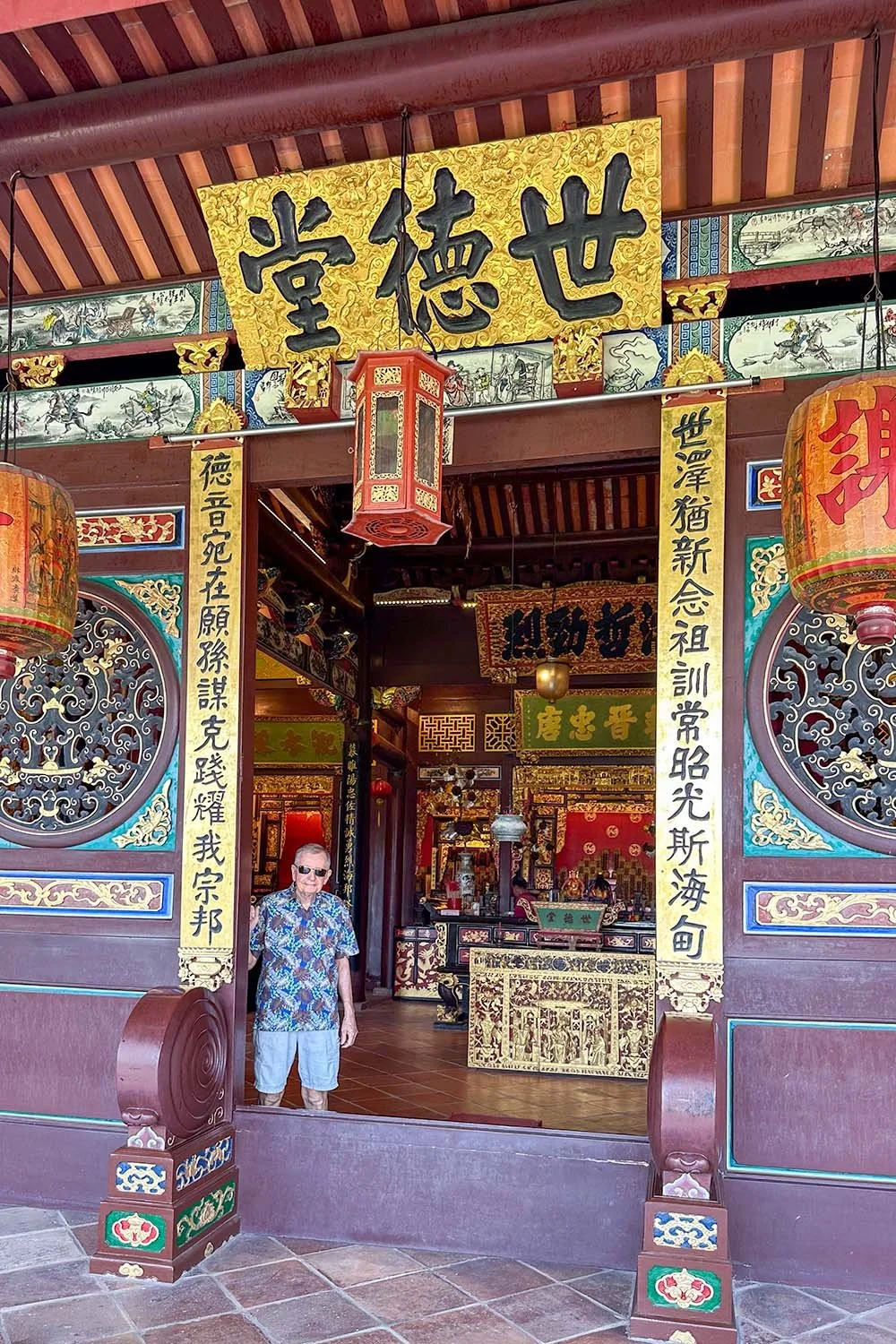
Entering the main courtyard of Cheah Kongsi.
We’d previously visited the popular Khoo Kongsi between Armenian Street and Acheh Street so on this trip we decided to instead check out the Cheah Kongsi on the other side of Armenian Street based on the recommendation of our home stay hosts.
They said the Cheah Kongsi was just as interesting as the more heavily promoted Khoo Kongsi, but much quieter. They were right, because there was only one other tourist at the Khoo Kongsi during our visit, so it felt like we had the whole complex to ourselves.
Kongsis are compounds comprising a temple, meeting hall and accommodation facilities that were established by Hokkien clans in the early 19th century to support immigrants from southern China. Today they include small museums and provide visitors the opportunity to learn about the history of the clans that subsequently formed the backbone of Penang’s economic development.
The temple inside the Cheah Kongsi complex.
There are five major kongsis in Penang, but only the Khoo and Cheah kongsis are open to the public. The entrance fee for the Khoo Kongsi is RM17 (main entrance is off Cannon Street) whilst the Cheah Kongsi is RM10. The small temple towards the top of Armenian Street is part of the Yap Kongsi, and the temple can be visited free of charge.
By the time we’d finished looking around the Cheah Kongsi and its informative interpretive centre, the tourist crowds were already building on Armenian Street. Several times we were approached by trishaw drivers offering ‘heritage tours’ around George Town (RM50 for an hour).
We politely declined explaining that we preferred to walk, but for any older travellers who have mobility problems or find the heat and humidity too oppressive for walking, these would provide a good option for seeing the best of George Town. Shorter trips (30 mins) can sometimes be negotiated for RM30.
Trishaw drivers taking tourists on heritage tours.
While Armenian Street is very touristy, there are some interesting small museums there that will appeal to art, photography and culture enthusiasts. The Batik Painting Museum (entrance fee RM10), the Asia Camera Museum (entrance fee RM20) and the Teochew Puppet and Opera Museum (entrance fee RM10) all receive good reviews from visitors.
After Armenian Street we headed over to Chulia Street and then panned out from there during the course of the day. We skipped the clan jetties down on the water as we’d visited those on previous trips, but they are worth a quick stop if you’ve not been to Penang before. We also skipped Fort Cornwallis for the same reason.
We had a very good Malaysian laksa for lunch in a café called Two Streets in an old heritage building before walking to the new History Gallery of Penang (entrance fee RM39, seniors RM29) in Bishop Street.
Laksa is a popular lunchtime dish in Malaysia.
We found this museum, which features walk-through street scenes and dioramas depicting life in Penang from when it was established in the late 18th century, more interesting than the nearby State Museum which we had visited on previous trips. For an additional RM10 per person you can have a knowledgeable guide take you through the exhibits and we found that well worth the extra money.
The Penang State Museum and Art Gallery closed for renovations in early 2023 and was supposed to have been reopened by the end of 2025, but as of the date of our visit (April 2026) it was still closed despite a sign on the gate saying it would reopen in 2024.
If you’ve not been to Penang before, then another museum in the same area worth visiting is the Pinang Peranakan Mansion (entrance fee RM 30) which one of our writers, Jillian Huntley, wrote about in her article ‘The Peranakan Heritage’. That’s actually our favourite museum in Penang because it’s so colourful.
Street door at the Pinang Peranakan Mansion.
And if that’s not enough museum visits for one day, then the Straits & Oriental Museum (entrance fee RM25) a block and a half back up Church Street towards the History Gallery may be of interest. This is another private museum that opened in 2022 and focuses on the maritime history of Penang. It has a large collection of Chinese ceramics and artifacts that were recovered from shipwrecks.
So how much had changed in George Town in 15 years? Aside from new eating places and coffee shops (many of which had closed during the Covid pandemic) and the new museums the physical environment was much as we remembered it from previous visits.
The heritage buildings are still in varying stages of renovation, and every street has interesting retail businesses operating from the traditional shophouses. These range from art galleries, antique shops, perfumeries and artisanal outlets selling hand-made jewellery and handicrafts to stores selling local products like herbs, teas and durian.
A well-patronised durian shop in George Town.
The street art has expanded somewhat and now includes many pieces constructed in wrought iron. Some of the smaller alleyways have been decorated with colourful umbrellas or lanterns to cater for the Instagrammers who were only in their infancy 15 years ago.
George Town is one of those places which in some ways feels like it never changes but every time you go back you find something new to enjoy. That’s exactly how we felt on this trip.
Penang Hill
For our third day in Penang, we made an early start to take the funicular railway up to the top of Penang Hill. Since our last visit, the second-generation coaches had been replaced with more modern third-generation coaches built in Switzerland, and we were keen to see how they compared.
The funicular railway line up Penang Hill.
There was not much difference in comfort, but the new coaches are air-conditioned and much faster with no changing trains at the middle station. What used to be a half hour journey now takes only seven minutes.
Upon disembarking at the top, we immediately noticed a difference in temperature (Penang Hill is typically 5ºC cooler than on the lowlands) and an early morning easterly breeze blowing across the Penang Strait made it feel even cooler than that.
We headed straight for The Loaf and Kota restaurant for breakfast but discovered that The Loaf had recently closed and Kota had no milk so couldn’t make a flat white. So, we headed up the hill to the Sky Terrace next to David Brown’s Tea Room instead and had a good breakfast there including an excellent flat white.
Morning view over George Town from the Sky Terrace.
We returned later in the day to Kota for lunch given its reputation for Nyonya fusion dishes but there were few people there. We wondered how long it might be before Kota closes as well if people are not patronising it. Further up the hill, the Sky Terrace and food court were packed to overflowing at lunchtime.
We don’t think it’s an issue with the food. It’s because visitors don’t know how to reach Kota which is in a heritage bungalow below the level of the upper station (accessible by a lift) or they are too keen to head further up the hill to the higher viewpoints, the Indian temple or the Habitat. Most visitors seem not to be aware of the bungalows below the station.
After breakfast we headed further up the hill to begin our morning walks. Penang Hill is the second ‘must-visit’ location on the island after George Town, but it gets crowded at weekends and on public holidays because it’s not just tourists but also locals who visit the hill to avoid the heat, especially in the hot months of April and May.
A mural at the Indian temple on Penang Hill.
The first three months of the year are just as hot temperature-wise as April and May, but they are drier with lower humidity, so don’t feel as sticky. If you can’t avoid going up on a weekend, then it’s best to purchase express lane tickets to avoid the long queues.
The current (April 2026) prices for return tickets are RM40 for adults and RM30 for seniors (60+). The express lane tickets are double those prices. You will need to bring ID showing your date of birth if you wish to purchase a senior ticket. Malaysian citizens pay only about a third of those prices, and if they go up before 8.00am, they pay only RM5.
Penang Hill was originally a British hill station established in the late 18th century and there are still about 50 colonial bungalows on the hill–some renovated and still in good condition and others in ruins. Bel Retiro is the largest having originally been built in 1789 for the founder of Penang, Captain Francis Light, and subsequently used as a retreat for the governor of the island.
The classic arched gate house entrance to Bel Retiro.
Bel Retiro was our first stop, but when we got to the gate house, we found access to the grounds is now blocked. On previous visits we had been allowed to walk in the grounds of Bel Retiro but that is no longer permitted. I subsequently read that access has been restricted for more than a decade because the bungalow is still used to accommodate visiting dignitaries, so tourists are now banned for security reasons.
Instead, we headed over to the Habitat–a rainforest walking trail that was opened in 2016 and includes a suspended bridge over the rainforest called the Langur Way Canopy Walk and an elevated viewing platform called the Curtis Crest Tree Top Walk. This eco-tourism development is built on the site of a nature trail that we walked for free on our last visit. Now there is an entrance fee of RM60 (seniors RM40).
Of course, we didn’t expect to visit for free because building these walkways costs a lot of money and helps protect the fragile eco-systems of the rainforest. But we were somewhat disappointed with the experience because we didn’t get to see much more than what we’d seen on our previous visit.
The Langur Way Canopy Walk at Habitat.
And the fact that we live in the wet tropics with rainforest walks on our doorstep would another reason why the Habitat didn’t appeal to us as much as it might to visitors from temperate and dry climates.
We also acknowledge that with nearly two million people visiting Penang Hill each year (about triple the number when we were last there) controlling access to the rainforest nature trails is a necessity, and the Habitat is a certainly a well-planned and well-maintained facility.
We especially loved the cafés and gift shops at each end of the trail–they had some good quality products on sale and not the usual made-in-China junk that you find at many tourist spots. The coffee and cakes were good too!
The Curtis Crest Tree Top Walk at Penang Hill.
The Habitat is especially recommended for senior travellers looking for an easy walk in a cooler climate and without too many steps. (For other recommendations for senior hikers in Malaysia, check out Alan Williams’ article here).
At the end of the Habitat trail there is a golf buggy type shuttle service that takes you back to the roundabout below the Indian temple, but there was a long queue waiting for it (the shuttle takes only 16 passengers every 15 minutes) so we decided instead to walk back along the summit road (Jalan Tuanku Yahya Petra).
We enjoyed that 1.5km walk as much as the Habitat walk itself as there were several viewpoints along the road that provided more interesting views than those we had seen from the Habitat. As well, there were many colourful flowering tropical plants along the side of the road which we were able to admire when not dodging the sightseeing buggies using the road.
Colourful Crown of Thorns along the roadway.
We also passed several historic villas including Eythrope Penang Hill which is now a luxury boutique hotel and is where one of our writers, Nannette Holliday, recently took a cooking class on her E&O trip to Penang. You can read about that trip here.
Back at the upper station for the funicular railway after lunch, we were faced with a long queue and we thought it would be a long wait, but we were lucky enough to be the last two passengers allowed to board the second train down. We were crammed in like sardines in a can, but we weren’t complaining because we still had a lot more sightseeing to do that afternoon.
In particular, we wanted to see the Guan Yin (the Chinese Buddhist Goddess of Mercy) statue at the top of the Kek Lok Si temple near the base of Penang Hill. It is a massive 30-metre-high bronze statue surrounded by an octagonal pavilion that is over 80 metres tall. The statue was completed in 2002 before our previous visit, but we hadn’t had time to view it close up on that trip.
The massive Guan Yin statute at Kek Lok Si.
The statue on a ridge on the eastern flanks of Penang Hill can be seen from many kilometres away, but close up it is awe inspiring. It is a marvel of modern engineering. From a distance it looks like the statue has been cast in solid bronze, but in fact it’s made of bronze plates cast in China and transported to Penang and attached to a steel ‘skeleton’.
The whole project took over 30 years from inception to completion and replaced a smaller plaster statue that was damaged by fire. The pavilion protecting the statue was completed seven years later and was modelled on the Temple of Heaven in Beijing.
Whilst we were impressed with the Guan Yin statue (also spelled as Kuan Yin) we weren’t so impressed with the upkeep of the temple itself. There was a lot of rubbish around, the gardens and ponds were unkept, and many of the decorative pagodas need repainting.
One of the better maintained sections of Kek Lok Si.
There is a lack of signage to direct visitors between the three levels of the hillside grounds of the temple. We took the two inclined lifts up to the Guan Yin statue (for a very reasonable price of RM8 per person) intending to walk back down through the temple complex but we couldn’t find the steps down.
We had to use the roadway between the car parks on the three levels to descend which was quite a long walk in the afternoon heat. When we got to the bottom, we continued walking to the Ayer Itam public market where we bought some juicy mangoes and some tasty pastries in one of the bakeries opposite the market for an afternoon snack.
From there we took a Grab to the Penang Botanic Gardens. We love visiting botanic gardens in Southeast Asia and have been to many wonderful gardens throughout the region, but the Penang gardens have always been one of our favourites with their impressive orchid, bromeliad and fern collections.
The Penang Botanic Gardens are 142 years old.
We were keen to see what changes there had been since the gardens were included in the transition zone for the UNESCO designated Penang Hill Biosphere Reserve in 2021.
Our Grab driver told us he could only take us to a drop-off point 700 metres from the gardens entrance because there was heavy machinery near the main gate involved in the construction of a new cable car up Penang Hill, and access by private vehicle is now restricted.
The walk to the main gate took 12 minutes and along the way we noted that the hawker centre that used to be outside the gardens had been demolished and was now hidden by high hoardings. We were told that a multi-storey car park was being built there for the new cable car.
The temporary pathway to the botanic gardens.
As we started our walk around the gardens, we were shocked at how dry and neglected it looked. There was rubbish everywhere, plants were dying, the lily pond was dried up, and–worst of all–the magnificent tropical plant collections that we had seen on previous visits were locked up and not accessible.
There were signs on some of the orchid and ferns houses stating that they were now only open to the public for three hours on Tuesdays, Wednesdays and Thursdays, but judging by the weeds on the walkways that we could see through the locked gates of the plant houses, it didn’t look like anyone had entered them for months.
A sign on one of the closed plant houses.
The Penang Botanic Gardens were established in 1884 and have long been recognised as a leading horticultural research facility on tropical plants, but now it looks more like an abandoned municipal park. How could the Malaysian government let such world-renowned gardens fall into such disrepair?
We saw only one employee in the gardens–a maintenance worker sweeping leaves along a gutter. He looked totally bored with his work and was moving so slowly we thought he was about to collapse in the heat.
As we walked back to the Grab pickup point, we passed a dead cat covered in flies lying alongside the pedestrian walkway. It wasn’t a feral cat. It was someone’s pet because it had a collar on. It was a distressing sight because it looked like it had been there for several days. It was just a few metres from the entrance to the botanic gardens administrative offices, but nobody had taken any action to remove it.
Dying Licuala palms at the botanic gardens.
That sighting, along with the signs on a nearby dilapidated heritage gate saying “Do Not Urinate Here” left us with the impression that the gardens employees had lost interest in their jobs. It was an unsettling conclusion to what otherwise should have been a great day.
Tropical Spice Garden
The next morning, we took a Grab to the Tropical Spice Garden on the northern side of the island, hoping that hadn’t befallen a similar fate. We’d heard it had been through tough times during the Covid pandemic, but recent reviews on Google Maps were favourable.
As we passed through Batu Ferringhi (Foreigner’s Beach) the optics didn’t look good. There were few tourists around and the whole area looked run down compared to when we were there several decades ago. But when we entered the Tropical Spice Garden, a few kilometres further on, things looked more promising.
We paid our entrance fee on arrival (RM30 for adults, RM20 for seniors) and headed straight to their rustic café for breakfast before starting our exploration of the garden. The food was excellent and the coffee was perfect.
K(an)opi Coffee at the Tropical Spice Garden.
The Tropical Spice Garden was developed around 20 years ago on an eight-acre hillside site that used to be part of a rubber plantation. It’s now a lush rainforest garden with walking paths (some of which are quite steep so not suitable for those with mobility issues) and over 500 species of tropical plants in themed sections.
It’s fairly compact and easy to get around with the help of the map which visitors are handed on arrival (along with a generous free dose of mosquito repellent).
The map details the major specimen plants in the garden and the location of a giant bamboo swing in the middle of the garden from which there is a great view of the lower sections. As we had arrived early, there were only a couple of other people in the garden, and we were able to relax on the bamboo swing listening to the sounds of the rainforest.
A spectacled langur in the Tropical Spice Garden.
Whilst on the swing we saw a troop of cute spectacled langurs in the trees. We were able to get quite close to them as they seemed unperturbed by the presence of humans and were not aggressive like some species of monkeys are.
At the top of the garden there is a gazebo where free herbal tea is served. A different brew is offered each day. On the day we were there it was pandan, lemongrass and stevia. It was cool and delicious.
Even though the Tropical Spice Garden is much smaller than the Penang botanic garden, we enjoyed our visit to the spice garden much more because it was clear that the staff there enjoyed what they were doing and took pride in their work.
A lily pond at the Tropical Spice Garden.
At the conclusion of our visit, we tried to get a Grab back into George Town, but no drivers responded. We were planning to go to the National Park as it was only a little further along the northern coastal road, but when we realised that we might have difficulty getting a Grab back, we decided to take a bus back into town instead.
In any event we had visited the National Park many years ago, and we doubted that had changed much. For those interested to include the National Park on an itinerary, David Lewis’ article on his short Penang visit last year contains a helpful suggestion about doing the trip to the turtle beach in reverse for a more relaxing experience.
On the bus back into town, I asked Gemini AI for some ideas on alternative places to visit. I entered the places we had been to and asked it what other ‘must see’ places there were in Penang.
Interestingly, because I hadn’t specified ‘Penang Island’ it gave me suggestions for Butterworth on the mainland as Butterworth is part of the state of Penang. Top of the list of suggestions was the Penang Bird Park and the Butterworth Art Walk.
As the bus we were on was going all the way to the jetty for the ferry to Butterworth, we made an impulse decision to follow the AI recommendations and head over to the mainland. Gemini said that the bird park was the biggest in Malaysia and both that and the art walk were “top attractions” that were well worth the ferry trip from Penang Island.
Butterworth
The ferry cost only RM2 and although it was crowded, the journey took only 12 minutes. We took a Grab from the ferry terminal at Butterworth to the bird park and after paying what we thought was a fairly expensive entrance fee of RM65 each (no discount for seniors), we entered the park.
The caged birds at the Penang Bird Park.
At that point we realised it was not a bird park as we had expected, but a bird zoo with most of the birds in cages. We thought it would be like the KL Bird Park in Kuala Lumpur where the birds are free to fly within a large walk-through aviary.
It turned out that Gemini AI was wrong in describing the Penang Bird Park as the biggest in Malaysia because a quick web search revealed that the KL Bird Park was four times as large and in fact is the largest free flight aviary in the world.
We had made an impulse decision based on AI recommendations without doing further research. A lesson learned. We don’t like seeing animals of any kind locked up in cages. Had we known that this was a bird zoo, we would not have gone.
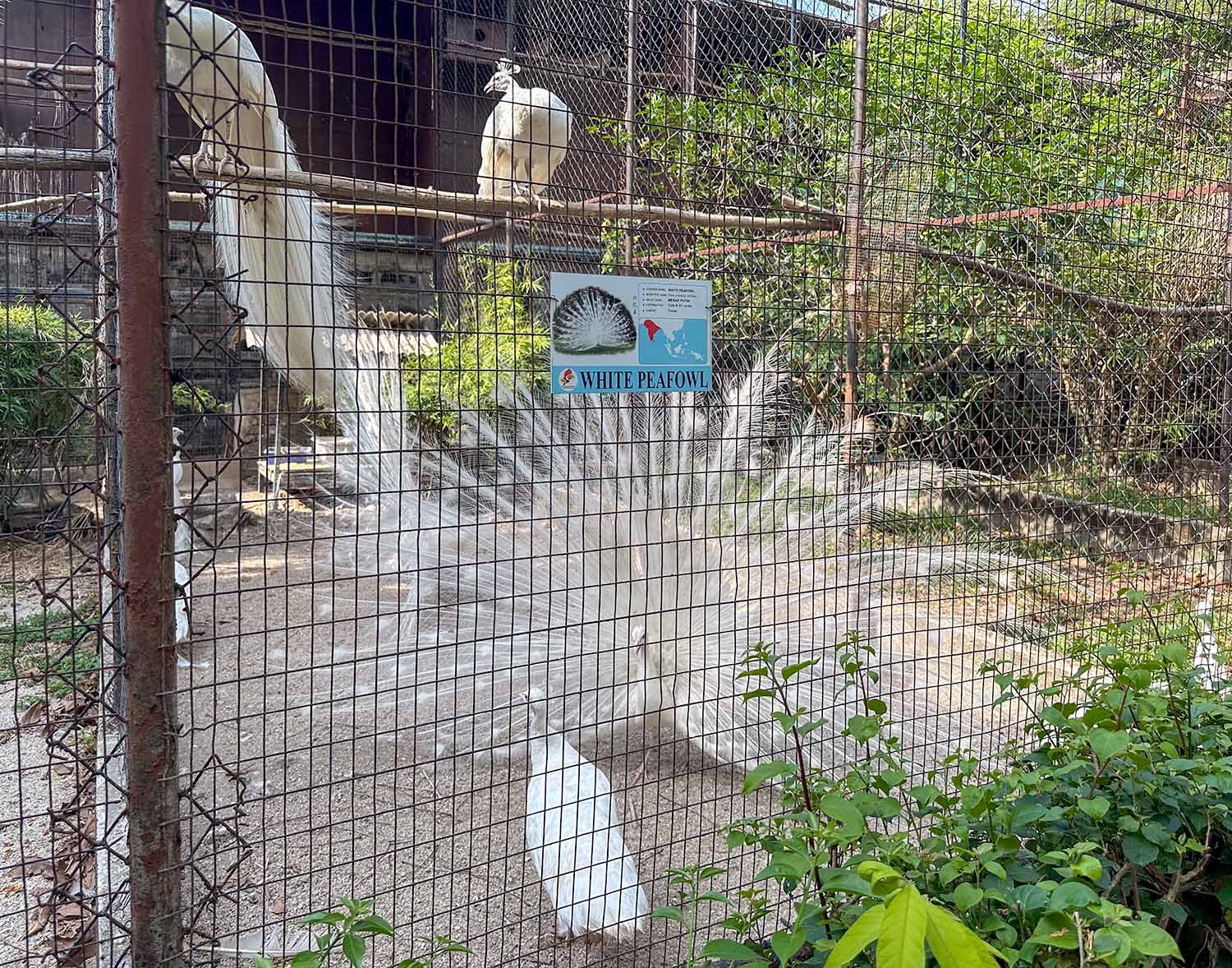
The white peacocks had little room to move around.
However, it did have some species of tropical birds that we had not seen before, and there were a few small walk-through aviaries of ground dwelling birds like flamingos, but even the experience of those were spoiled by employees aggressively trying to sell packets of seeds for RM5 to feed to the birds.
Right from the start when we were given coupons for a Coca-Cola promotion (buy an over-priced Coke and get a free pen) to being pursued by a photographer who insisted that we hold an owl for a ‘free’ photograph (as we expected it turned out that only the process of taking the photo was free–the prints were RM35 each) we felt like the whole place was a tourist trap.
It didn’t even live up to its description of “lush landscaped grounds”. The park was smelly and whilst maintenance looked better than what we’d seen at the Penang Botanic Gardens, it was far from “lush”.
Street art in Butterworth–good but not much of it.
Our next stop was the Butterworth Art Walk. Given that the bird park had not lived up to the hype of our AI recommendations, we tempered our expectations. And just as well because it took less than five minutes to see.
The street art was good, but there wasn’t much of it. Just two alleys behind some retail businesses in a commercial area of Butterworth. We probably would have seen more if we had stayed in George Town and walked a few streets that we had missed on our second day,
We headed back to George Town on the 6.00pm ferry and then walked to the Bombay Kitchen & Bar to meet up with a friend who was visiting from Australia. We had an excellent dinner there which made up for the somewhat disappointing afternoon in Butterworth.
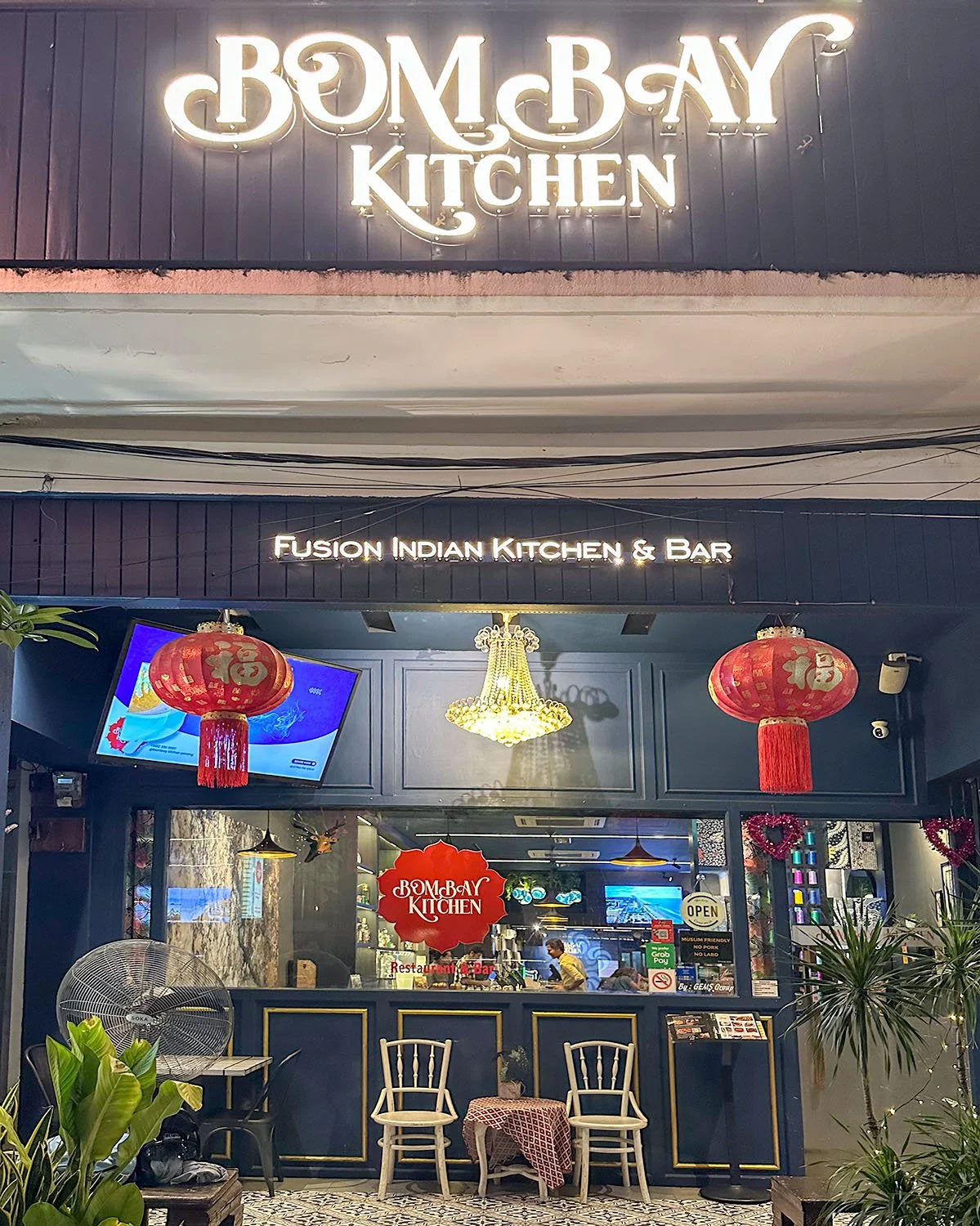
A final meal at the popular Bombay Kitchen.
On our last morning, we had breakfast at Kafka Coffee, a café tucked away behind the Penang Flying Club. Had it not been recommended to us, and given detailed directions for reaching it, I doubt we would ever have found it. The food and coffee were excellent, and then we headed to the airport for our flight home.
Despite our disappointments with the botanic gardens on the third day, and with the Butterworth attractions on the previous day, it had been an interesting four-day break. And Penang had certainly lived up to its reputation as a good destination for foodies.