Travelling in Kazakhstan and Kyrgyzstan at 85
For travellers over 80, exploring Central Asia can be immensely rewarding but it presents unique challenges, from steep travel insurance costs to the physical demands of remote geography. Engaging a local guide removes the burden of trip logistics so you can focus on the journey. Here, an Almaty-based tour professional offers pacing tips and regional insights for octogenarians venturing into Kazakhstan and Kyrgyzstan.
One evening during a tour, I went around the shops looking for wooden Kazakh bowls. My guest, an 85-year-old woman from New Zealand, had admired the carved patterns on these traditional cups, which we call pialas.
We had not managed to find any on the tour, but when I finally found some and presented them to her, she was delighted. It is one of my favourite memories of that particular journey.
As a guide in Kazakhstan and Kyrgyzstan, I spend plenty of time thinking about routes and landscapes. But when I remember particular trips, it is often the people who come back to me first.
Some of the guests who have left the strongest impression on me have been in their eighties. Their curiosity and enjoyment of travel have made me think about how I want to live my own life.
My New Zealand guest had come to Kazakhstan to judge a fishing competition. She had set aside a free week to explore the country as well.
Over dinners and glasses of wine, she told me about her life and how she had become a judge in international fishing competitions. I found the whole story fascinating.
A shared moment beside the dunes.
Here was someone travelling around the world at 85, involved in an activity she cared about and making time for another adventure. We enjoyed restaurants together and took the cable car up to Shymbulak, where we also had dinner.
She appreciated the food as much as the mountain scenery. The search for the wooden pialas became another small part of our time together and giving them to her was a pleasure for me too.
These are the moments that can disappear from a tightly written itinerary. There is no box on a route plan for a conversation that lasts longer than expected, or for discovering something a guest would love to take home.
Yet those moments can matter as much as the famous sights. I like leaving enough space in a journey for them to happen.
A Hotel of a Thousand Stars
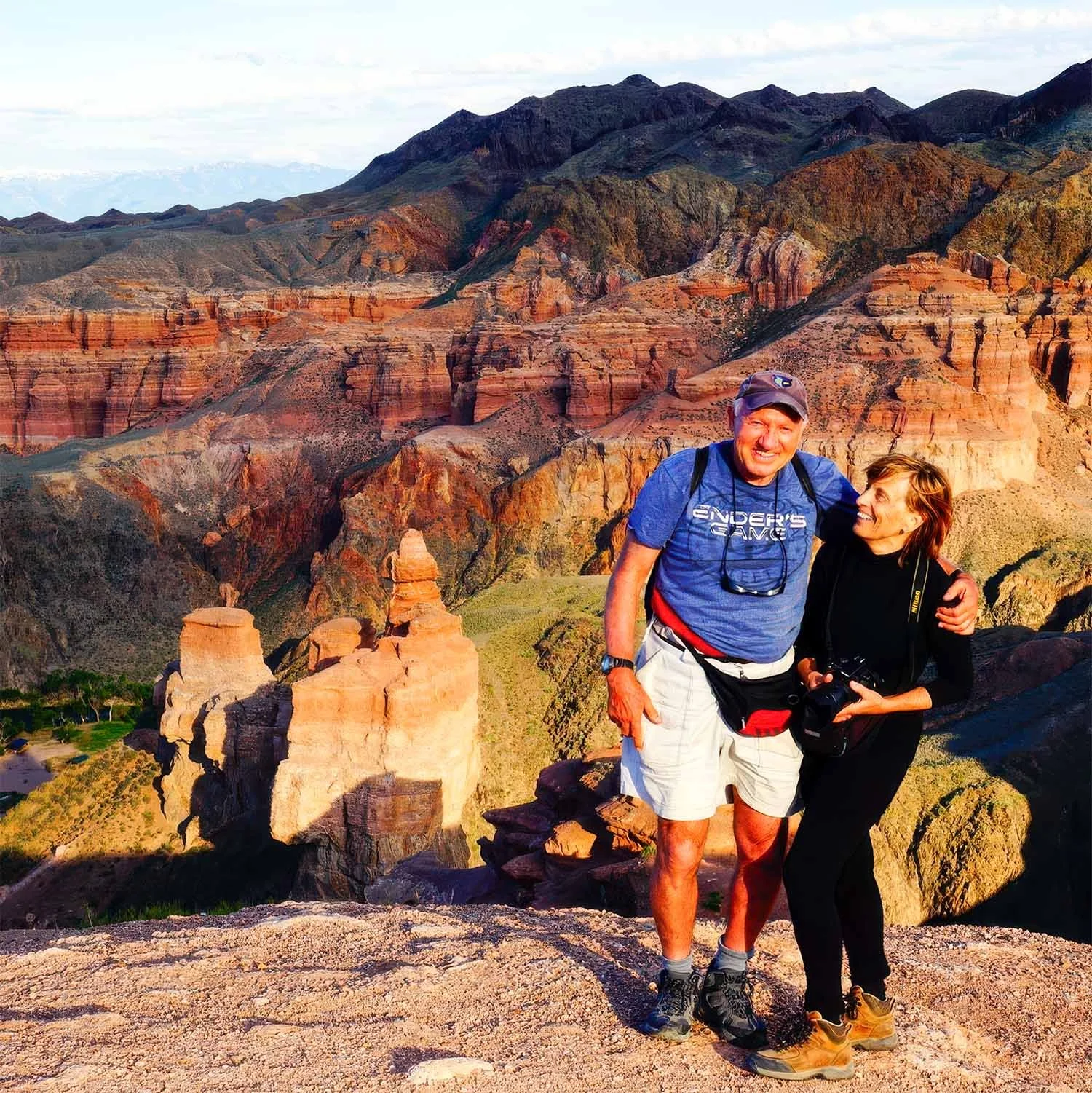
Another journey took me through Kazakhstan and Kyrgyzstan with a Romanian couple. Both were 85.
They arrived with trekking poles, sun hats, walking boots and large hiking backpacks. Their preparation impressed me immediately, and their energy stayed with me throughout the trip.
A quiet moment together at camp.
We took short walks, spent long stretches outside, cooked and made coffee. We also camped beside a lake. They joked that we were staying in “a hotel of a thousand stars”. I loved that description.
They were enjoying the experience on its own terms, with the landscape around us providing a view no hotel room could quite reproduce.
Photography became part of the fun. We posed for pictures and compared our photographs, turning parts of the journey into a friendly competition. On one occasion we were lucky enough to see Khan Tengri, the spectacular 7000m high mountain that sits on the tri-point border of Kazakhstan, Kyrgyzstan and China.
On the road between Kazakhstan and Kyrgyzstan, we came across two bulls locking horns in the middle of the road. It was one of those unexpected scenes that stays in your memory alongside the places you deliberately travel to see.
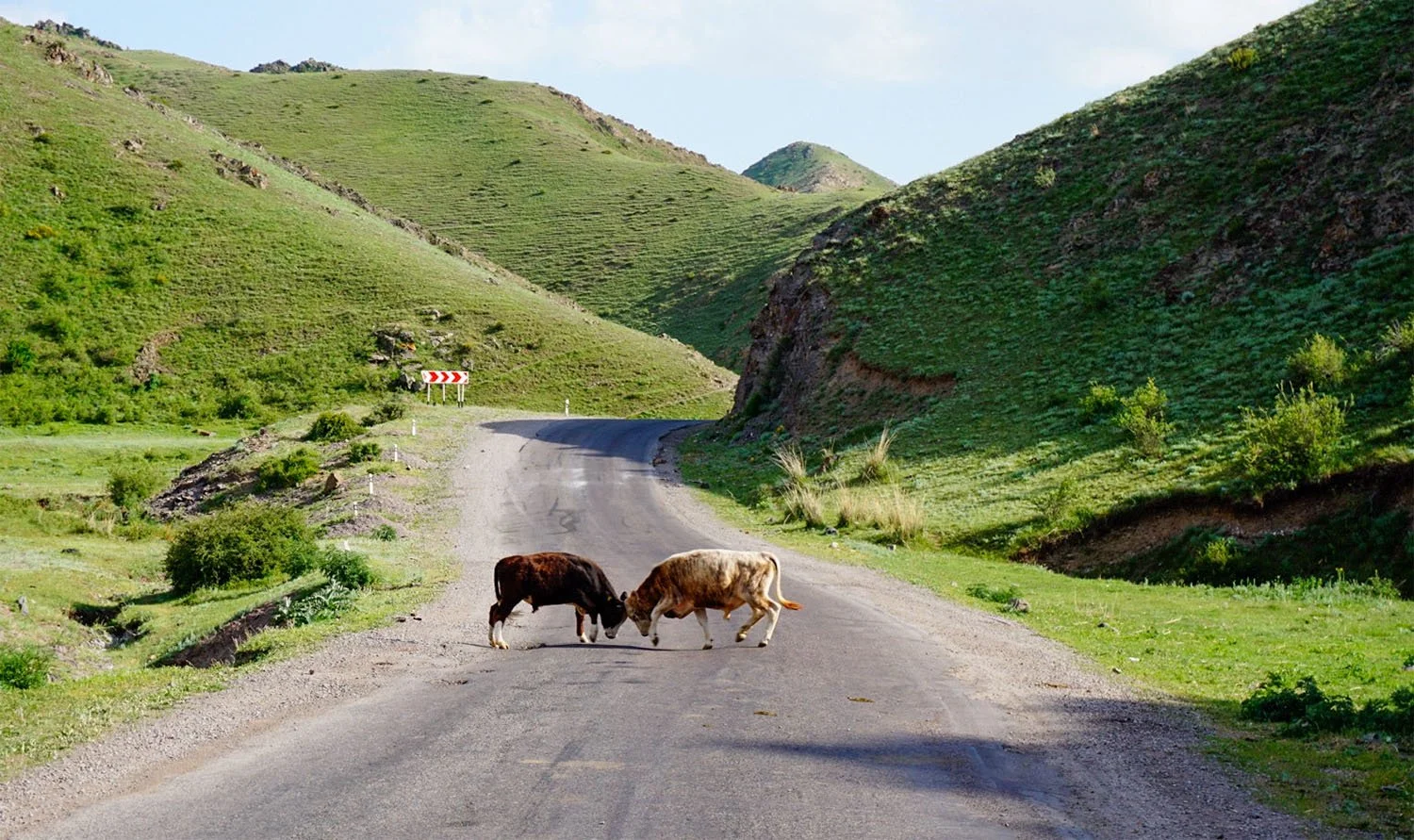
Two bulls on a road through the hills.
The weather gave us another memorable contrast. One day we were in desert heat of roughly 35–40°C. The next, we were beside a mountain lake with the temperature close to freezing.
We put on our jackets and still felt the cold. That change made the variety of the journey very real, and it is something I remember when helping guests prepare.
Planning Around the Person
These guests were wonderful travelling companions, but I would never use their trips as a template for everyone of the same age. Someone may love camping and short hikes; someone else may want a comfortable room, good restaurants and views reached with very little walking.
Both can have a rewarding journey here.
Before deciding on a route, I recommend being specific about what makes a day enjoyable or tiring. How long are you comfortable sitting in a vehicle? What sort of surfaces do you like walking on? How much time do you want for lunch, photographs or a quiet afternoon?
These answers are more useful than an age alone.
Distances deserve particular attention in Kazakhstan. A day can involve 350–400 kilometres of driving between places. A route that looks manageable as a list of attractions may feel quite different from the passenger seat.
I would rather allow time for breaks and enjoy fewer stops than spend every day trying to recover a rushed schedule.
Road quality matters too. Some internal routes in Altyn-Emel can be rough and tiring, even in a large SUV. I think of that part of a journey as an option for people who are comfortable with those conditions, rather than an essential stop everyone must fit in.
Ask about the actual road to each place, not simply the kind of vehicle you will be travelling in. There are rewarding routes that stay closer to the main roads.
Taking the Mountains Steadily
My usual advice is to spend a day or two in Almaty after arrival before setting off on a longer journey. It gives you time to recover from the flight and settle into the trip. It also means the first day does not have to combine travel fatigue with an ambitious mountain itinerary.
Resting in the city should not be confused with being fully acclimatised to high altitude. For a route that goes into higher mountains, the pace of ascent and the altitude of overnight stops need separate attention. Passing briefly over a high pass is different from sleeping high.
Travellers with health issues or concerns should discuss a proposed itinerary with their doctor before departure and make sure their guide knows about any relevant limitations.
Changing weather is another reason to prepare carefully. Pack layers rather than assuming that a hot forecast for Almaty applies to the whole journey. Comfortable footwear, sun protection and a warm layer all have a place in the same bag.
Camera in hand, wind in the hair.
The Romanian couple’s walking equipment helped them enjoy the activities they had chosen; the point is to bring what suits your own plans, not to pack for someone else’s adventure.
I also like recommending a night in a yurt when it fits the traveller. Before choosing a camp, ask about the beds, warmth at night, toilet facilities and how far you will need to walk to reach them.
Consider its altitude as well. Knowing the practical details makes it easier to decide whether the experience is right for you.
What I Take Home
I have enjoyed listening to these guests as much as showing them my country. They have years of experience, stories they are happy to share and perspectives I would not otherwise encounter.
During a journey we can become close surprisingly quickly. In some ways, guests become mentors to me.
For anyone wondering whether they have left travel too late, I would start with what you still want to experience, then work out a comfortable way to do it. That might mean a tent beside a lake, or a cable car ride followed by a good dinner.
The people I remember most did not all travel in the same way. They brought their curiosity, their humour and their willingness to enjoy being somewhere new. I was fortunate to share that time with them.