Three Areas of Bali Perfect for Older Travellers
We’ve all heard the negative reviews in recent years about how crowded Bali is these days and how it is straining under the pressures of overtourism. From my personal experience, I can say there is a lot of truth in those criticisms. That said, most of the complaints have come from travellers who have spent their time on the southern part of the island.
Places like Canggu or Kuta are fine if you’re visiting Bali to stay in luxury villas or resorts, to go shopping or spending your days in trendy cafés. But these areas have gradually lost their cultural roots due to mass tourism. So the frustration of those who arrive in Bali expecting the essence of the famous Island of the Gods, only to find something quite different, is very understandable.
If there’s one tricky thing about this Indonesian island, it’s choosing which areas to visit. That’s especially so for older first-time visitors who don’t want to find themselves staying somewhere that is party central. The options are many, and some look far more appealing online than they are in reality.
If you don’t plan carefully, you might end up with a bittersweet experience. However, the good news is that Bali still has areas that are completely authentic, where you can experience the island and its culture without going through tourist-trap experiences.
Away from the tourist crowds at Pura Gunung Kawi.
Bali is bigger than it looks on the map and distances can be long. Traffic can be heavy on trunk roads and some drives across the island can take 3 to 5 hours. That’s why it’s wise to choose your areas carefully and plan visits by locality, so you don’t spend a lot of your time on long journeys.
Recently, I returned to Bali to explore some new corners and rediscover some familiar ones. Here are three areas that I consider good options for older travellers:
Ubud
It may surprise you that I’ve included Ubud after my comments about overtourism, because the centre of the town is one of the most crowded places on the island, but Ubud is Bali’s cultural heart and is still worth visiting despite the crowds.
Ornate stone carvings at Pura Tirta Empul near Ubud.
Ubud is located towards the island’s centre, about 30 km from Denpasar. From the airport, it’s an hour and a half’s drive. There’s lots of accommodation options in every price range in and around Ubud from which you can spend a couple of days exploring the area at a relaxed pace.
It might sound cliché, but Ubud still remains one of my favorite spots in Bali despite the traffic congestion and queues at some attractions which can be tiring.
Ubud has a special charm, with its many Hindu temples, bustling markets, cozy warungs, artisan workshops, yoga retreats, dance performances and countless hidden corners waiting to be explored.
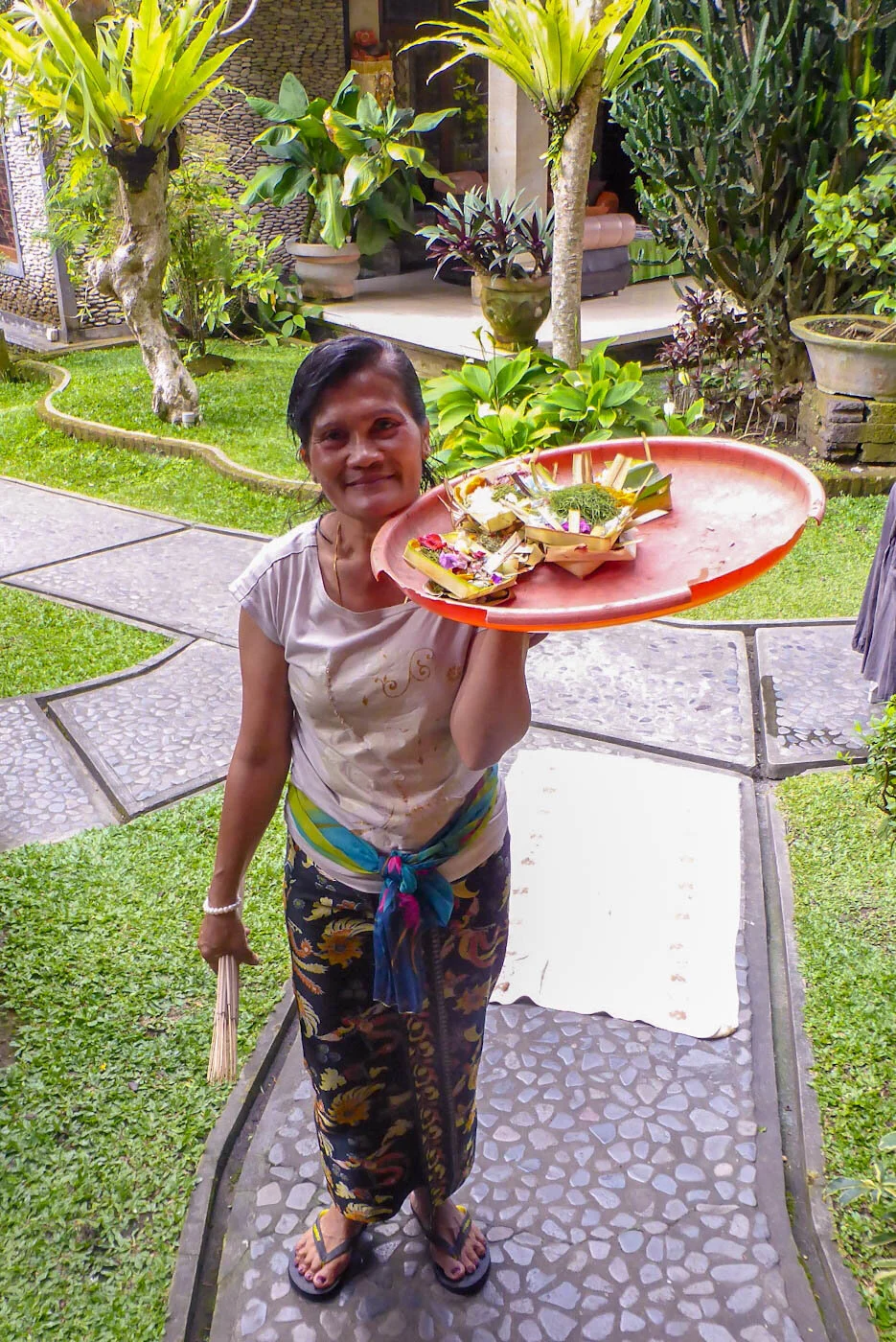
One thing I especially love about Ubud is the abundance of canang sari offerings everywhere. Balinese Hindus use them to give thanks to Sang Hyang Widhi or other local spirits and deities (guardian gods of the home, rice, nature, etc). You’ll see them on streets, temples, statues, doorways, shops and even vehicles.
Canang sari offerings can be seen all over Ubud.
Ubud is the cradle of Hinduism in Bali and home to some of the island’s most spectacular temples. Those in Ubud truly blew me away, not just because of their architecture, but also because of how deeply rooted they are in the local community.
Beyond being places of worship, the temples embody Balinese symbolism and are the perfect way to immerse yourself in the island’s culture.
Despite the number of tourists visiting these temples, exploring them at your own pace can be a relaxing way to spend a few hours.
I recommend that you don’t miss visiting three very special temples. The first one is Pura Taman Saraswati, dedicated to the goddess of knowledge and the arts and surrounded by lotus-filled ponds. It’s also known as the Water Palace and is easy to reach because it’s right in the middle of town.
Lotus pond and fountains at Pura Taman Saraswati.
The second is Goa Gajah, an ancient temple with both Hindu and Buddhist influences, where you can spot symbols of Shiva and Ganesha, as well as Buddhist stupas. It’s also known as the Elephant Cave. Goa Gajah is about 15 minutes drive out of town so you’ll need to use a taxi or Grab to get there if you don’t have your own transport.
The third is Pura Tirta Empul, one of Bali’s most iconic temples. It’s famous for its sacred spring, where purification rituals are still carried out. The temple is dedicated to Vishnu, the god of supreme consciousness, also known as Narayan.
This one is about 30 minutes to the north of Ubud but you can combine a trip there with Goa Gajah without coming back through the town.
Aside from temple visits, catching a Balinese dance performance in Ubud is a ‘must-do’ activity when visiting. It is a beautiful experience with live music, meaningful movements and an energy that grabs you from the first moment. The dances share traditional stories and legends packed with emotion and meaning, and you can really feel it as you watch.
Balinese dance at the Sacred Monkey Forest Temple.
One of the most popular dances is the Kecak. Besides being incredibly entertaining, it has a beautiful story behind it. It’s based on the Ramayana, an epic poem from Hindu tradition.
The story is about Prince Rama’s wife, Sita, who is kidnapped by the demon Ravana, sparking an epic adventure to rescue her by the prince and his companion, Hanuman.
You can enjoy these shows at many of the temples around the area, but the most iconic place to watch them is the Ubud Palace, right in the town centre. You can buy tickets at the door from late afternoon, but in peak season it may be wise to buy them online in advance, as they do sell out on many days.
Another relaxing activity to do in Ubud is to stroll the Campuhan Ridge Walk. This ridge trail is two and a half kilometres long and starts near the Campuhan Bridge, just a kilometre from the centre of Ubud. The trail winds through rice fields, palm trees, and tropical vegetation, and is mostly flat.
The easy Campuhan Ridge Walk.
It ends up in a quiet village where there are several nice restaurants and coffee shops, as well as some good massage and spa businesses.
There are usually local taxis hanging around there if you’d prefer to ride back into town, rather than doing the ridge walk in reverse.
The best time to do the walk is during the rice-growing periods, between January and March or June and August. During these months, the fields are completely green and the scenery looks like it’s straight out of a postcard.
By the way, if you want to see the more famous Tegallalang rice terraces that you see on all the postcards in the souvenir shops, they are about 11 kilometres from Ubud, so you’ll need to take a Grab there.
The iconic Tegallalang rice terraces near Ubud.
If you want to spend longer exploring this area, here’s a complete guide to Ubud to help you plan your daily itineraries.
Sidemen
When it comes to Bali’s natural beauty, it’s hard to beat Sidemen. While it’s not very central, it’s worth making the effort because its relative isolation makes it much quieter than other areas of Bali.
The village of Sidemen is about two hours’ drive from Ubud (around 40 km) and four hours from Denpasar (around 70 km).
Sidemen is surrounded by rice fields, green valleys, waterfalls and mountains, with amazing views of Mount Agung, Bali’s highest volcano. Here, it’s all about nature and enjoying its relaxing rural vistas. I’m sure the Tegallalang terraces are a little jealous of Sidemen’s.
Relaxing rural views outside the village of Sidemen.
The best part is that Sidemen hasn’t been overtaken by mass tourism. Here, you won’t find huge hotels or resorts, just small villas and homestays focused on sustainable tourism. If you’re after luxury and big facilities, Sidemen isn’t your spot. But if you want a calm and a close connection to nature, Sidemen is perfect.
Among the highlights here are its nearby waterfalls, Gembleng and Jagasatru. Both have calm pools that are perfect for a nice swim, plus beautiful paths leading up to them. Gembleng is a 15 mins drive south of the village whilst Jagasatru is 25 mins to the east.
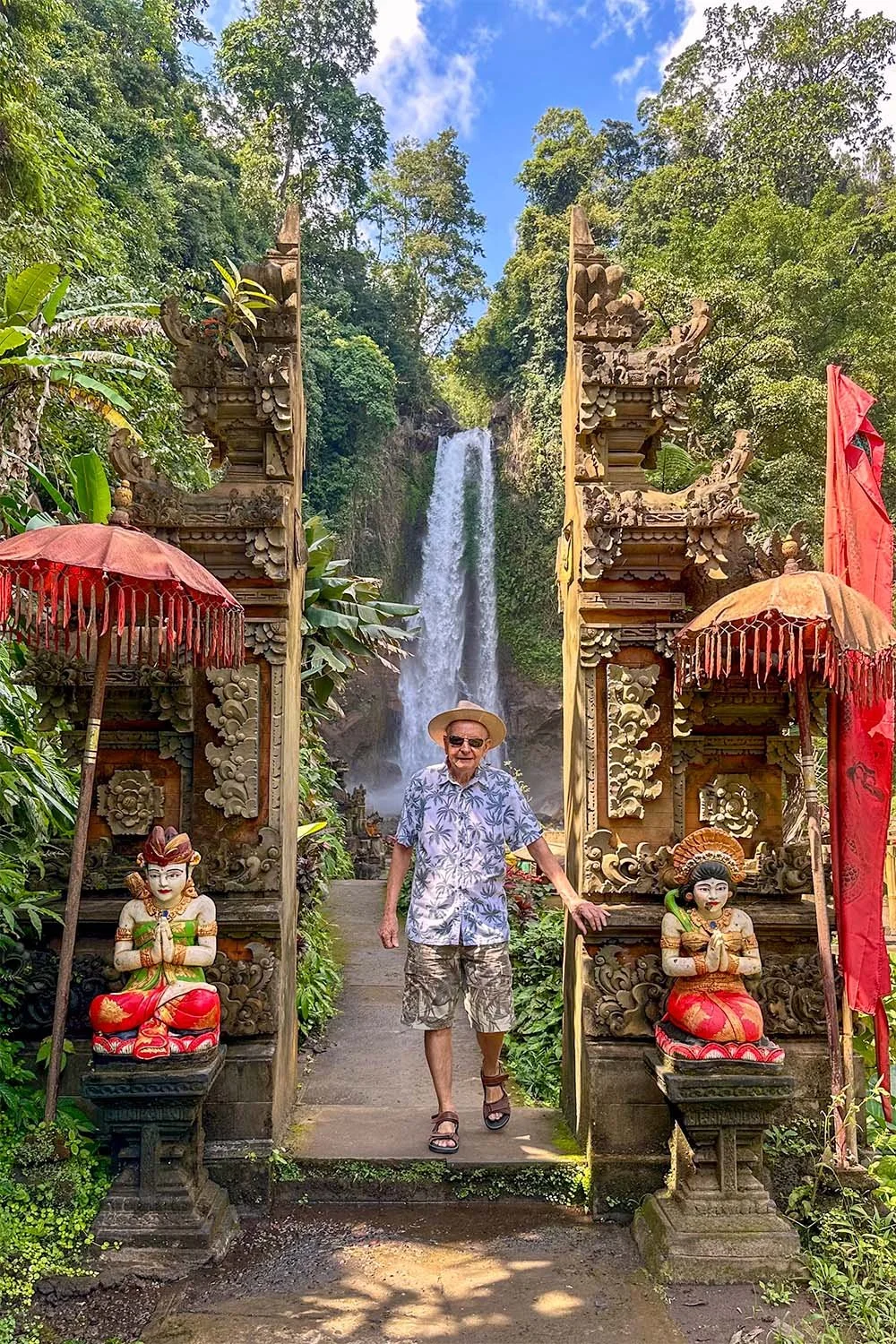
Further away to the west of the village is a most eye-catching waterfall called Tukad Cepung. The water falls through a cave-like opening between high rocks and when the sunlight shines through the opening, it creates a beautiful glowing effect.
Although Tukad Cepung is not far in direct distance, getting there involves a somewhat circuitous route which can take anything up to an hour, depending on what part of Sidemen you are staying in.
The impressive curtain of water at Tukad Cepung.
Another lovely thing to do is take a gentle trek through Sidemen’s plantations. The local economy is mainly farming-based. Aside from the rice paddies and terraces, you’ll find clove and tobacco plantations all around Sidemen.
Walking through these areas and seeing the farmers at work is such a great way to get a real feel for everyday life in Bali.
While in Sidemen, you must take the opportunity to visit Pura Besakih, Bali’s largest and most sacred temple complex. It’s about 30 minutes away by road to the north of the village and located on the slopes of Mount Agung, at around 1,000 metres above sea level.
Pura Besakih is known as the ‘Mother Temple’ or ‘Great Temple’ and there are over 80 individual temples within the complex. The most important is Pura Penataran Agung, which is not open to tourists, but you can you reach the entrance by climbing six levels of stone steps, from where you can get a sneak peek inside.
Balinese on their way to pray at Pura Besakih.
What makes this temple truly special is seeing the locals coming with their whole families to make offerings and pray together. It’s a really lovely experience!
Amed
Now for my personal favourite. I love the ocean, so it’s no surprise that I’m completely smitten with Amed. Bali’s beaches generally aren’t spectacular, but Amed’s are amazing. If you enjoy sand, water and marine life, you can’t miss this part of the island.
Amed is a small fishing village on the east coast of Bali. It’s off the main tourist radar, so there aren’t big shopping centres or large constructions. Instead, you’ll find low-rise houses, cozy hostels and beachfront bungalows, creating a local, authentic feel that’s hard to find in most of the resort areas of southern Bali.
A picturesque view of Amed village and Mount Agung.
Getting there takes about three hours by car from Denpasar (90 km) or Ubud (80 km). In return for the long travel time, you’ll be rewarded with secluded beaches, incredible coral reefs and lovely sunsets.
In Amed, life revolves around the sea. Nets are spread out on the shore, and traditional jukung boats line the beach. Amed is famous for its black volcanic sand beaches, and has a really laid-back, local vibe.
The area is not overly commercial, but there are plenty of warungs and a few restaurants with hammocks where you can relax in the sun. And even though the area feels very local, all the beaches are easy to reach.
A boy fishing at lovely Selang Beach.
Jemeluk Bay, Ibus Beach, and Lipah Beach are all good, but I recoomend that you find time to visit Selang Beach in particular. It’s a tiny bay, about 250 metres long, with really blue waters. It’s a little out of the centre of Amed, but the scenery is stunning and you’ll be almost alone.
In the afternoon, you shouldn’t miss the sunset at Amed Beach, one of the most beautiful sights on the island of Bali. You’ll enjoy the sun going down with Mount Agung in the background.
The landscape turns into a stunning display of orange hues that colour the sky, the sea, and the volcano, creating a truly lovely scene.
Although its beaches are beautiful, the real highlight of Amed lies beneath the surface, where marine life thrives. All the snorkelling spots are easy to get to and packed with corals, barracudas, and colourful fish. If you’re lucky, you might spot small manta rays and turtles swimming by.
Snorkeling in the clear waters off Amed Beach.
You’ll find great places to snorkel on almost every beach. For example, at Jemeluk Bay, you can swim alongside a small sunken temple surrounded by colourful fish.
And at Lipah Beach, just a few metres from the shore, there’s a marine garden filled with countless hard coral formations in every shade. Just remember not to touch them and be careful as you enter so you don’t trip over any.
My favourite snorkelling spot is Amed Beach, the main beach of the village. It has a very accessible spot for spotting hawksbill turtles. If you’re not in a rush and are patient, they’ll eventually show up and you can swim close to them. It’s one of the most beautiful experiences this part of Bali has to offer.
If you want more of an adventure, don’t hesitate to spend a couple of hours at the Japanese Wreck, a World War II sunken ship where an artificial reef has formed, full of corals and fish.
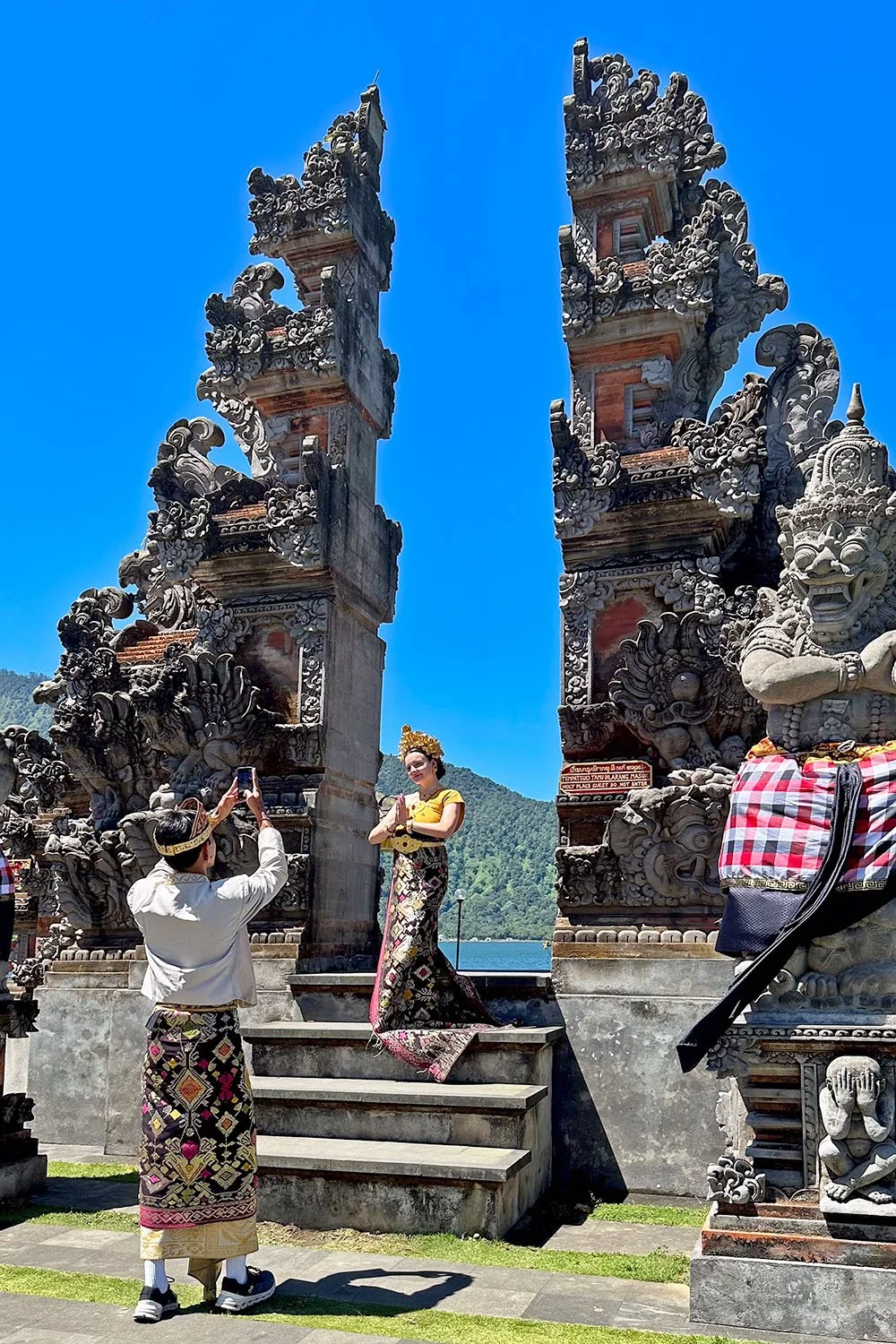
The famous Gates of Heaven at Pura Lempuyang.
Aside from the beaches and marine activities at Amed, there are also several temples worth visting. You’ve probably heard of the famous Gates of Heaven at Pura Lempuyang, overlooking Mount Agung. T
his temple is dedicated to Gni Jaya (Iswara), the guardian of the universe’s direction. Its name means sacred light (lempu = light, hyang = sacred).
Pura Lempuyang is one of the most visited places by Instagrammers on the island, but if you are staying at Amed, which is only 15 kilometres away, you can visit the temple early in the day before the crowds arrive.
Another lovely spot nearby that is quieter (though not by much) is Tirta Gangga. It’s an old royal water palace set on the southeastern slopes of Mount Agung and is famous for its ornate gardens, fish ponds, bathing pools, and beautiful stonework and statues. You’ll surely enjoy a stroll here and learning more about Balinese culture.
Fountains and ponds in the Tirta Gagga gardens.
Its name comes from the sacred Ganges River, very important in Hinduism, and its waters are considered holy. Within the complex is the Patirthan temple, a pilgrimage site for Balinese people who traditionally come here to purify themselves with the holy water.
Aside from Ubud, Sidemen and Amed, if you’re left craving more Bali (and you probably will), consider areas like Munduk, Singaraja, Lovina, Uluwatu, Nusa Penida and its sister island Nusa Lembongan.
However, only travel out to the islands when the weather is good. Two of the fast boat ferries to Nusa Penida and Nusa Lembongan have capsized in rough seas in recent months with several fatalities.
Images: © Iria Salcedo