Travel Tips and Day Trips from Busan, Korea
Busan is South Korea’s second largest city and has as much to offer visitors as the country’s capital Seoul.
Personally, I prefer Busan to Seoul because its location on the southeastern coast of the Korean peninsula means there are lots of nice coastal walks to enjoy, as well as beaches and islands in addition to the many city sights and attractions.
For first time visitors to South Korea, Busan may be a better starting point than Seoul because it doesn’t suffer the chronic traffic congestion of the capital (which has three times the population) and it’s easy to get around Busan on its efficient public transport system.
Busan is a city that has many places to see and things to do that will appeal to older travellers. Before I retired from full-time work, I used to visit Busan from time to time for the annual film festival, but that was work related and I never really had the chance to be a tourist in Busan.
That changed recently when we spent a month on nearby Geoje Island and were able to make the occasional day trip into Busan to sample some of what it had to offer international visitors. I used Nannette Holliday’s excellent guide to Busan (which you can read by clicking here) to help us to decide what to see on our day trips.
Firstly, three updates to Nannette’s guide which was published a few years ago:
Visitors stroll through the Huinnyeoul Culture Village.
(1) The Huinnyeoul Culture Village which Nannette mentioned as not being in the guidebooks yet, has been well and truly ‘discovered’ by travel bloggers and influencers now.
However, it’s still not as crowded or touristy as the more well known Gamcheon Culture Village, and we liked it better (despite being smaller) because there are higher quality cafes and coffee shops in Huinnyeoul.
Most of the people we saw in Huinnyeoul were independent travellers, whereas in Gamcheon it was predominantly tour groups. We had a superb lunch at a new café called Merci Nook, about 7-8 minutes’ walk up the main road from the bus stop outside the Having Moment coffee shop (which has great coffee too).
Most of the buildings in the Huinnyeoul Culture Village are constructed on the side of a cliff, and there are a lot of steps down from the main road and back up again. So, for those with any mobility problems, the Gamcheon Culture Village is the better option.
Steps down to the Haedong Yonggungsa Temple.
(2) The Haedong Yonggungsa Temple on the coast to the east of Haeundae Beach is getting overrun with tourists these days (not surprising given it is one of the country’s most picturesque temple locations and one of few overlooking the ocean) but you can still enjoy the tranquillity of this temple if you get there early before the tourist hordes arrive.
It opens at 5am so if you are an early riser, this is a lovely spot from which to enjoy a sunrise.
Most of Busan’s blue buses start service between 4am and 5am, but if you want to be sure of getting there for the sunrise, it’s best you take a taxi because the entrance to the temple is about 800 metres from the bus stop, and it’s a mostly uphill walk.
This travel blog has a lot of useful and detailed information about the temple, as well as maps of the walking trails on either side of the temple. Again this is not somewhere that anyone with mobility issues will enjoy because there’s a lot of steps to negotiate and the walking trails are uneven.
Passengers walk to board the SRT in Suseo, Seoul.
(3) There is now a bullet train (Korea’s first) from Seoul to Busan which can get you to your destination even faster than the KTX express trains. It’s called the SRT (Super Rapid Train) and can take you from Seoul to Busan in just two hours and 10 minutes.
That beats the fastest KTX express by five minutes, but most of the KTX Seoul to Busan services take up to half an hour longer because they stop at more stations.
Even some of the SRT trains may take around two and a half hours when they make more stops, so check the timetables for the fastest options at the time you want to travel. One may be better than the other and note that whilst the KTX trains leave from the main Seoul station, the SRT trains leave from Suseo on the southern side of Seoul (there are direct airport buses from Incheon to Suseo).
If you are travelling on a weekend, and haven’t made advance reservations, then the KTX may be the better option because the SRT is always booked out on Saturdays and Sundays.
BIFF Square in Busan has lots of eating options.
So where and what did we enjoy most from our day trips to Busan? Nannette was there for ten days whilst we were only able to make three day trips, so we had to be fairly choosy about where to go.
On the first day we headed to the Haedong Yonggungsa Temple first and then worked our way back to Haeundae Beach visiting the places that Nannette had recommended along that part of the coast.
On our second day trip we did all the sights around Nampo (BIFF Square, Gwangbok-ro, Yongdusan Park, Jagalchi fish market), the two culture villages and Taejongdae Park.
On the third day we were going to try and visit the Beomeosa and Samgwangsa temples, but we only made it to the first because it started to rain heavily just as we were finishing up our visit to the Beomeosa Temple.
Instead, we ended up taking a bus into the city and attending an event at BEXCO (Busan Exhibition & Conference Centre). There are always multiple events happening at BEXCO so it’s a good idea to check their website if you are going to be in Busan for any length of time.
An exhibition of Buddhist art at BEXCO.
We also wanted to visit the Busan Museum of Art next door, but we discovered that had been closed for major renovations since December 2023 and is not scheduled to reopen until 2026.
We enjoyed our visits to all of the places that Nannette had recommended but for us the highlights were the Haeundae Sky Capsules and the Beomeosa Temple. Why? Firstly, the Sky Capsules provided an unusual but very relaxing way of travelling from Cheongsapo to Mipo (which is a 30 minutes’ ride).
You can also take a train called the Haeundae Blueline Park Beach Train which goes twice as fast, but we enjoyed the sky capsules better because they are elevated above the train track and give you a better view of the coastline.
There is also a walking path alongside the train track if you are looking for some good exercise.
Sky Capsules with Haeundae Beach in the background.
The sky capsules only run from Mipo at the eastern end of Haeundae Beach to the small fishing port of Cheongsapo. The beach train goes all the way from Mipo to Songjeong Beach (about three times the distance).
Most people ride the sky capsules from Mipo to Cheongsapo but we did it in the reverse direction which avoided the long queues for tickets at Mipo.
So, if you are at Haeundae Beach and want to ride both the beach train and the sky capsules, the best way to do it is to take the beach train from Mipo to Songjeong Beach, then after exploring Songjeong take the beach train back to Cheongsapo (or walk if you have the energy) and then hop on the sky capsules at Cheongsapo.
Each sky capsule has space for four passengers, but when we were there, they were allowing couples to have their own capsule, offering more privacy and room to take photographs. I don’t know whether they would still do that in peak periods, but going from Cheongsapo to Mipo would definitely give you a better chance of getting a capsule to yourselves.
A Sky Capsule passing the Haewol Skywalk.
There is no stop between Mipo and Cheongsapo on the sky capsules, but on the beach train there are five stops between Mipo and Songjeong, namely the Dalmaji Tunnel, the Haewol Skywalk, Cheongsapo, the Daritdol Skywalk, and Gudeokpo.
The two skywalks, which extend out over the ocean, may be closed if there are strong winds or heavy rain.
You can either buy a ‘two rides’ pass which will get you to Songjeong and back to Cheongsapo, or you can buy a ‘all stops’ pass which will let you get off and on at any station on the route. A sort of ‘hop-on, hop-off’ ticket.
The reason that we rated the Beomeosa Temple as our other highlight is that it is much larger and significantly less crowded than the Haedong Yonggungsa Temple. Whilst its location is not quite as scenic as the coastal temple, the surrounding mountains and panoramic views created a much more serene atmosphere.
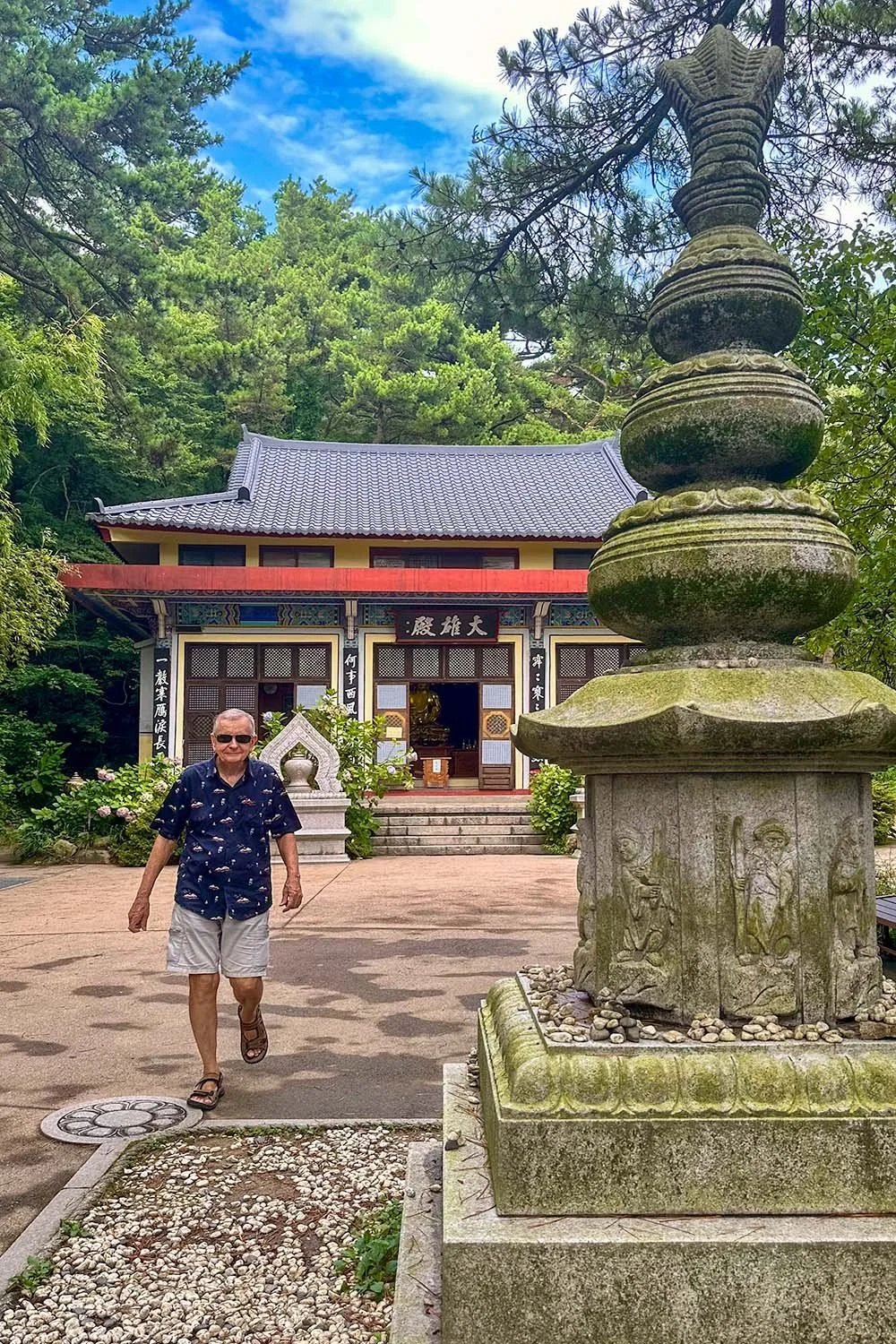
Part of the peaceful Beomeosa Temple complex.
There are more temple buildings to see at Beomeosa and plenty of hiking paths that will take you to smaller temples and shrines on the pine forested mountain. If travelling there on public transport, it’s best to get off the metro at Nopo and not Beomeosa.
From the Nopo metro station you can take the No 90 bus from the bus station right outside the metro exit up to the temple entrance.
If you get off at Beomeosa metro station, you will have a fair walk up the hill to the No 90 bus stop, and you may find yourself going in the wrong direction because the buses do a strange ‘round the block’ loop there and the buses coming down the mountain drop off passengers at the same stop as buses picking up passengers to go up the mountain.
Day trips from Busan
If you are staying in Busan for a week or more, then you may wish to consider a day trip to either Gyeongju or Goeje Island. Both of these destinations really require 2-3 days to fully explore them, but in one day you can certainly see the highlights.
Travel time is only an hour by bus to both (plus whatever time it takes to get to the relevant Busan bus terminal from where you are staying in Busan).
The nearby city of Gimhae where Busan’s international airport is located is also a candidate for a day trip (and the closest in terms of travel time), but there’s less to see there that is different to Busan compared to Gyeongju and Goeje.
Ancient burial mounds in Gyeongju city.
The same applies to the cities of Changwon, Yangsan, and Ulsan. All of those cities can be reached in less than an hour and have interesting places to see and local experiences to enjoy, but if you are looking for destinations that are completely different to Busan, then Gyeongju and Goeje are the best choices.
Gyeongju
The ancient city of Gyeongju was the capital of the Silla Kingdom – the forerunner to modern-day Korea – for about 1,000 years. By the 9th century it was the fourth largest city in the world with around one million inhabitants.
Many of the large, grassed burial mounds of the Silla kings can be seen in Gyeongju.
It is fortunate that Gyeongju was spared the destruction that other cities suffered during the Korean War in the early 1950s. That resulted in Gyeongju having more ancient buildings, temples, pagodas, archaeological sites and artifacts than any other Korean city and gaining UNESCO World Heritage listing status in the year 2000 for five of its historical areas.
A Confucian school in Gyeongju that dates back to 1493.
For those interested in ancient history, Gyeongju is a ‘must visit’ destination if you are in southern Korea. Despite the thousands of visitors that the city receives each year, aside from the very touristy area around Hwangnidan-gil Street where there are lots of restaurants, cafes and souvenir shops, it is an uncrowded and peaceful city.
It’s often called an open-air museum, and you can spend days strolling around its parks, gardens, historical sights and traditional villages taking in all that this clean and picturesque city has to offer. Printed tourist maps in different languages can help guide you around the historic areas.
The maps recommend three main areas for tourists to visit. The first is the Gyeongju Daereungwon Ancient Tomb Complex, and this is the area that you should focus on if you are only there for one day.
Within this complex there are many ancient tombs – some of which have been excavated and one that you can enter inside – as well as the other principal sights of the area, namely the Cheomseongdae Observatory (around which there are many flower gardens), the Donggung Palace and Wolji Pond, the Gyeongju National Museum, the Woljeonggyo Bridge, the Geongjuhyanggyo Confucian School and the Gyochon Hanok Village.
Cheomseongdae is the oldest astronomical observatory in Asia.
We managed to see all those places easily in a day and did it all on foot. In hindsight, we should have hired bicycles because it involved a lot of walking (around 20,000 steps) and we could have seen more on bicycles.
For those who don’t want to walk or cycle, there are golf carts that can be hired to drive around the historic area.
By the time we reached the Hanok village in the late afternoon, there were only a handful of other tourists around. In fact, when we crossed the beautiful Woljeonggyo Bridge we had it all to ourselves for a while, so were able to take photographs without any other visitors in frame. It’s not often that you can visit such a renowned World Heritage site in the middle of summer with so few people around.
The only place on our walk that was a disappointment was the Donggung Palace. We discovered after paying the entrance fee that it was only the site of the palace with three reconstructed pavilions. The pond around which the pavilions are built has historical significance as it was constructed in the year 674 and was the centrepiece of the palace, but there’s little to see there now.
A traditional home in the Gyochon Hanok Village.
The second area that you can visit is called the Gyeongju Namsen Region. It is an elongated mountain region to the south of the Gyeongju Daereungwon Ancient Tomb Complex with many old temples on both sides of the mountains overlooking the two valleys to the east and west.
We didn’t get time to visit the Gyeongju Namsen Region because we were there for only one day, but we will surely visit that area next time we are in Gyeongju. There is also the famed Bulguksa Temple and many other ancient temples and pagodas on the other side of the valley to the east of the Gyeongju Namsen Region, but those are very spread out and would be best visited using a rental car.
The third area that that the tourist maps recommend visiting is called the Bomun Tourist Complex to the east of the Gyeongju Daereungwon Ancient Tomb Complex but that didn’t interest us because it’s predominantly hotels, golf courses, a theme park and a water park.
Whilst it looks a pretty area from photographs we saw (especially at cherry blossom time in the spring), it looks too touristy for us and more suitable for families with children.
The Woljeonggyo Bridge was originally built in 760 AD.
Getting to Gyeongju is easy. The express bus to the city leaves from the Busan Dongbu Bus Terminal located next to the Nopo metro station at the northern end of line 1.
If you happen to be staying on the western side of Busan, you can also take an express bus from the Busan Seobu Bus Terminal located at Sasang. That will get you to Gyeongju a little quicker than taking the metro to Nopo.
You can take a KTX train to Gyeongju, which is a good option if you are staying near the Busan main railway station, but the railway station in Gyeongju is further away from the historical area than the bus station (which is within easy walking distance), so although the train journey might be faster, total travel time won’t be much different.
Geoje Island
Whilst Gyeongju is absolutely the number one option for a day trip from Busan, Geoje Island is a good second choice if you enjoy nature destinations. Geoje is connected to the mainland just west of Busan via a 3.7km undersea tunnel and two bridges totalling another 3.5km. There is no railway or metro service to Goeje.
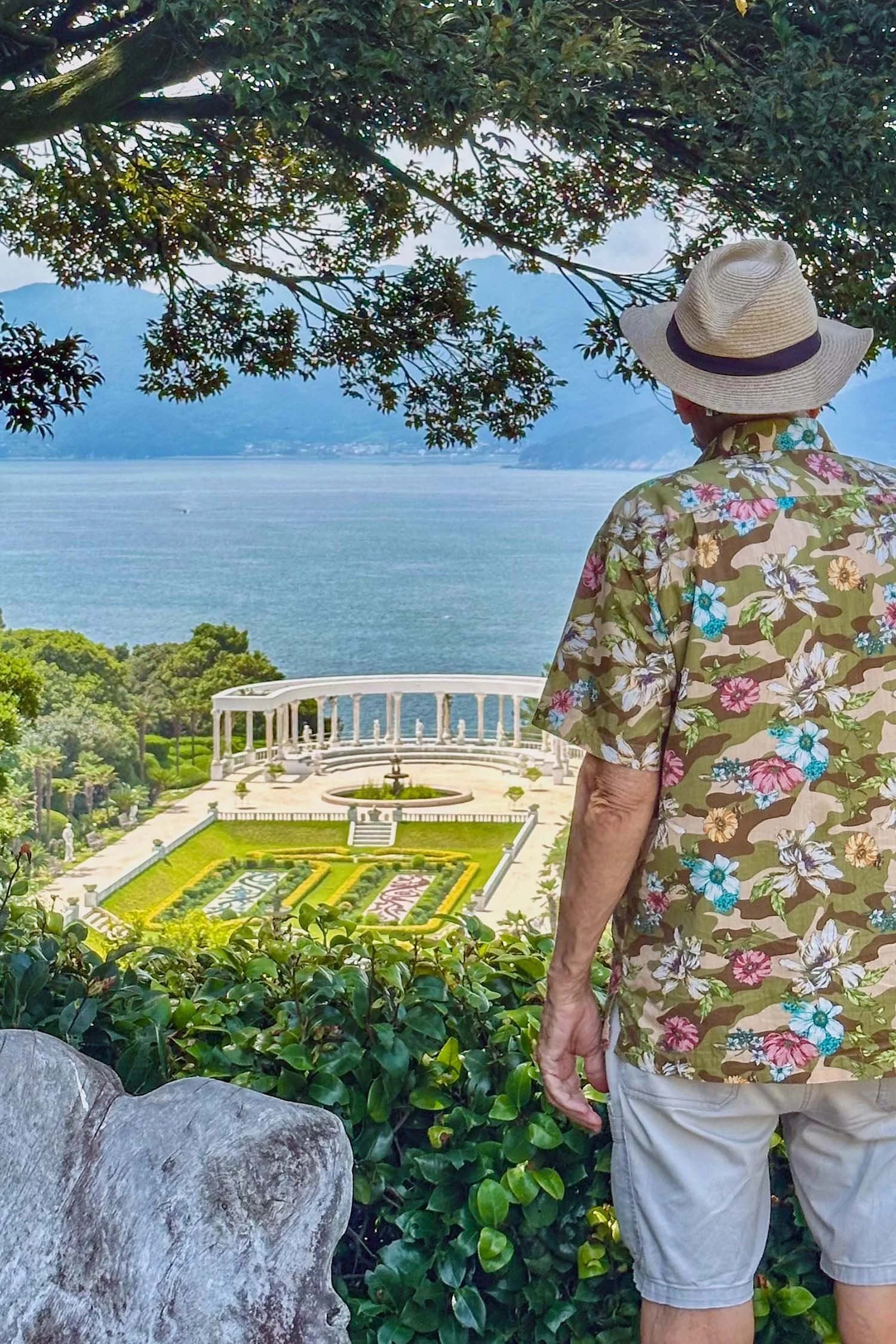
Beautiful Oeda Botanica off Goeje Island.
Goeje is best explored using a rental car and with that you can easily drive around the whole island in a day and see all of the highlights. If you are not keen to drive there, you can take an express bus to Geoje and then use their very efficient local bus network to get around.
You can read our detailed guide to getting around Geoje on the local buses here.
If you are using the buses, you won’t be able to see everything in one day, but you can certainly cover the highlights. If you have only one day, and the weather is fine, then we would recommend taking an express bus to Gohyeon and then transferring to a local bus to travel to the Geoje Panorama Cable Car.
That will take you up to the top of Mt. Noja on the southern side of Geoje Island where you will have outstanding views over the Hallyeohaesang Archipelago and many of Geoje’s southern coves and beaches. It beats the views from Busan’s Diamond Tower or ‘X the Sky’ observation platforms hands down (unless you prefer city views to nature views).
View of Hakdong Beach from the Mt. Noja summit.
After your visit to Mt. Noja, you can choose to either come back to Gohyeon and visit the impressive Geoje Jungle Dome on the west coast on the way, or alternatively head down to Hakdong Beach and back up the east coast to Gujora from where you can take a ferry over to Oeda Botanica.
The frequent express buses to Geoje Island leave from the Busan Seobu Bus Terminal which is a short walk (2-3 mins) from the Sasang metro station on line 2. The buses go either to Gohyeon or to Okpo (and onto Jangseungpo).
If you happen to be staying somewhere along line 1 in the southwestern part of Busan, then an alternative option would be to take the No. 2000 bus from the interchange outside Hadan Station.
If traveling to Gohyeon, that bus takes about 15 minutes longer than the express buses from Sasang because it takes a more scenic route down the east coast of Geoje Island to Okpo first, before heading across to Gohyeon.
All images: © David Astley