Is Japan’s Expo 2025 in Osaka Worth Visiting?
World Expo 2025 in Osaka, Japan, did not get off to a good start. Five country pavilions were still under construction and three others weren’t open on the first day. Mobile phone and Wi-Fi reception was poor making it impossible for some visitors to pay for food and drinks in the cashless Expo site.
Excruciatingly long queues getting into and out of the Expo site, and queueing outside pavilions where there was no shelter from rain, made it a miserable experience for many.
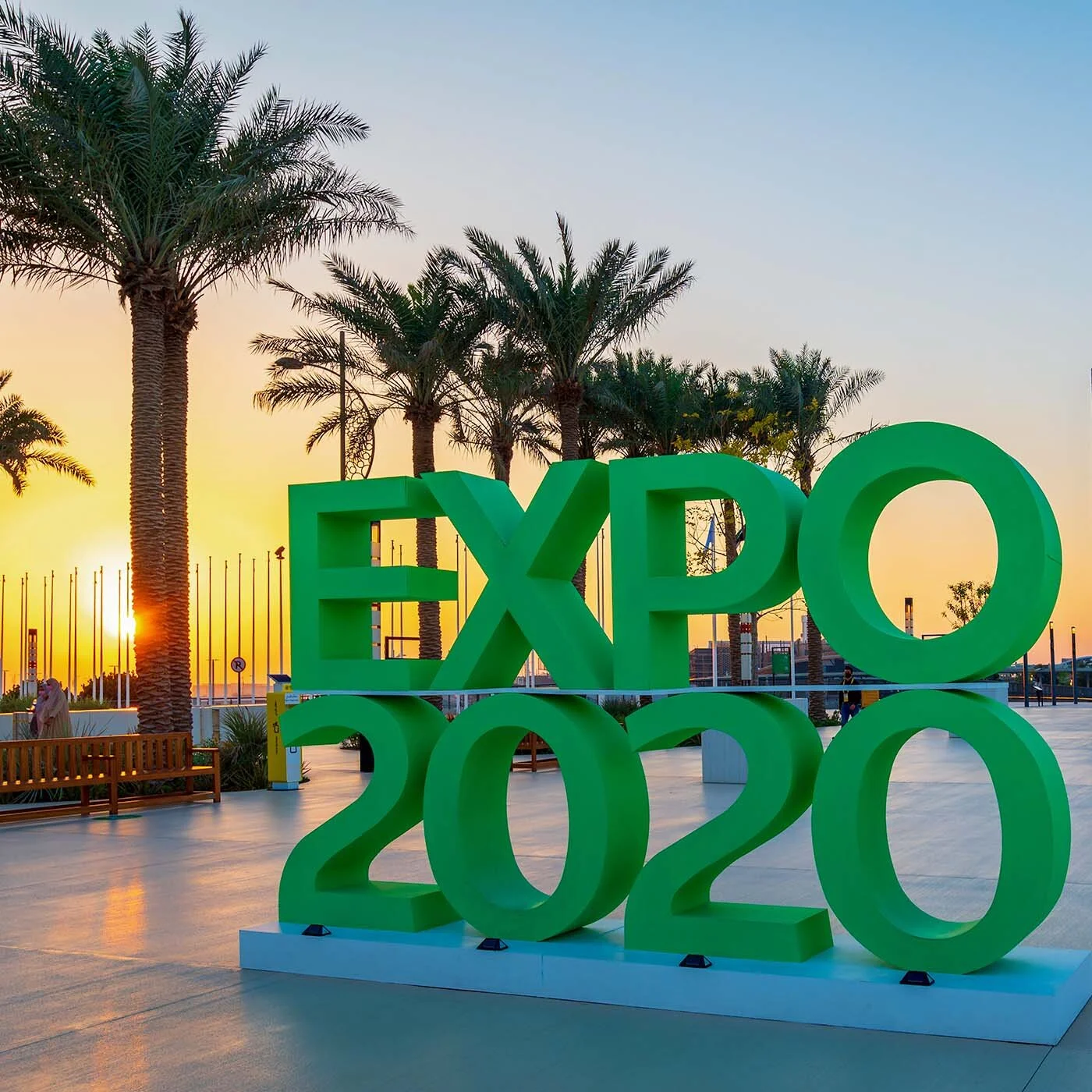
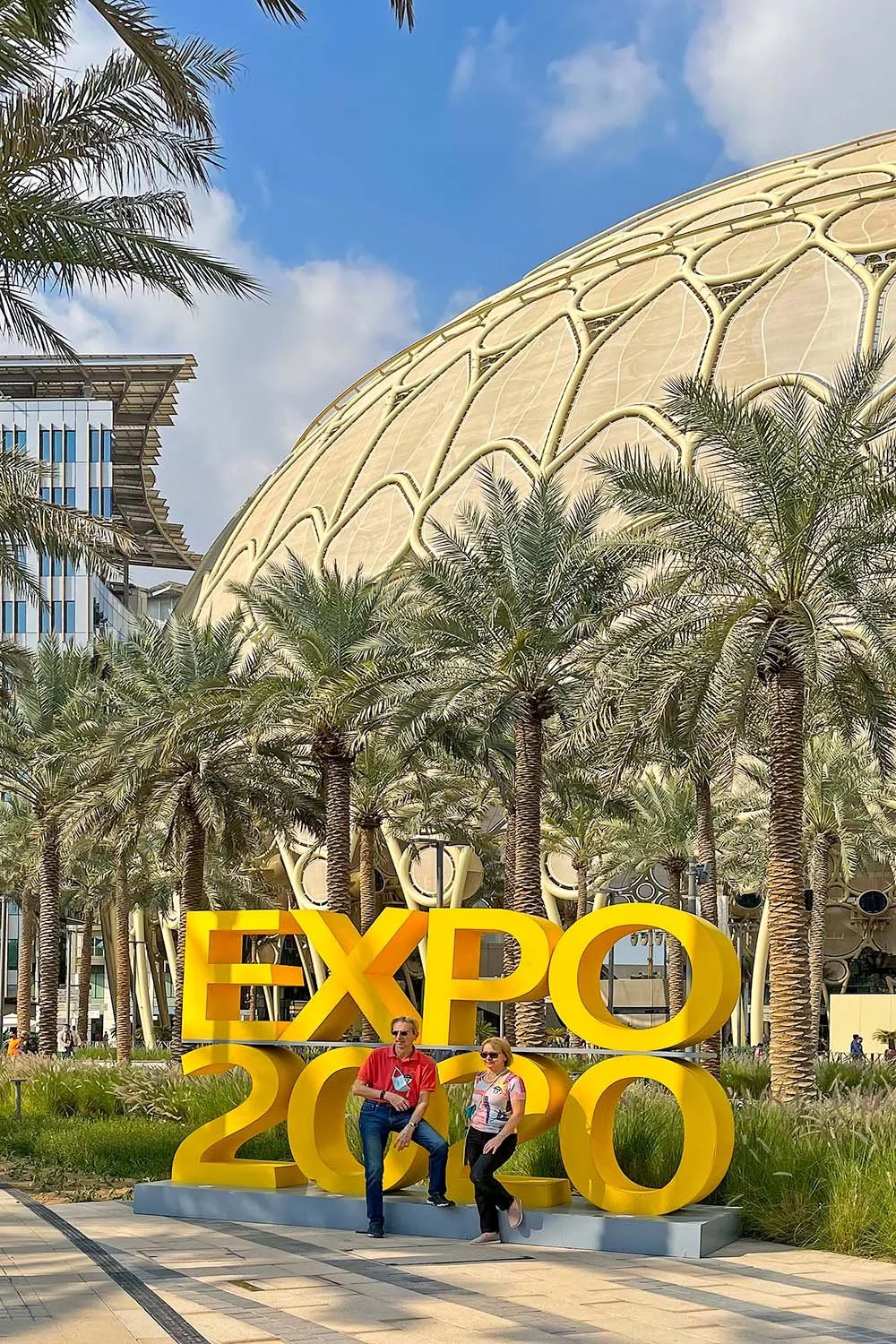
Japan’s national broadcaster, NHK, politely called it “teething pains” but visitors on social media and online forums lambasted the organisers. “Worst Expo ever”, “a disaster”, and “a fiasco” were common refrains. Many compared it with Dubai’s successful World Expo in 2021/22 expressing surprise that Japan had fallen so short of the standards set in Dubai.
Even after the organisers said they would take action in the following weeks to fix many of the problems, complaints continued about the difficult-to-navigate Expo website and apps, and the complicated processes of entering tickets into advance lotteries to secure reservations to the most popular pavilions.
“Trust the Japanese to make things more complicated than they need be,” one visitor on a Reddit forum said.
After reading all the bad reviews about Expo 2025, I was not so keen to visit as I was after spending nearly a week at the Dubai Expo, but as we would be in Busan during August – just an hour’s flight from Osaka – it seemed a pity not to take the opportunity to check it out at least for a day or two to see if all the negative commentary was justified.
Japan’s Expo 2025 mascot which is named Myaku-Myaku
So, a little over two months before our planned departure from Busan, I bought tickets online for Expo 2025 to enable us try for reservations to the pavilions for which I had read the best reviews. The ticket purchasing process was complicated and I had to wait in an online queue for more than 30 minutes to make the transaction.
However, that process was nothing compared to the complexity of applying for the lottery tickets. Despite the millions of yen spent on developing the Expo website, it seems the organisers only used AI to produce the English translations, because many of them were confusing and didn’t make sense.
In addition, the search function for the events and pavilions was user-unfriendly, kept producing “nil” results, and many of the pavilions which were by reservation only didn’t show up. After hours of trying different workarounds, I was eventually able to apply for a reservation for the Japan pavilion for three different times, and a couple of events.
We had bought tickets for a Thursday evening and a whole-day Friday ticket, so after lodging the Thursday applications I did the same for Friday. I was only able to apply for the same pavilion and events because nothing else was showing up in the search function.
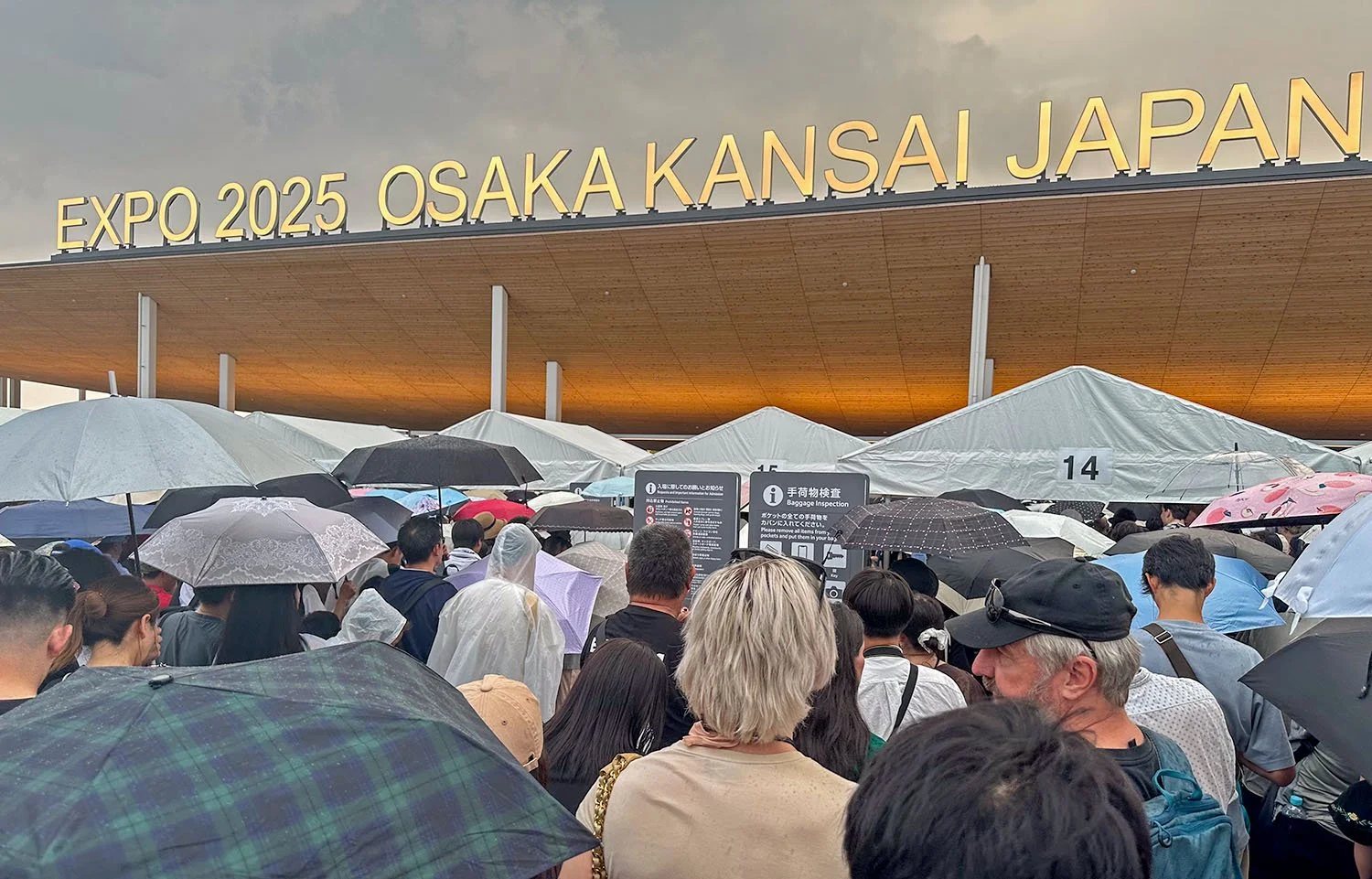
Ticket holders queue to enter Expo 2025 in Osaka.
A week later I received an email that I had won a reservation to the Japan Pavilion on the Thursday evening. A day after that I received another email saying I had won a reservation to the Japan Pavilion for the Friday morning. Despite all the complexity of the Expo lottery system, it wasn’t sophisticated enough to pick up that I had already been awarded a reservation for the Japan Pavilion.
Six weeks later I went through the same process to lodge applications for the 7-day lottery. This time a few more results showed up and I was able to select a couple of alternative pavilions for both days, and for our alternative choices I selected the ‘Under the Midnight Rainbow’ water fountain show for the Thursday evening and a Chopin concert at the Polish Pavilion for the Friday.
I didn’t get any email notifications back from the organisers after the closing date for the second lottery, so I assumed that meant we weren’t successful in that lottery. Possibly that was because many more people were applying for reservations in the 7-day lottery than in the one that was two months out.
Two days before our departure to Osaka we received an email advising that we could now make advance applications for pavilions and events on the Expo app. That proved to be a new learning experience and even more complicated than the Expo website.
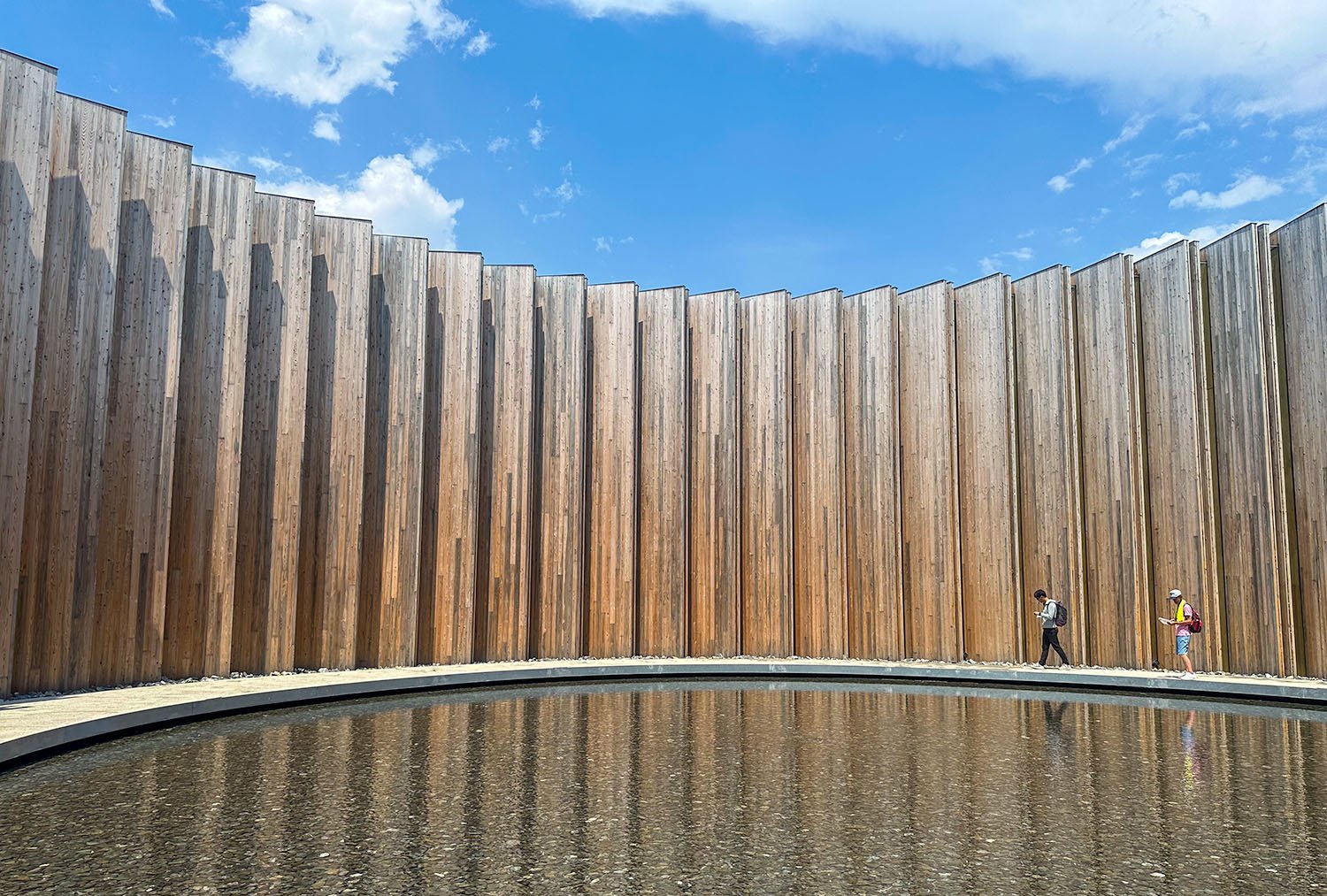
A pond of recycled water inside the Japan Pavilion.
It took a good hour to work out how to apply for available slots (during which time I saw a message confirming that our four 7-day lottery applications had been unsuccessful). I eventually found the screen listing what pavilions and events could be applied for in advance for our dates. There were none. They were all marked as full.
The app advised that the next opportunity we would have to apply for reservations would be 10 minutes after we had entered the Expo site, so we copied the log-in details for the app and made sure we had a spare battery on hand because it sounded like we’d be using the phone a lot. Each time a log-in is made on the app, a one-time password is sent to the email that I used to purchase our tickets, so you need to have your email set-up on your phone to receive those OTPs.
Our arrival in Osaka did not auger well for our Expo visit. Japan has recently introduced a mandatory online arrival card which generates a QR code that you have to show at a kiosk on arrival which captures a facial image and your fingerprints. This was advertised as making the arrival immigration process more efficient.
Once we’d been through that process, we thought that we would be free to collect our baggage, but to our horror we discovered that we still had to join long queues for the immigration desks despite having done everything online.
Whilst the online registrations and the do-it-yourself kiosks for the facial images and fingerprints no doubt meant less work for the immigration officers, the whole process resulted in a much longer time for travellers to make it through immigration. Normally getting through immigration at Kansai International Airport takes about 50 minutes to an hour. Under the new system it takes well over an hour.
Expo banners on Namba’s busy shopping streets.
At least the delay at immigration ensured that our bags were waiting for us when we eventually made it into the baggage hall, so we grabbed those and headed to the railway station to take the airport express to Namba. Fortunately, we didn’t get stopped for a customs check as we had on so many previous trips to Japan.
We had booked a hotel close to Namba station which had good reviews on Booking.com so dropped our bags off at the hotel and then headed down back to the station to catch a train to Kujo where we transferred to the metro for the five-stop ride to Yumeshima which is next to the Expo east gate.
Upon our arrival at the east gate at around 5.30pm we were shocked at the massive queues waiting to get in. There were about 15 queues of 200-300 people slowly shuffling forward to a security check, and then after that to the ticket check. As we joined the back of one of the queues there was an announcement advising people to take shelter undercover to avoid lightning strikes from an approaching thunderstorm.
There was nowhere to take shelter because all the queues were on an open tarmac area. As the storm hit Expo, up went umbrellas, but they did little to protect people from the driving rain. Those without umbrellas were soaked to the skin.
There were some small marquees close to the security check but they only provided minimal shelter for about 500 people. The other 3,000 or so people had no option but to endure the storm.
Inside the East Gate as the thunderstorm moves away.
We stood in the rain for about one hour before reaching the security check and it only started easing off after we had been through the ticket check. By this time, we were too late to make it to the Japan pavilion for the 6.20pm reservation that we had won for our evening tickets, so it turned out to be a blessing in disguise that we’d also won a morning reservation at the same pavilion in our two-month lottery.
We started checking out the pavilions on the southern side of the Expo site where the Japan pavilion was located so that we would know what route to take the following morning in order to not be late for our second Japan reservation.
Getting around the Expo site involves a lot of walking. It is over 150 hectares in area, so we only saw a fraction of that area on the first evening.
Most of the pavilions that we wanted to visit had “reservations only” signs up, and there were long queues at every pavilion that permitted visits without reservations. Incredibly the Canada pavilion was already closed at 7.20pm, even though Expo is supposed to be open until 9pm. It looked like that our evening ticket wasn’t going to provide a great deal of value.
No queue at the Canada Pavilion because it closed early.
At least we would be able to see the drone show we thought, but then as we were walking around looking for pavilions with shorter queues, there was an announcement that the evening’s drone show had been cancelled (presumably because of possible lightning strikes).
We joined what looked like a shorter queue for the UAE pavilion and whilst in the queue tried for to see if there were any available reservations at other pavilions on the Expo app but gave up after 20 minutes because there was nothing available.
The UAE pavilion did not have much in it and was a disappointment compared to what they had built in Dubai.
We joined another short queue for the Thailand pavilion. Whilst the exterior architecture of the pavilion was impressive, the displays inside were not much more than an advertisement for Thailand’s medical tourism. Some beds of Thai herbs around the pavilion were looking decidedly ragged, no doubt because of the summer heat.
The architecturally stylish exterior of the Thailand Pavilion.
Most of the other pavilions that had queues had signs up indicating that the waiting time was 60 minutes or more, so aside from one short visit to the Earth at Night pavilion (again quite disappointing) we spent the rest of the evening walking on the Grand Ring – a very impressive element of Expo 2025 being the world’s largest wooden structure – and having a distant view of the water fountain show (for which we had not been able to secure reservations).
Let me pause here and explain what I mean when I say a pavilion is disappointing.
When you go to an Expo, you expect to see something more than tourism posters and AV presentations that you can watch on YouTube. There needs to be interactive activities like traditional music presentations, live demonstrations, or other participatory elements.
Without those you may just as well stay at home and watch a documentary about the country without having to travel long distances and wait in long queues. So, if a country’s pavilion has no interactive content, or nothing unique that I can’t easily see elsewhere, then I would rate it as disappointing.
View from the Grand Ring around closing time.
If the queues getting into Expo were a shock, the queues getting out between the east gate and the metro station were an even bigger shock.
Although the entrance to the metro station was only 500 metres away, the organisers set up barriers in the evening to force people to walk about a kilometre in a wide circle to avoid congestion at the station entrance.
It was hard to estimate how many people were trying to get into the station at around 9pm. My best guess was between 8,000 and 10,000. We shuffled forward slowly for about an hour before reaching the station entrance. It was a horrific and claustrophobic experience that we never wanted to experience again.
We decided that we would not stay until closing time the following day. In fact, had we not been to Osaka several times before and seen all the interesting places in and around the city, we would not have gone back to Expo at all. It was only because we had the Japan pavilion reservation and were hopeful of securing more reservations on the Expo app the next day that we decided to return.
The horrendous queues for the metro after closing time.
We had done a fair amount of research of what pavilions we wanted to see, so we hoped with an earlier start we would be able to gain entry to at least some of them. In addition to the Japan pavilion, we had the Korea, Singapore, Sumitomo, Future of Life, Earth Mart, Tech Village and Future Living pavilions on our wish list as well as the Chopin concert at the Polish pavilion.
The next morning, we woke up later than planned because we were tired from the travel the previous day and our evening visit to Expo. Our health apps showed we had walked over 20,000 steps the previous day – well above our normal step count. We skipped breakfast because we needed to be at the Expo east gate before 10am because our entry ticket was for the 9-10am slot.
We actually didn’t make it until 10.07am but we were relieved to see the 9am entry gates were still open. There were about 1,000 people still queueing but to the left of the 9am queues there were what looked like huge cattle pens with about 3-4,000 people crammed in one with a large ‘10am entry’ sign.
Beyond that there was another pen with a ‘11am entry’ sign with about 100 people waiting inside, and further on an almost empty pen marked ‘12pm entry’ with a dozen people sitting on the ground under umbrellas, sheltering from the hot sun.
Umbrellas up on our second day, not for the rain but for the sun.
As we approached the back of the 9am queues we saw the security staff open the gates to the 10am pen and hundreds of people started running towards the back of the 9am queues. We picked up our pace and just made it to the queues before the 10am ticket holders joined them. If we had arrived one minute later, we would have found 4-5,000 people in front of us instead of 1,000.
We made it inside a little quicker than the previous evening – about 40 minutes queuing time – and then headed straight to a Lawson café for breakfast. Whilst having breakfast we set about trying to secure pavilion reservations through the Expo app.
We managed to bring up more pavilions and events on the search function this time, including some on our wish list, but none of them had any vacant slots.
So, we headed off to the Japan Pavilion for which we did have reservations. The waiting time for those with reservations was only about 10 minutes and we were soon ushered inside to begin our guided tour. The air-conditioning was a relief as it was already 34°C outside and we found the displays interesting and informative.
A magnified model of spirulina algae in the Japan Pavilion.
The theme of the pavilion was recycling and incorporated a biogas generation plant using food waste from the Expo site and large fermentation tanks in which algae was growing.
There was also a ‘factory’ area showing how algae can be used to make natural products such as furniture, and demonstrations of other types of new recycling technologies.
The pavilion was spacious and well organised allowing everyone to see the exhibits and demonstrations. Aside from a wall showing different algae species that had been turned into cartoon characters (I would have preferred to see magnified models of what the algae species actually looked like as they did in an adjacent room with spirulina), the displays were very educational.
The Japan Pavilion was the first pavilion that we saw that was up to the standards of the Dubai Expo. In fact, it turned out to be the only pavilion that we could describe that way because for the rest of the day we had no luck at all in securing reservations to anything through the Expo app – not just those pavilions and events on our wish list, but even pavilions that we had noted down as a ‘reserve’ list (Germany, China and Indonesia).
Visitors watch animated visuals inside the China Pavilion.
We did, however, manage to make it into the China Pavilion after one-hour of queuing in 36°C heat with no shade until you got close to the pavilion entrance. There were a few rare antiquities on display and also a piece of lunar rock that had been brought back from the moon. It was definitely worth a look, but I wouldn’t rate it as worth queuing for 60 minutes.
We also made it into the Qatar Pavilion after 40 minutes of queueing, but it was so crowded inside that it was difficult to see anything. The pavilion had AV presentations and panoramic photos showing the country’s progression from pearl diving villages to a modern metropolis, but most of the time we were just looking at the backs of people’s heads.
We had to keep ducking into the shade of the Grand Ring between checking out the pavilion queues and keep buying drinks to stay hydrated in the heat. There were free water fountains around the Grand Ring where you could refill water bottles, but even those had long queues.
There were lots of seats under the Grand Ring but with thousands of people looking for somewhere to sit in the shade, we were never successful in finding a vacant seat to rest our legs.
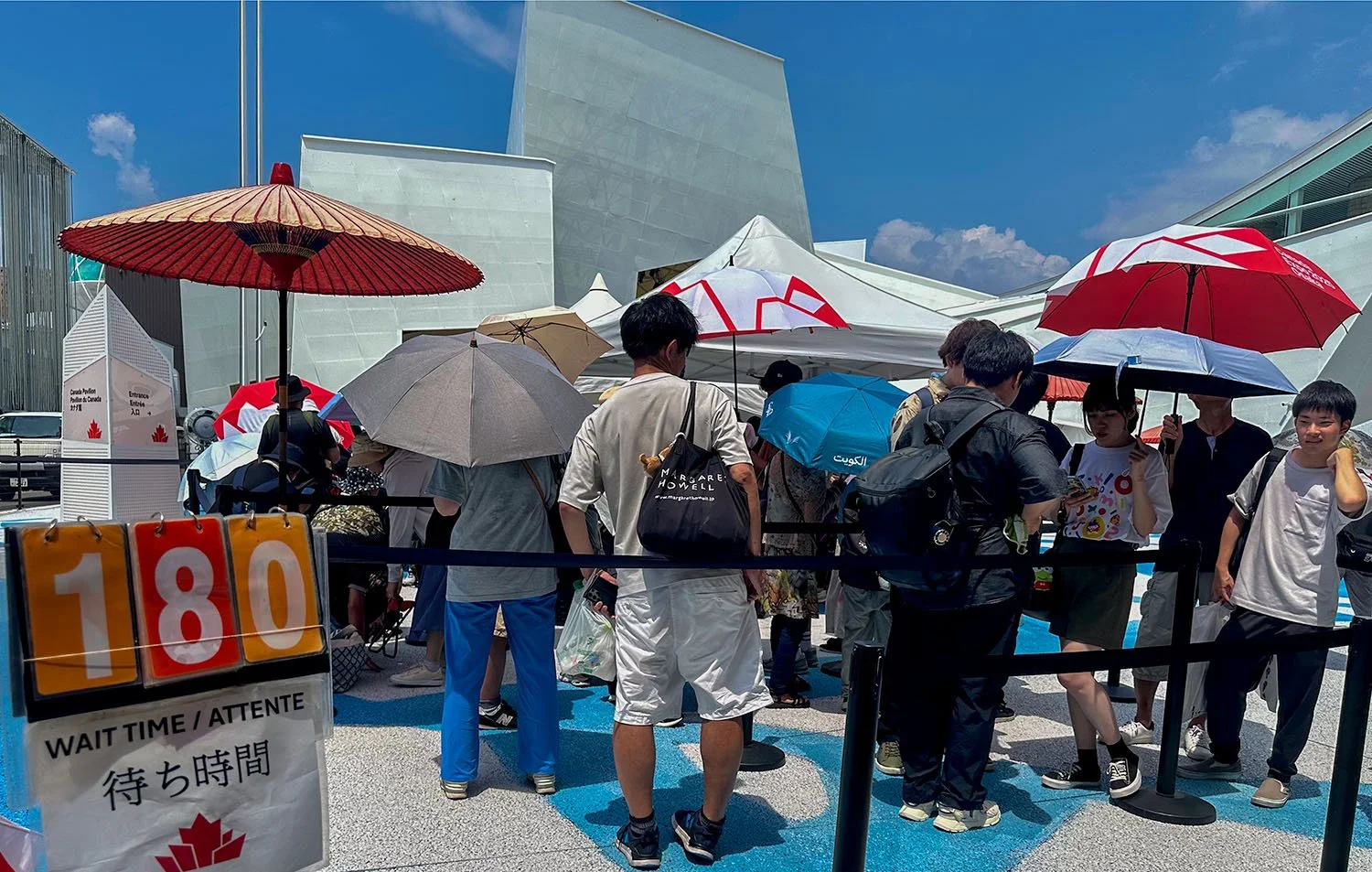
Sign at the Canada Pavilion indicating the wait time.
We passed the Canada Pavilion at one stage and noted they had a sign up indicating that the queuing time for those without reservations was 180 minutes. Most other pavilions had similar waiting times or signs indicating that queuing was closed for the day and only those with reservations would be able to enter.
By mid-afternoon the crowds had grown to a point where it was hard to move anywhere without bumping into people (I had read that the average daily attendance at Expo at that stage was around 150,000 people and reaching 160,000 on some days) so we decided to call it a day and head back to our hotel.
It was clear that we were not going to make it into any more pavilions without being prepared to queue in the hot sun for 2-3 hours.
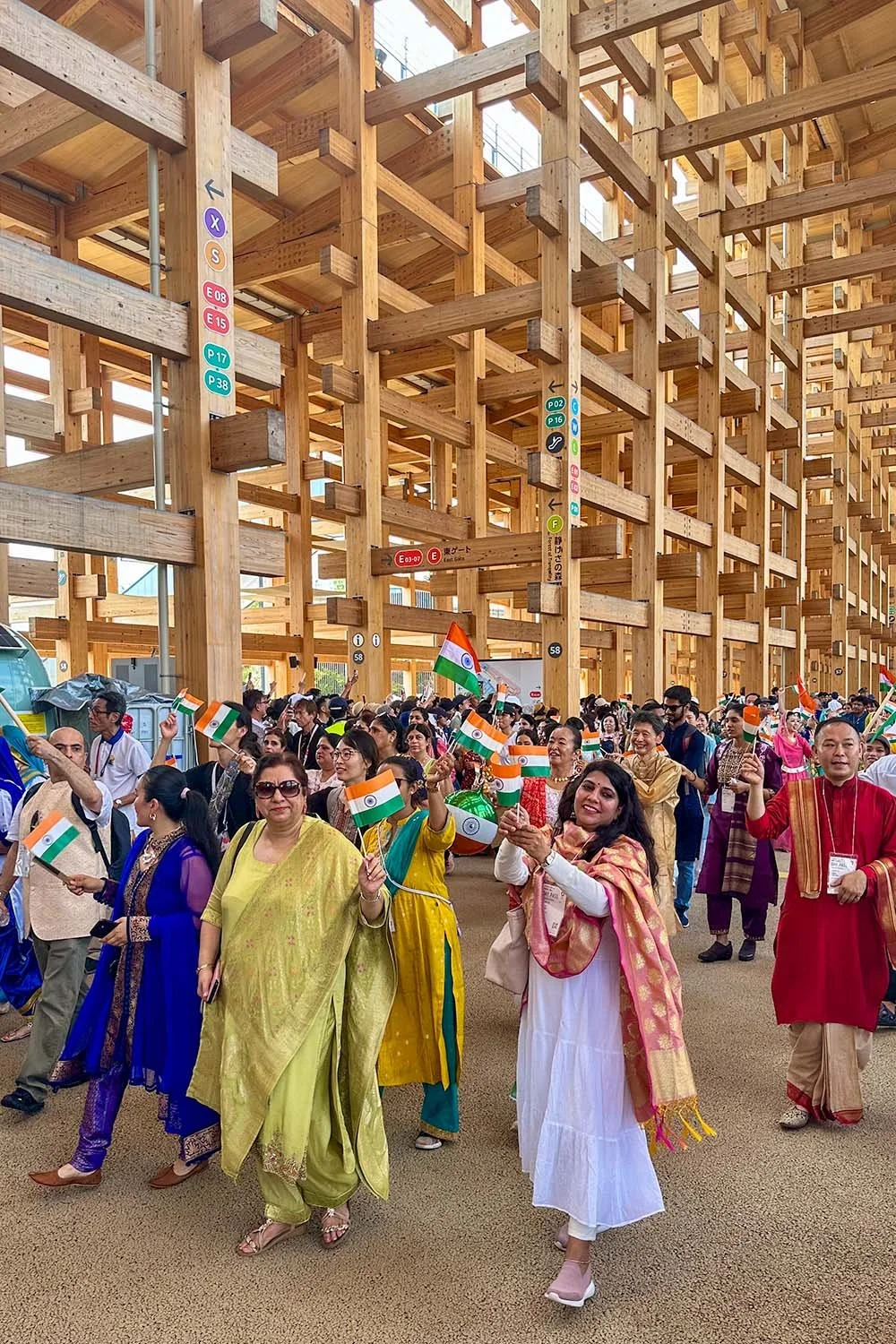
On our way out we were fortunate to come across a small parade of Indian people who were celebrating their India Day. It wasn’t a big parade but the participants, in their colourful traditional dress, seemed to be having a lot of fun and it added a nice festive atmosphere to the area under the Grand Ring.
The India Day parade under the Grand Ring.
Leaving in the middle of the afternoon, we reached the metro station without enduring the football stadium type crowds of the previous evening, but the station and trains were still very congested, and we had to stand all the way back into the city.
Although we had never expected to get into all 10 of our wish-list pavilions/events in one and a half days, we were disappointed that we had only made it into one. It was clear EXPO2025 simply can’t handle the number of people who are visiting. You spend more time queueing than doing anything else.
Compared to the Dubai Expo, I can only agree with the early day critics who described Japan’s third World Expo (they also hosted in 1970 and 2005) as a fiasco.
I was surprised that after four months the organisers hadn’t fixed many of the problems identified in the opening week. It wasn’t what I expected of a country that has a reputation for doing things efficiently.
The Kuwait Pavilion with its distinctive ‘wings’ at night.
So, to answer the question “Is Expo 2025 in Osaka worth visiting?” I would have to say that if you went to the World Expo in Dubai, it’s definitely NOT worth making a special trip to Osaka. You will be disappointed. Japan didn’t get close to organising an event to match what the UAE staged.
However, if you are already in Japan, and haven’t been to an Expo before, and are interested to see the impressive Grand Ring and architecture of the pavilions (and don’t mind spending time in long queues) then the ticket price of $US40 should not deter you from taking a look.
But wait until the summer heat subsides (I got badly sunburned legs from our one day at Expo), make sure you go on a weekday (Tuesdays, Wednesdays and Thursdays are supposedly a little less busy) and be prepared to leave before the big evening exodus.
Hotel prices in Osaka are 80 percent higher than in summer last year, and they are unlikely to drop back to normal levels until Expo is over. Weather-wise, October would be the best month to go, but as World Expos are traditionally very crowded in their last two weeks (Expo2025 will finish on 13 October), the last two weeks of September would be the best option.
All images: © David Astley