How to Explore Geoje Island on Public Transport
Geoje Island is South Korea’s second largest island, but it’s not as well-known as the larger and more popular Jeju Island which attracts around 13 million tourists a year, including nearly two million from overseas.
By contrast, Geoje attracts only about a million domestic tourists and a much smaller number of international travellers.
However, for older travellers looking for a quieter destination offering opportunities for coastal walks, mountain hikes, scenic views and some excellent international restaurants (as well as Korean seafood, of course),
Goeje may be a better alternative. It’s easier to reach as it’s connected to the mainland by bridges and an undersea tunnel, and its proximity to Busan means that big city attractions are only an hour away.
Goeje has a good range of accommodation options from budget to 5-star at prices that are generally cheaper than Jeju. Most of the hotels are located on the east coast – many in the shipbuilding town of Okpo where there is a significant expat population, and others at the many beaches (both sand and pebble) along the coast.
We stayed at Okpo as we wanted access to more eating options than are available at the coastal resorts and hotels. As well as dozens of Korean restaurants, Okpo has Italian, French, Japanese, Indian, Lebanese and Nepalese restaurants. It also has many excellent coffee shops and bakeries.
The shipbuilding town of Okpo.
Goeje is about half the size of Singapore with a rugged coastline, many headlands and coves, and a mountainous interior traversed by good roads. It is best explored with a rental car, but if you are not keen to drive in South Korea, then Goeje has a good local bus network on which you can reach all of the east coast towns and most of the main tourist sights.
Payment can be made using a stored value T-Money card (available from 7-Eleven stores) and the card can be topped up at most 7-Elevens. Each trip costs 1,560 won (about one US dollar).
If you are making one or two connections to reach your destination, then you won’t be charged for the second and third trips as long as you remember to tap your card on the reader when you get off as well as when you board.
Unfortunately, there is no bus route map available in English, so you will need to have international roaming or a local SIM card and download the Naver Maps app (available with English instructions) to your phone to find out what bus to take.
Google Maps does not provide directions in Korea. This article will explain how to reach the major tourist sites from Okpo.
Goeje Panorama Cable Car
If the weather is fine on your first full day in Goeje, then head down to the Goeje Panorama Cable Car for some spectacular panoramic views from the top of Nojasan Mountain. You’ll enjoy 360° views of the island and across to the many islets of the Hallyeohaesang Archipelago.
There is no point in making the trip if the top of the mountain is hidden by cloud, because all you will see when you are up there is fog.
The view across to the Hallyeohaesang Archipelago.
There is an excellent coffee shop at the top of the cable car and an observation deck on top of that. There are also two observation platforms on mountain peaks that can be accessed by boardwalks or walking tracks. One is just a few minutes from the top of the cable car, whilst the other is a longer and more strenuous walk.
The cable car is open from 9am to 7pm every day, with the last ride up at 6pm. Round-trip ticket prices are 15,000 won for the standard cabin and 20,000 won for the ‘crystal cabin’ (which has a glass floor). There’s a small discount for seniors.
Getting there by public transport requires a little advance planning as only the southbound 55 bus from the main Gohyeon bus terminal stops at the entrance to the cable car base station, and that bus only runs every two hours.
From Okpo you can take a 10, 11, 16, 22 or 23 bus to Gohyeon and check the departure times for the 55 bus on the timetable at the terminal. Going back is a little easier as you can walk down to the bus stop at the roundabout below the cable car station (which takes 10-12 mins – but it’s all downhill) and take either a 55 or 67-1 northbound to Gohyeon or a 67-1 southbound changing to a 10, 11, 22 or 23 bus in Jangseungpo.
Historic Park of Geoje POW Camp
Gohyeon is the main city on Geoje Island but there’s not much of interest for visitors there except possibly the park that commemorates the prisoner-of-war camp that was established on Goeje Island during the Korean War in the early 1950s. Much of Gohyeon city is built on the site of that POW camp which housed up to 173,000 prisoners.

A gruesome diorama inside the Historic Park of Geoje POW Camp.
The park is quite large and seeing all of the exhibits involves a lot of walking. It comprises four zones called the War Zone, Captive Zone, Restore Zone and Peace Zone.
It takes about an hour and a half to get around them all. Those interested in 20th century history, and in particular the Korean War, will likely find the first two zones fairly interesting and educational.
The other two zones were a disappointment because nothing was open when we visited. The Restore Zone has a VR experience centre which was closed and the monorail from the Peace Zone was under repair. We couldn’t find the 4DFX theatre in the Peace Zone because there was nobody in the building to direct us. There was only a small ‘Exhibition Hall of Peace’ open which was unimpressive.
Tickets for the attractions in the Restore Zone and Peace Zone have to purchased separately, so we didn’t feel cheated. The park is open from 9am to 6pm daily, with last ticket sales at 5pm.
The entry fee is 7,000 won. Seniors are free but require presentation of an ID showing your age. The park is a 10 mins ride on the 100 or 101 bus from the Gohyeon bus terminal.
The rest of Goeje’s main tourist attractions are listed below in clockwise order from Gohyeon:
Geoje Maengjongjuk Bamboo Theme Park
The name of this attraction is something of a misnomer. Calling it a theme park may give the impression that it is an amusement park. It’s not. It’s a bamboo forest park on the side of a hill with walking trails. The ‘theme’ is that bamboo is used extensively throughout the park and there is a bamboo crafts shop and a bamboo workshop (but they are a long walk from the entrance).
The lower bamboo trails are wide and not steep.
The bamboo forest is as impressive as Kyoto’s famous Arashiyama Bamboo Forest, but without the crowds. On weekdays you’ll likely have most of the park to yourself – something that would never be possible at Arashiyama. It’s more tranquil and less touristy than Arashiyama.
You need to be reasonably fit to get to the lookouts at the top of the hill – from where there are some pleasant views across a large bay to Chilcheondo Island – but if you can’t make it to the top there are still plenty of walking paths through the bamboo forest that are not too steep on the lower sections.
There are a lot of mosquitoes in the bamboo park (and ticks as well – although we didn’t encounter any) so take advantage of the free insect repellent spray that you will see on the right just after the ticket office. The entrance fee is 4,000 won.
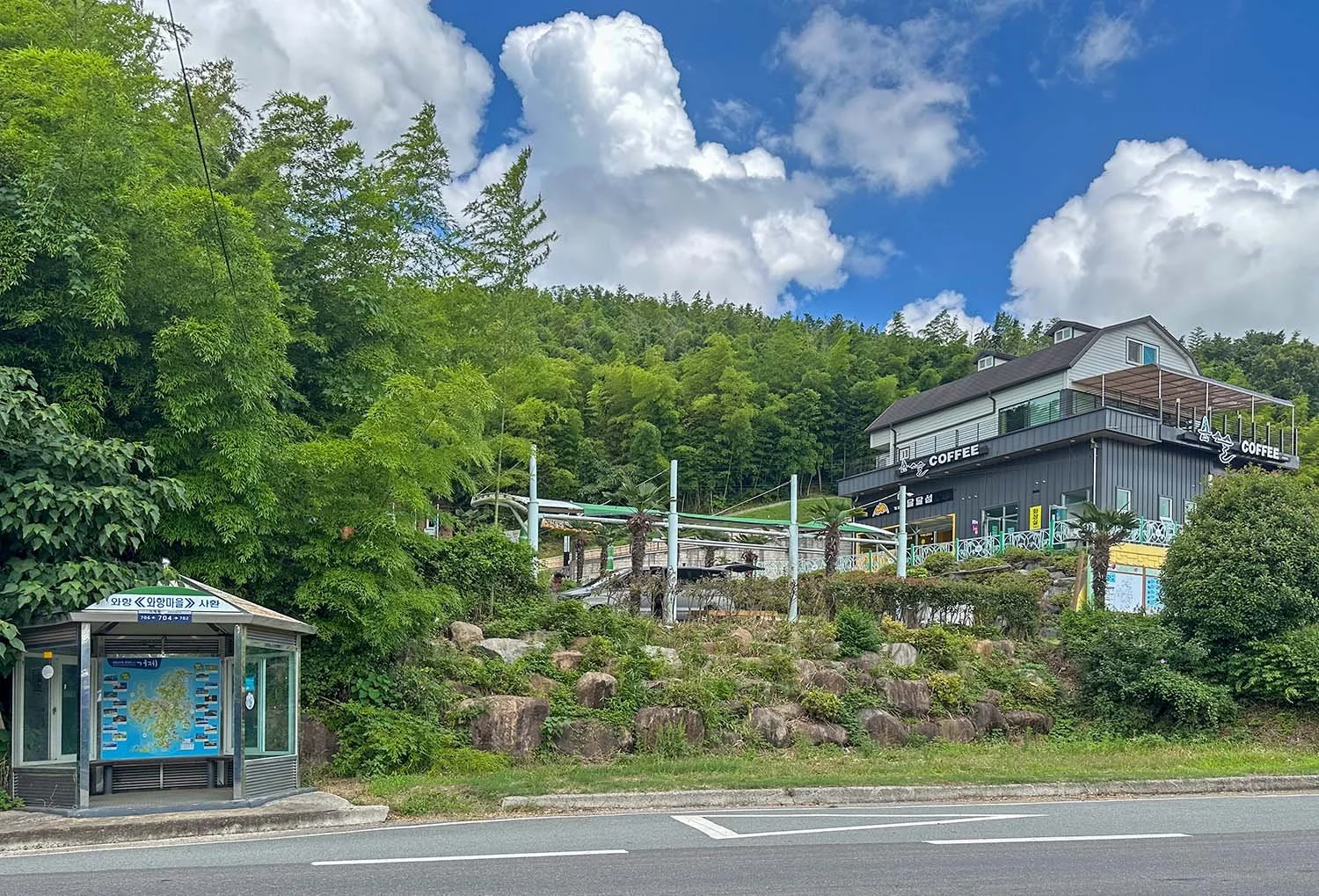
The bus stop outside the bamboo park entrance.
The bamboo forest park is served by buses 30, 31, 32, 33 and 35 and is a 15-20 mins ride from the Gohyeon bus terminal. If coming from Okpo you can take a 10, 11, 22 or 23 bus to the Yeoncho Three Way Intersection and change there, rather than going all the way into Gohyeon.
The bus stop is right outside the entrance to the bamboo forest, and on Naver Maps the stop is called Wahang Village.
Yuho Observation Platform
The Geoga Bridge which connects Goeje to the mainland near Busan (via two cable-stayed bridges, an island tunnel and a 3.7km long undersea tunnel) is an impressive feat of engineering. It was opened in 2010 and made access from Busan much easier – cutting a 3-4 hours’ road journey via Tongyeong down to less than an hour.
The best place to view the bridge is from the Yuho observation platform on the hill on the Goeje side of the bridge, just south of where the main highway emerges from a land tunnel onto the bridge.
Unfortunately, it is not easy to reach by public transport because even though many of the 30 series buses pass it (you’ll need to check Naver Maps for the best one to take) there is no bus stop at the observation platform.
Naver Maps will give you a route getting off the bus at Hayu on the north side of the bridge from which it is a steep one-kilometre uphill walk along the main road to the observation platform. However, it is better to get off at Nongso on the western side of the hill. The walk from the Nongso bus stop is a few metres longer but it’s a less steep incline.
Nighttime view of the Geoga Bridge from the observation platform.
The view from the observation platform is even more spectacular at night when the bridge is bathed in changing coloured lights, but it is risky to walk up the road to the platform after dark as there is no sidewalk and only limited street lighting. Whilst there is hardly any traffic on that road at night, walking it should only be attempted if you have good torches.
Maemi Castle (aka Maemiseong Fortress)
This is not a real castle or fortress, but it’s a nice stop on the coast between the Yuho Observatory and Okpo. It is a coastal fortification near the Sibang ferry port that was built over a period of 18 years from 2003 to 2021 by a farmer to protect his cliff-top land after part of it got washed away in a typhoon.
It attracts visitors because there are many restaurants and cafés with pleasant views across the bay to Isu Island and distant views of the Geoga Bridge on fine days.
Our favourite was Café Sibang-ri because aside from cakes and pastries, they have a range of bagels with savoury fillings that make an excellent light lunch. The laneway down to Maemi Castle has several places selling Korean snacks and street food if you are not into bagels.
There are two bus stops in Sibang. One at the entrance to the laneway down to Maemi Castle and one opposite the Café Sibang-ri. Between these two stops there are many airconditioned coffee shops (some with outdoor seating on terraces for when it is not too hot or cold) from which you can enjoy the bay views.
The new coffee and dessert shop above Maemi Castle.
When we were there, an architecturally unusual coffee shop had just opened on the cliff above Maemi Castle. If you want to check that out, you don’t have to walk all the way down to the beach and back up the steps to the castle.
You’ll see a pathway off to the left that goes directly to the coffee shop about halfway down the laneway from the bus stop to the beach.
If you are heading south towards Okpo, or back to Gohyeon, you can also catch a 2000 express bus from the bus stop opposite Café Sibang-ri which will get you to your destination faster than the 32 or 33 local buses.
The express bus passes through Sibang every 30 minutes, whereas the local buses are less frequent.
Yangjam Sculpture Park
Most Goeje tourist maps and brochures include the Yangjam Sculpture Park as one of the island’s ‘must visit’ places, but unless you have a special interest in park sculptures, this is one you might want to leave off your itinerary.
It’s a large park on the ridge of a hill overlooking Neungpo, and there are pleasant coastal views from the top to both the northwest and southeast, but we found it underwhelming.
You can walk south from the sculpture park along a concreted pathway to the Yangjam Rose Park, but when we were there in July there were no rose bushes to be seen anywhere – only a few beds of zinnia.
The Yangjam Sculpture Park overlooking Neungpo port.
Alternatively, you can walk north to the Yangjam Lighthouse, but that’s a 5km round trip from the sculpture park. Again, there are some nice coastal views from along that path, but there are plenty of other coastal walks with similar views all around Goeje.
There’s nothing else to see around Neungpo which has a somewhat rundown feel to the area.
If you do want to visit the Yangjam Sculpture Park, it is easy to reach on a number 10 or 11 bus, both of which terminate in Neungpo.
Get off at the second last stop, and then walk back up the hill a few metres, and you will see a wide pathway of coloured stamped concrete going up the hill. It’s a fairly steep walk but only about 500 metres long. There is no entrance fee.
Gujora & Wahyeon Beaches
There are many beaches around Goeje – both sand and pebble. Gujora Beach is the longest and most popular yellow sand beach. At all of Goeje’s main beaches, there are opportunities for both swimming and water sports, and in the summer months there are lifeguards on duty.
You can hire picnic tables and umbrellas that are already set up on the beach if you want to bring your own food or buy take-out and eat whilst enjoying the ocean views.
There are about half a dozen Korean seafood restaurants along Gujora Beach and a western restaurant called The Bay up on the main highway above the beach car park. There’s also a lovely coffee and cake shop called Oedo Nursery overlooking the beach that is in a large greenhouse-style structure.
Looking west along Gujora Beach on a summer’s day.
Wahyeon Beach is a smaller sand beach about a kilometre or so to the east of Gujora Beach. Unfortunately, you can’t walk to Wahyeon from Gujora without going back up the hill onto the main highway because there are steep cliffs between the two beaches.
There are more coffee shops and western eating options at Wahyeon than at Gujora.
Gujora Beach is easy to reach as the 22, 23 and 67 buses all stop within easy walking distance. Wahyeon Beach is a little harder as only the 60 bus stops right at the beach and that only runs a couple of times a day.
However, the 22, 23 and 67 buses stop on the main highway above the road down to the beach which involves a steep walk of 200 metres or so.
Oeda Botania
Just a few minutes’ walk from Gujora Beach is the Gujora Cruise Ship Terminal from which you can take a ferry to Oeda Island – the location of the largest of Geoje’s two botanic gardens. Oeda Botania is a collection of manicured gardens with sea views on a rocky island about 20 mins out from Gujora.
We went in early August and were somewhat disappointed because there was not a lot of colour in the gardens because of the summer heat. Spring is definitely the best time to visit Oedo Island.
Nevertheless, we enjoyed the visit and took a cruise option that included a circumnavigation of the Haegeumgang Islets at the eastern tip of the Hallyeohaesang National Park on the way to Oedo Island.
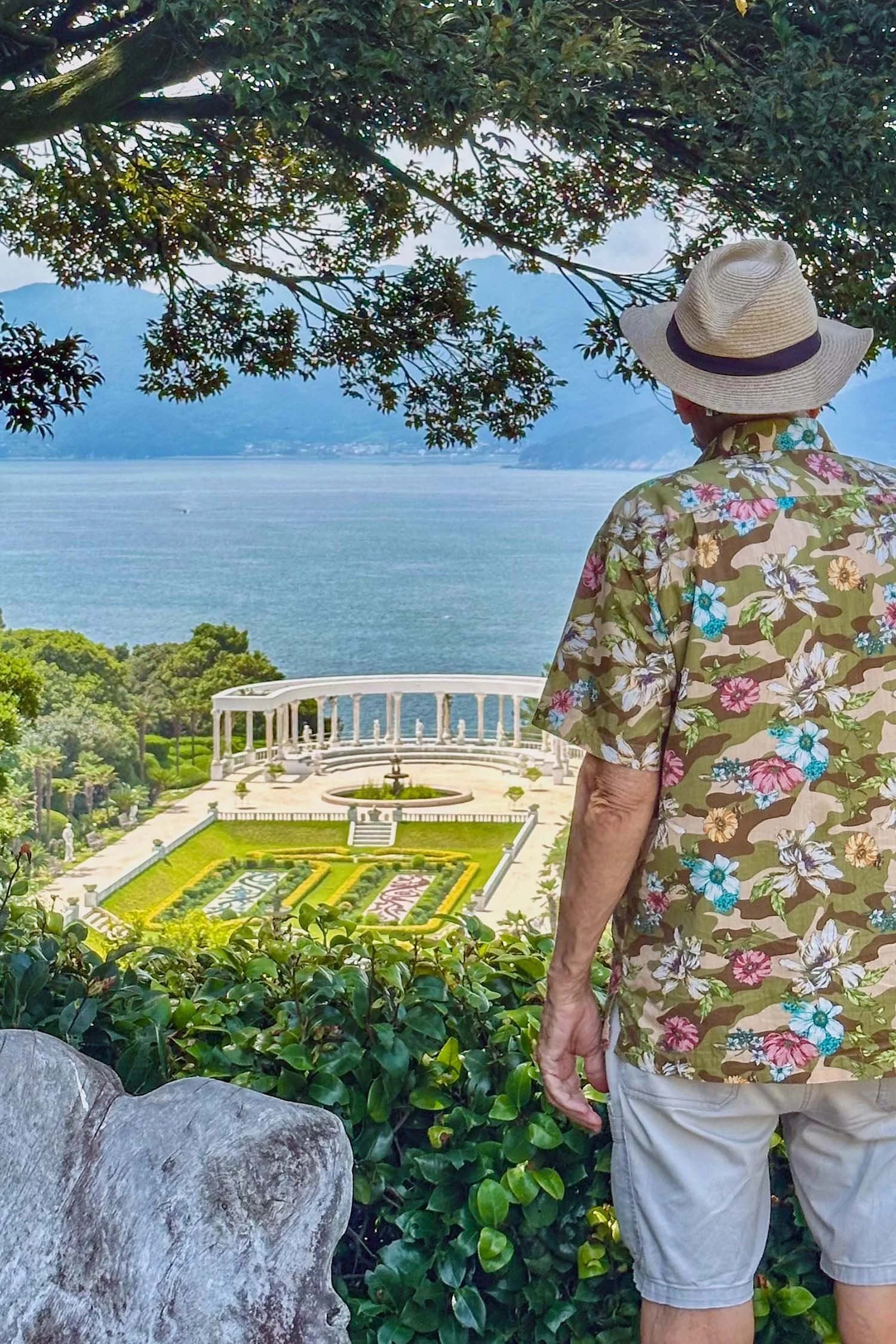
The botanic gardens on Oedo Island.
Be aware that some of the pathways on Oedo are quite steep and to see all of the gardens you need to follow the pathway right to the top of the hill (where there is a small café with refreshments, but no real coffee or proper meals) so may not suit older travellers who are not reasonably fit.
Bring water with you because it’s expensive on Oedo.
There are island cruises and ferries to Oedo that operate from many of the harbours down the east coast of Goeje, but Gujora harbour is the closest and the cruises from there have the best reviews. Prices range from 24,000 won for a return ferry trip direct to Oedo to around 35,000 won for a short cruise around the islets that includes a little under two hours at Oedo Botania.
The 22 and 23 buses from Gohyeon and Okpo stop right outside the cruise terminal, whilst the 67 bus stops on the main highway above the port.
Hakdong Black Pebble Beach
Goeje’s longest and most popular pebble beach is called the Hakdong Black Pearl Pebble Beach on the tourist maps, but we couldn’t work out how the word ‘pearl’ got into the name because the pebbles are not round – they are large, flattened oval-shaped.
Sun umbrellas for hire on the Hakdong pebble beach.
There are more eating places here than at Gujora and Wahyeon beaches, and we made a special trip down to Hakdong to check out the Jazz Club which has a renowned southern Italian restaurant attached to it and for which we had read good reviews on Naver Maps.
However, we were disappointed as we were informed that there was no live jazz being performed currently (despite it being the middle of Korea’s summer holidays) and we discovered that the restaurant menu was not as extensive as it used to be.
There is a small media art gallery above the restaurant but it’s not something that would warrant a special trip.
The 55 bus from Gohyeon and the 67 bus from Neungpo stop at Hakdong Beach but both buses only operate every two hours. So it’s important to keep an eye on departure times to avoid long waits. From Okpo you can take a 22 or 23 southbound bus and change to a 67 at the Goeje Arts Centre in Jangseungpo.
Windy Hill
Further south on the Haegeumgang Peninsula is a spot known as Windy Hill. It attracts local tourists because the Dutch-style windmill located on the hill above the Dojangpo fishing village has been featured in several Korean TV dramas. There is a coastal lookout near the windmill that has pleasant views back towards Hakdong Beach and across to Oedo Botania.
The iconic windmill at Windy Hill on an overcast day.
On the southern side of the peninsula there is another lookout overlooking a rocky outcrop known as Sinseondae Cliff from which there are scenic views of the more rugged coastline along that side of the peninsula.
Both lookouts are within easy walking distance of the Windy Hill bus stop but there are quite a few steps to negotiate.
If you don’t feel like tackling the steps to the lookouts, you can instead enjoy a panoramic view of Windy Hill and the Dojangpo harbour from the three-storey Café Two Moon coffee shop near the bus stop and then cross the road to the Haegeumgang Theme Museum which houses displays of memorabilia from the 1950s to 1980s – a period in Korean history that the museum describes as an “era of violent change.”
The displays include street scenes, shopfronts and a school classroom. They are quite well done.
Above the museum there is the Yukyung Art Museum with four fairly small galleries and an exhibition room. There was an interesting range of paintings on display from both local and overseas artists, but when we visited one of the rooms was being redecorated and the exhibition room was not open, so we didn’t feel that we got our money’s worth (the entry fee was 6,000 won) – especially as the rooftop terrace was closed (which the museum’s brochure promotes as a spot from which you can enjoy “a magnificent view of Sinseondae Cliff”).
Windy Hill is served only by the 55 bus from Gohyeon which operates six times a day with roughly two hours between departures.
Geoje Jungle Dome
The only tourist attraction worth visiting in the western region of the island is the Geoje Jungle Dome which is part of the Geoje Botanic Garden. This botanic garden is much smaller than Oedo Botania and there is not much to see in the outdoor sections yet because the gardens only opened in 2020.
The geodesic Geoje Jungle Dome and waterlily pond.
However, the jungle dome is well worth a visit because in the six years since it opened, it has developed into an impressive climate-controlled display of around 7,000 tropical plants in what is Korea’s largest domed greenhouse. There is an artificial waterfall, a skywalk and around 300 different varieties of tropical plants including palms and a baobab tree.
It’s about 4,500 sq m in area and nearly 7,500 triangular panes of glass were used in its geodesic construction. That makes it a little over half the size of the Cloud Forest Dome in Singapore’s Gardens by the Bay but the standard of maintenance of the plants in the Geoje jungle dome is on a par with Singapore and the entrance fee is very much cheaper.
Entry tickets to the Geoje jungle dome are 5,000 won (compared to Singapore’s Cloud Forest Dome entry fee which is the equivalent of 30,000 won). Only the 50-1 and 71 buses stop at the Geoje Botanic Garden, and they run on fairly infrequent schedules.
Alternatively, you can take any 50 series bus or a 67-1 to the big road junction about 750 metres east of the botanic garden and walk from there. The bus stop there is called Good News Hospital on Naver Maps. Note that the jungle dome is closed on Mondays.
Day trips from Geoje Island
If you are staying on Geoje Island for more than a week, you might want to consider making day trips to one of the neighbouring cities. The closest is Tongyeong which is only a 30 mins ride on an intercity express bus from the Gohyeon bus terminal. Tongyeong is a clean and attractive modern city built around picturesque, forested hills and rocky coves to the west of Goeje Island.
Colourful art murals at Dongpirang Village in Tongyeong.
Tongyeong has a large traditional Korean market at Jungang-dong which is interesting to stroll through. Close by, and within easy walking distance, is Dongpirang Village which is worth visiting to see the many art murals on the walls of the houses – a sort of mini-version of Busan’s more well known Gamcheon Culture Village but far less touristy.
Getting to Geoje Island
The easiest way to reach Geoje Island is to fly into Busan and take an airport bus from Gimhae Airport. The bus takes a little over an hour. There are frequent departures to the Gohyeon bus terminal and three departures a day direct to Okpo.
If arriving in South Korea at Incheon Airport, there are three options. The first and fastest is to take an internal flight to Busan and then the airport bus from there.
The second option – and the one we took – is to take an airport bus to Suseo station on the outskirts of Seoul (one hour) and then the SRT (Super Rapid Train) to Busan (a little over two hours), transfer to the Busan Seobu Bus Terminal at Sasang via the metro (45 mins) and then take an intercity bus to Gohyeon or Okpo from there (one hour).
Note that the SRT is nearly always booked out in advance at weekends, so if choosing the second option and arriving on a weekend, you will need to buy tickets online in advance.
The third option is to take an airport bus from Incheon Airport to Gohyeon. That’s the cheapest option but the journey takes about five and a half hours.
All images © David Astley except Geoga Bridge © Mike Turner