A Relaxing Half-day Cycling Tour around Chiang Mai
I don't like cycling very much, yet somehow, I keep ending up on cycling tours.
This may come as a surprise to anyone familiar with Dutch culture, but after years of cycling 32 kilometres a day to and from school, I considered my cycling obligations fulfilled for life a long time ago.
My husband Marc, however, sees cycling as both a hobby and a convenient way to stay fit. As a result, our holidays tend to involve rather more bicycles than I would choose of my own accord.
This is how, after already cycling through Bangkok and across Koh Samet, we now found ourselves setting out for a cycling trip through the Lanna countryside outside Chiang Mai.
It started with a hotel pick-up. Not by the van-and-driver combination we’d come to expect, but by songthaew-and-driver. This was an interesting experience given that at least half of the journey out of town was by motorway. I felt clinging to the edges of the songthaew in order not to get spilled onto the tarmac was an interesting start to what was already shaping up to be an adventurous day.
Songthaews on a highway heading out of Chiang Mai.
The surprises didn't stop there.
We arrived at a small cycling resort in the Thai countryside run by a fellow Dutchman. Among the bikes sat a Bierfiets, a vehicle that combines cycling and beer in a way that seems questionable even before the first round is served. Fortunately, that wasn't our mode of transport for the day.
Instead, we were handed ordinary bicycles and pointed towards the countryside. Perhaps because the owner was Dutch, these were decent bikes. This was a welcome change from previous too-small bicycles with unreliable brakes that had left me looking – and feeling – like a clown on a tricycle.
Helmets were available but politely declined. We were supplied with a litre of water each and sent on our way. One guide cycled ahead, another behind, while our small group of six occupied the middle like children on a school trip. It was, guide number one informed us, good that we were early because it was still “nice and cool”. It was 34 degrees at the time.
Our first real challenge came almost immediately: after about ten minutes of quiet little lanes, we were to cross a four-lane road connecting Chiang Mai to destinations unknown. The guide in front waved us through at an opportune moment, the guide at the back checked nobody was about to make a poor decision and moments later we were safely on the other side.
Next, we made a quick stop at a rice field that didn't look all that different from the fields I routinely drive past on my way to work, except without the cows. It was April and apparently not the prime season for flooded rice fields with farmers working in them.
Our stop was at a rice field where new panicles of rice were appearing.
So were they green? Yes. Were they picturesque? Absolutely. Were they anything like the mental image most people have when they think of rice fields? Not really. On the bright side, we'd missed the seasonal burning of the harvested fields. This meant we could breathe, which seemed a worthwhile trade-off.
Our next stop could never be mistaken for anything you'd find in the Dutch countryside. It was a small family-run workshop that built the elaborate funeral houses, known as Prasat Sop, used in traditional Lanna cremation ceremonies. Looking rather like ornate miniature temples, they serve as a symbolic home for the deceased and are burned during the funeral.
What surprised me most was seeing them in various stages of completion. Some were little more than bamboo skeletons, while others were covered in intricate decorative details and looked ready for a royal procession.
The young women working on the final decorations showed us the coloured, silver and gold paper they carefully carved by hand and how they attached it to the wooden structures with remarkable precision. I was fascinated by the tradition and touched by the amount of care that goes into giving someone a final send-off.
Lanna funerary structures under construction in the workshop.
After that, it was back to fresh bottles of water and more cycling.
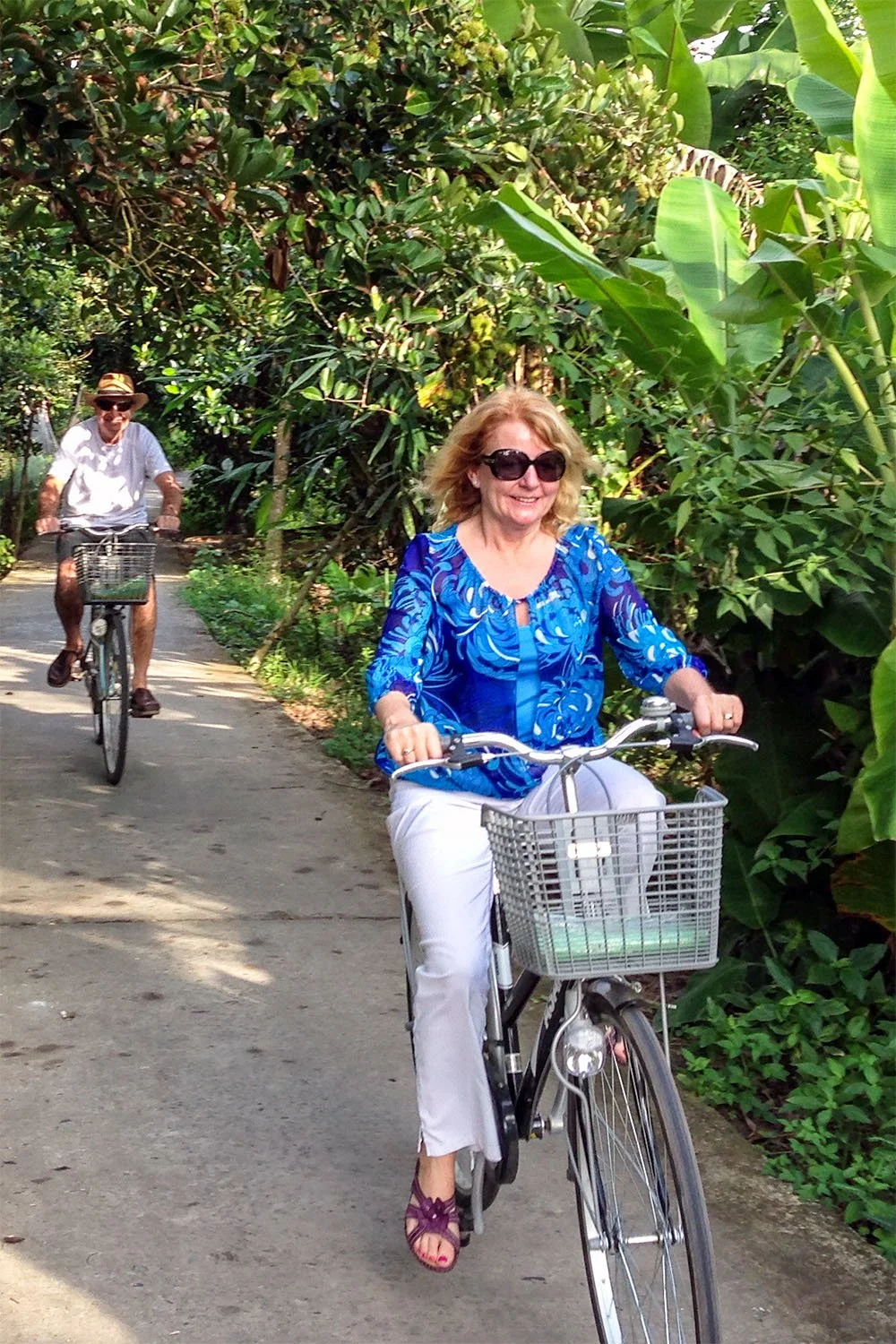
The cycling itself was quite lovely. We rode along quiet roads, past rice fields and through traditional villages, with trees shielding us from the worst of the sun and a constant supply of water preventing dehydration.
The landscape was mostly flat, so no struggling up hills. The roads were mostly tarmac or concrete, so no trudging through loose sand and gravel while trying not to get stuck and fall into a ditch. This was a route designed by someone who clearly knew what they were doing.
Nevertheless, after the third stop, a local wood-carving workshop with a fridge full of soft drinks and an endless supply of tasty bananas, the inevitable happened: Marc got a puncture.
Checking out the wood carvings while Marc’s puncture is repaired.
This was where the guide bringing up the rear came into his own. He rushed forward, repair kit in hand, gently but firmly moved Marc aside and turned the bike upside down.
The puncture was fixed before the rest of us had fully registered there had been a problem. Personally, I wouldn't have minded if he had taken a little longer. By then the heat and humidity were beginning to get to me. More about that later.
Our next and final stop on the tour was the inevitable village market. Unlike everything we'd seen in Bangkok, Chiang Mai and pretty much everywhere else in Thailand, this was not a tourist attraction. In fact, we were the only tourists there.
Thai merchants were selling all kinds of produce. There was a fish seller and a smell that left no doubt about what he was selling. There were roots and peppers and garlic in every imaginable shape and size, and an old lady who smiled at me and nodded yes when I gestured to ask whether I could take her picture. Always ask, and give people the chance to say no.
Elderly vegetable sellers waiting for customers in the market.
I bought some passion fruit and, for reasons that now escape me, even more bananas. After a few polite bows and smiles, I left feeling that I had briefly stepped into everyday life rather than a visitor attraction.
After this, there was nothing left but the stretch back to the resort. This was where I really started to feel the heat and humidity. Possibly because I was still recovering from double pneumonia a few months earlier. Possibly because I stubbornly refused to ask the guide to slow down. Whatever the reason: I was struggling during the final few miles.
This was also where my all-too-familiar doom-spiralling kicked in. What if I have to stop? What if I don't make it? What if everyone thinks I shouldn't have been on this tour?
Luckily, Marc suddenly spotted something in a field next to the road. Whatever it was turned out to be nothing particularly noteworthy, but it was interesting enough for the entire group to stop and have a look. The pause gave me a chance to catch up and catch my breath. While we were standing there, Marc asked the guide how much further we had to go.
Shady stops helped a lot in the heat and humidity.
It was a mile. I could do a mile. I don't think Marc's sudden interest in that field was entirely a coincidence, but I didn't ask.
Back at the resort, we parked our bikes next to the Bierfiets and thanked the guides for showing us around the countryside and for not losing us along the way.
Then it was time for the final reward: lunch. We were served a generous platter of fried rice, chicken, fresh fruit, vegetables, more water and, somewhat surprisingly given that it was barely noon, a Thai beer. After several hours of cycling in 34-degree ‘cool’ weather, I felt I had earned it. Eventually, we were herded back onto the songthaew and returned to our very comfortable De Charme Hotel Chiang Mai right inside the old town.
As it turned out, this was exactly the kind of cycling tour I enjoy: one where cycling is really just an excuse to see interesting things.
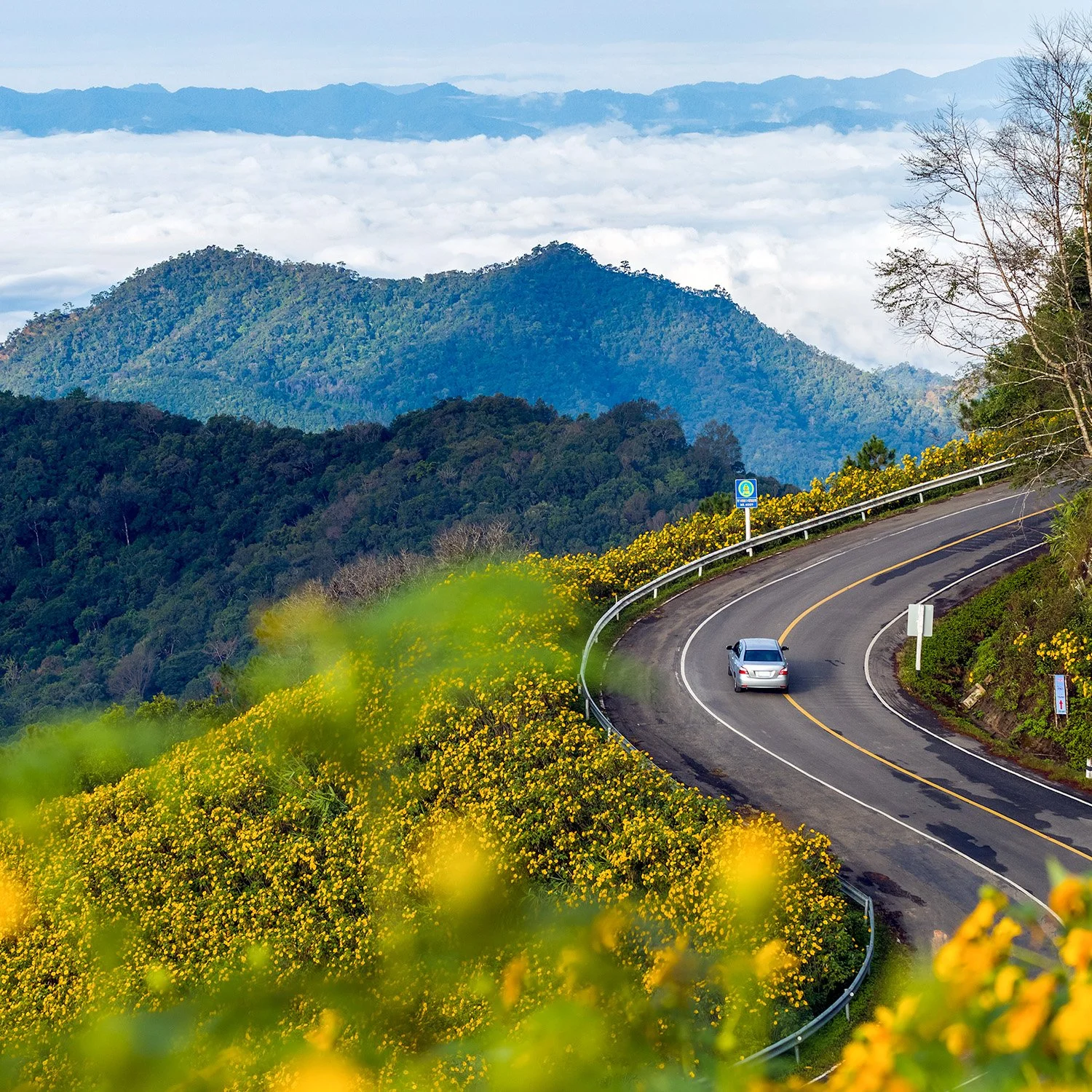
The landscape was mostly flat so made for easy cycling.
The route was flat; the pace was mostly relaxed and there were plenty of stops along the way. More importantly, it took us through parts of the Chiang Mai countryside we would never have discovered on our own. From funeral-house workshops and village markets to rice fields and woodcarvers, the day offered a glimpse into everyday life beyond the city.
This wasn't our first cycling adventure in Thailand. We'd previously cycled through Bangkok, which turned out to be far less daunting than it sounds, but the Lanna countryside was undoubtedly the more relaxed experience.
For those interested in doing the same tour, we joined the Into the Lanna Countryside tour by the company Chiang Mai Bicycle Tours. It’s a roughly 4-hour cycling tour covering around 20 kilometers. It includes bicycles, guides, water, snacks and lunch. I would describe it as easy rather than strenuous, although the heat and humidity can make it feel more challenging than the route itself.
Would I do it again? Yes. Which, coming from someone who believes she completed her lifetime cycling obligations during secondary school, is probably the strongest recommendation I can give.
Header image: © Davd Astley
Songthaews image: © Ilya Plekhanov
All other images: © Alexandra Te Riele