Gaziantep at a Gentle Pace: A Slow Food Walk Through the Old Town
Some cities ask you to hurry. Gaziantep, in southeastern Türkiye, rewards the opposite. Its old town is compact, its best food is served early in the day, and almost every stop on a good walk comes with a chair, a glass of tea and someone happy to talk.
I live in Gaziantep, and this is the route I suggest to friends who want to taste the city without rushing: a few short stretches on foot, long pauses, and plenty to eat.
The pleasant surprise for a slow traveller is that much of this can be found within a small area around the old bazaars.
Gaziantep has been part of the UNESCO Creative Cities Network for Gastronomy since 2015. The title is not about one famous dish. It is about a daily food culture that is still very much alive in homes, small workshops and family-run shops.
Gaziantep's cuisine combines Anatolian traditions, Ottoman legacies, and regional Middle Eastern influences. The city has over 100 geographic indicators protecting its unique local flavours—an astonishing achievement that hasn’t been surpassed by any other city in Türkiye.
In Gaziantep, the day begins with soup. Beyran is made with lamb, rice, garlic and red pepper, and arrives at the table steaming in a copper bowl, usually with thin flatbread on the side.
Beyran is a traditional breakfast dish. Image: © Kemel Cam
Locals eat it early in the morning; many beyran houses open at dawn and close before noon, when the pot is empty.
For a slow traveller, this early start has a real advantage. The streets are cool and quiet, the light is soft, and you can sit as long as you like over your bowl and a glass of black tea.
If you prefer something milder, ask for a smaller portion and less pepper; nobody will mind.
From the beyran houses it is a short walk to the Coppersmiths’ Bazaar. Here craftsmen still shape trays, bowls and coffee pots by hand, and the sound of small hammers fills the narrow lanes.
A craftsman at work in the Coppersmiths’ Bazaar. Image: Erhanaydin6428, CC BY-SA 4.0
The bazaar is best enjoyed slowly: stop at a doorway, watch a pattern being tapped into a tray, and move on when you are ready. Many shops have a stool by the door, and it is perfectly normal to sit for a minute while you look.
A practical note: the old streets are paved with stone and can be uneven in places, and some lanes climb gently towards the citadel. Comfortable shoes with a good grip make a big difference.
If you would rather not walk uphill, the citadel can be admired from below, and taxis are easy to find on the main streets around the old town.
A few steps away stands the Zincirli Bedesten, an eighteenth-century covered market whose stone arches now shelter butchers, spice sellers and small shops.
The Zincirli Bedesten bazaar with its artisanal products. Image: Emin Başar Özdemir, CC BY 3.0
Nearby is the historic Tahmis coffeehouse, dating from the seventeenth century, one of the most pleasant places in town to rest.
This is the place to try menengiç coffee. It is not made from coffee beans at all, but from the roasted fruit of the wild pistachio tree, ground and cooked with milk.
It is gentle, slightly nutty and caffeine-light, which makes it a good choice in the afternoon. People in this region drank it long before coffee beans arrived.
You will see pistachios everywhere in Gaziantep: in the shell and roasted, shelled for pastry makers, coarsely ground for baklava or finely ground for katmer, a thin, flaky pastry filled with pistachio and clotted cream.
Freshly harvested pistachios in Gaziantep. Image: © Mehmet Özbakır
The orchards surround the city, and the main harvest takes place between late summer and September.
There is also an early harvest in summer, when the nut is still dark green and soft. These pistachios give the local baklava its bright green colour. They are picked before they are fully ripe, so the yield is lower; colour is chosen over quantity, and you can taste the difference.
In the markets, sellers usually invite you to taste before you buy. If you want to take some home, pistachios in the shell keep longer than shelled ones and travel better. Store them somewhere cool and dry.
No walk in Gaziantep is complete without baklava. Here it is a serious craft: dough rolled out by hand until it is almost transparent, brushed with clarified butter, layered with pistachio and finished with a light syrup.
Gaziantep pistachio baklava, classic cut and ‘carrot slice’ cut. Image: © Mehmet Özbakır
Gaziantep baklava was the first Turkish product to be registered as a geographical indication in the European Union, in 2013.
Some long-established baklava houses let visitors watch the work through a glass window, which is a lovely way to spend a quarter of an hour sitting down.
There is also a local way to eat it: turn the slice upside down so the pistachio side touches your tongue first, and drink water or unsweetened tea with it rather than sweetened coffee.
Baklava is best eaten fresh, on the day it is made, and one or two pieces are usually enough.
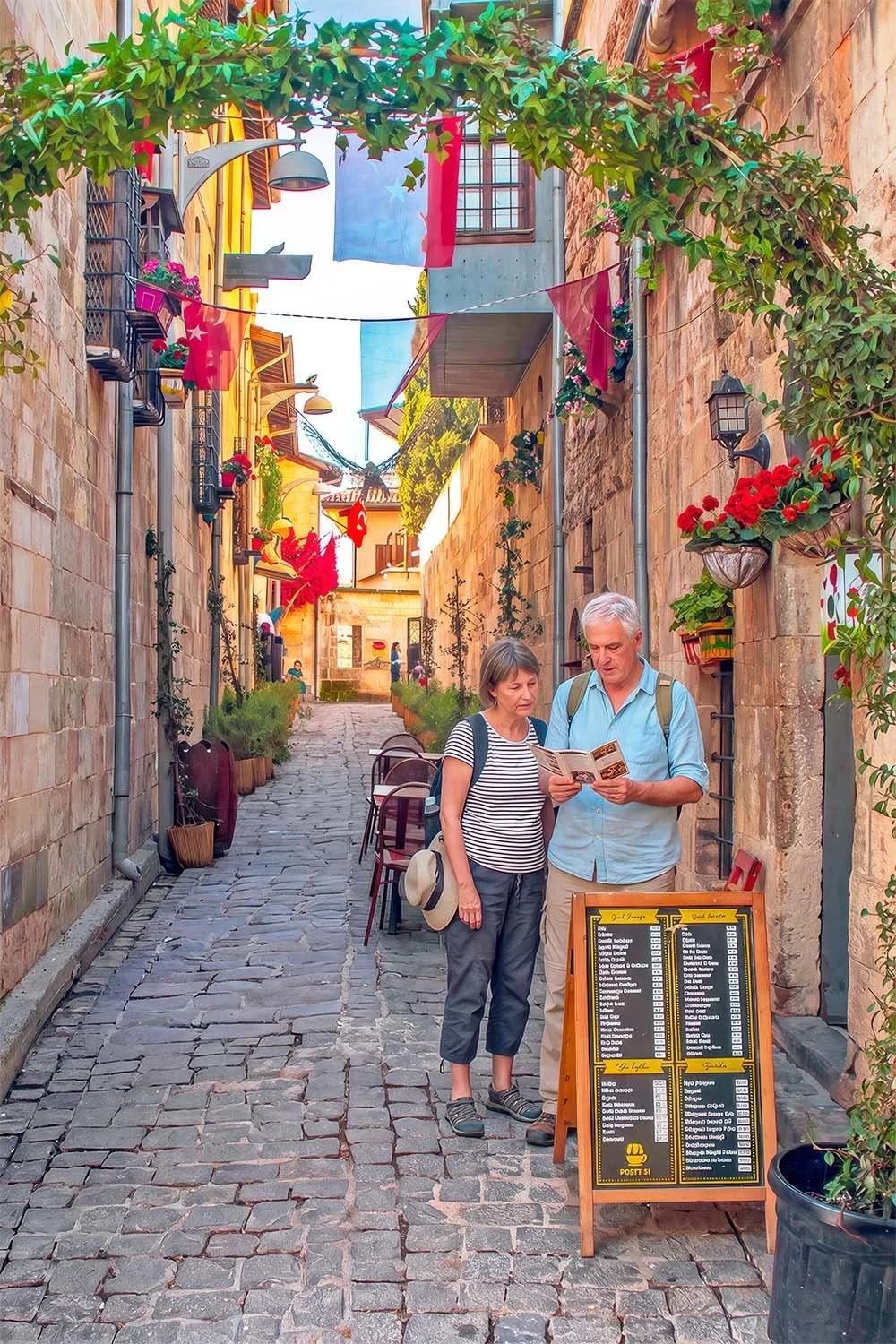
Exploring the narrow alleys of the old town. Image: © Hasan Hüsyen Turan.
Two more places suit a gentle pace. The Emine Göğüş Kitchen Museum, set in an old stone house, tells the story of local cooking from the pantry to the table and is small enough to see without tiring.
The Zeugma Mosaic Museum, one of the largest mosaic museums in the world, is a short taxi ride from the old town. It displays mosaics rescued from the Roman city of Zeugma on the Euphrates, including the famous face known as the ‘Gypsy Girl’.
The galleries are spacious and indoors, which makes the museum a good choice on a hot afternoon.
Practical notes for a relaxed visit
Getting there: Gaziantep airport is about an hour and a half by plane from Istanbul.
How long: two or three days are enough for the old town, a baklava house, the mosaic museum and an unhurried meal or two.
When to go: late September to early October, or April to May, when the heat is gentler. Summer afternoons can be very hot; plan your walking for the morning and the earlyevening.
Pacing: the best food in Gaziantep is served early. Have beyran before nine, rest at midday, and save the baklava for the afternoon.
Food sensitivities: many dishes use lamb, butter, nuts and red pepper. Ask for less spice if needed. If you have a nut allergy, be very careful, because pistachio appears in a great many sweets.
Taking food home: buy baklava on the day you travel and keep it cool.
My last piece of advice is simple. Ask someone in Gaziantep what they ate today. You will get a long, detailed and warm answer, and very possibly an invitation to sit down and share a glass of tea.
In this city, slowing down is not a compromise; it is how the food, and the people, are best enjoyed.
If you would like a little more background on the city before you go, you can read more about Gaziantep here.
Header image: © Hakan Şentürk