Is Doha a Worthwhile Stopover Destination?
I once said in one of my early travel blogs that Doha was the most boring capital city in Asia after Bandar Seri Begawan.
That was way back in 2002 when West Bay was not much more than a big construction site and there was little to see or do in the country aside from walking along the Corniche and visiting the old Souq Waqif (before it burned down in 2003).
For the next 20 years or so, I transited through Doha many times on my way to or from Asia but never had any desire to spend any time there.
However, recently when booking a return trip from Phuket to Istanbul, I was enticed by the stopover packages offered by Qatar Airways. Two nights in a 5-star hotel including arrival and departure airport transfers for US$160.
Aside from the attractive price, the two-nights stopover enabled us to return to Phuket on a day flight rather than enduring an uncomfortable overnight flight from Doha to Phuket. The air ticket price was the same, with or without the stopover, and we would have a full day to explore Doha which had grown exponentially since I previously visited in 2002.
So, what did I think of Doha in 2025 compared to 2002?
Mind blowing would be an apt description in terms of the development that has taken place in those intervening two decades. West Bay is now a skyline of skyscrapers almost on a par with Dubai, Souq Waqif has been rebuilt, there is a world-renowned Museum of Islamic Arts, modern shopping malls, luxury hotels, and many tourist attractions that didn’t exist 20 years ago.
A section of Doha’s airport that looks much like Singapore’s Changi.
The new Hamad International Airport at Doha is one of the best in the world (albeit expensive if you want to eat or drink there) and the underground Doha Metro and above ground tramways are clean and efficient, easy to use, and provide a great way to get around the city to see the sights of Doha.
Doha is surprisingly quiet compared to Dubai, and doesn’t offer the same range of attractions, but that’s something that may appeal to many older travellers.
Away from the airport, meals and coffees are surprisingly affordable for this part of the world, and there is an excellent range of international standard eating places to choose from.
We stayed at the Millenium Plaza Hotel which was a 10 mins walk from the Al Sadd Metro station. Our deluxe room was 36 sq m with a comfortable bed and all the amenities that you’d expect in a 5-star hotel. The staff were friendly and helpful, and we soon wished we had booked a three-nights stopover instead of two.
The Doha Metro is clean and efficient with driverless trains.
From there we explored most of Doha using the Metro. We bought Gold Club cards for 130 riyals (100 for the card and 30 for the day pass) which translates to about $35 which gave us unlimited travel on the three Metro lines for a day, as well as the trams up towards Lusail, and the MetroLink buses (which we didn’t end up using).
That was expensive compared to the standard cards which are only 16 riyals (10 for the card and 6 for the day pass) but we bought the Gold Club cards (which entitle you to travel in the Gold Club carriage) thinking the trains would be crowded. But they were not crowded at all except for about an hour around the evening rush hour.
If we ever do another Doha stopover, we will just buy a standard card, but it was nice to experience the Gold Club carriages for a day.
They are undoubtedly the most luxurious Metro carriages anywhere in the world, and for every one of our trips except one, we had the carriage to ourselves.
The luxurious Gold Club carriage on a Doha Metro train.
The Doha Metro is a state-of-the-art transport system with clean driverless trains that arrive every six minutes. The stations are spacious and clearly signed in both English and Arabic.
In most stations there are helpful Gold Club concierges that can offer advice on the best station to disembark from to visit particular attractions.
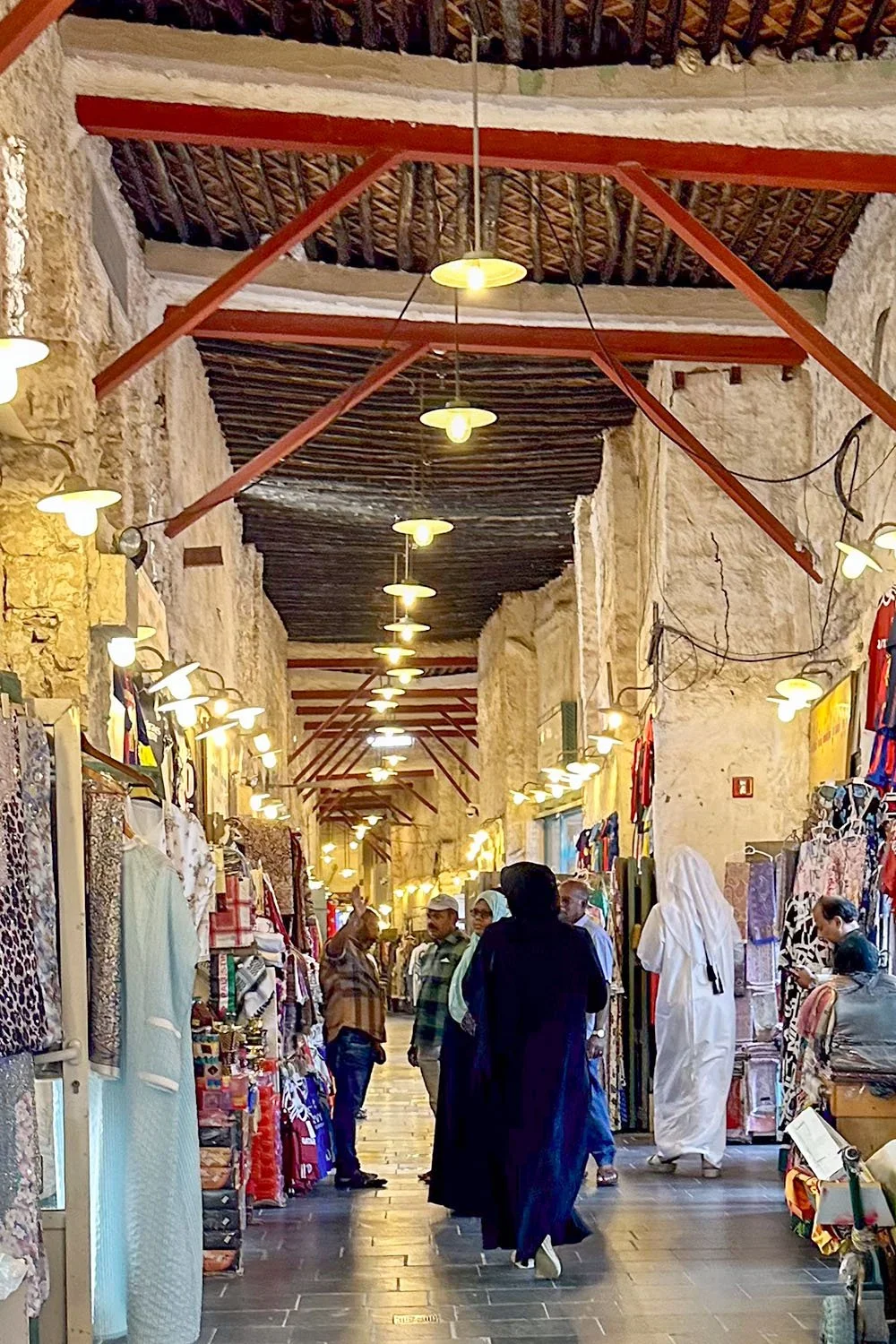
Our first stop was the new Souq Waqif which was completed in 2006. It’s now more than just a traditional market – it has boutique hotels, restaurants, coffee shops and wide boulevards as well as clean alleyways with shops and stalls selling dates, spices, gold, jewellery, Qatari garments and souvenirs.
One section away from the main tourist area is devoted to shops selling falcons. It’s an interesting (albeit somewhat smelly) part of the souq where you can see dozens of hooded birds tethered to perches awaiting inspection by potential buyers, and shelves full of falconry accessories.
The new Souk Waqif is uncrowded and easy to navigate.
One friendly shopkeeper who didn’t have any customers invited us into his shop to let us look around and take some photographs of his birds.
We thought that was a nice gesture, especially as he must have known we wouldn’t be buying a falcon as a souvenir!
On the outside of the souq beyond the falconry section is a large camel pen with many tethered camels (even more smelly!) that belong to the Qatari Royal Guard. There is a twice-daily parade of the camels at 8am and 4pm.
Whilst the camel pen provides an opportunity to take close-up photos of these majestic ‘ships of the desert’, many animal rights activists complain that leaving the camels with their front legs tied for most of the day and night is a cruel practice as it limits their ability to stretch and roll around on the sand.
Camels of the Qatari Royal Guard near Souk Waqif.
We walked back to the Metro station using a different route through the souq to head to our next stop – the National Museum of Qatar. This is an interesting museum in an architecturally stunning building, but it was a bit of a letdown for us as we had really wanted to visit the Museum of Islamic Arts.
However, upon our arrival in Qatar we discovered it was closed on Wednesdays – another reason why we wished we had booked a three-night stopover instead of two.
After the museum visit, we headed into Msheireb for lunch. Msheireb is Doha’s modern downtown area, and we were amazed at how clean and quiet it was. We enjoyed a superb lunch in a classy café where we were the only customers.
After lunch we walked around Msheireb which felt almost like a ghost town. Perhaps everyone was taking siestas in the midday heat.
In the afternoon we headed up to Legtaifiya Beach on the north side of the city. The beach was a letdown but the view across to The Pearl Island was impressive. The Pearl Island is an upmarket urban development on reclaimed land with condos, marinas, and dozens of world-class restaurants and cafes.
The view across to The Pearl Island from Legtaifiya Beach.
After that we decided to head further north on one of the trams, away from the tourist areas, to see how the locals live.
We travelled five stops on the Orange Line and got off at Tarfat South. There was a shopping mall called Place Vendôme right next to the tram station, so we headed inside to check it out.
It was not the ‘local mall’ we were looking for. Firstly, it was way more opulent than what we expected. Luxury branded goods, perfume and jewellery shops, high-end fashion stores, expensive restaurants and coffee shops, and more. Nearly 600 stores on four expansive levels of marble floors and chandeliers reminiscent of a French palace.
Secondly, it was almost empty. There were a few customers walking through the wide boulevards of the mall and in some of the stores, but it had that ‘ghost town’ feeling that we’d experienced earlier in the day in Msheireb. However, it was ‘local’ in the context that the shoppers were all well-dressed Qatari citizens, and we saw no tourists there.
One of the upmarket but empty restaurants at Place Vendôme.
The mall experience did serve the purpose of demonstrating to us just how wealthy the average Qatari must be. Nowhere else in the world have we seen such a high level of retail infrastructure serving so few people.
This should have been no surprise given that Qatar has the highest GDP per capita of any country in the Middle East.
Our next stop was the Katara Cultural Village. We did this on the way back into the city so that we would arrive as it was getting dark.
We’d read that there was not much shade at Katara and it can get very hot during the day. When we arrived there, we could see why. The wide boulevards and courtyards were all paved in sandstone with little vegetation or shaded areas.
Katara is unlike other cultural villages that we’ve visited in Asia in that it’s all been built over the past 15 years. The buildings have been constructed to emulate traditional Qatari architecture but with a modern flair. It’s pleasant to walk around but feels somewhat sterile.
Traditional architecture at the Katara Cultural Village.
Nevertheless, there are some world class art galleries, event spaces and performance venues within the complex and with advance planning would be well worth visiting to attend a symphony concert, opera or festival event.
Unfortunately, on the evening we visited there was only an Arabic book fair being held in one of the exhibition halls, so there wasn’t much by way of cultural events for us to appreciate.
Our last planned stop for the evening was the viewpoint on the Al Corniche Waterfront where you can look across Doha Bay to the skyscrapers lining the West Bay shoreline. This view is impressive at night, and reminiscent of the nighttime view from Kowloon across Victoria Harbour to Hong Kong Island.
But getting to the viewpoint was a challenge. We got off the Metro at Al Bidda which is only 600 metres from the viewpoint, but between the Al Bidda station exit (which is in the middle of a park) and the viewpoint there are two major highways.
An unusual and somewhat surreal sculpture near Katara Beach.
Google Maps gave us a crazy 3km walking route which it said would take 40 minutes, but we were sure there must be a shorter way to reach the viewpoint. And there was.
We headed towards the viewpoint using a straight-line setting on the compass on my phone and managed to find a pedestrian crossing on the first highway on the northern edge of the park.
The traffic on the six-lane highway was fast-moving, and nobody was stopping at the pedestrian crossing, but fortunately there were traffic lights further up the highway which resulted in a gap in the traffic every 4-5 minutes.
We waited for one of the gaps and made our way across to the centre island and then repeated the process on the other side. We continued along the edge of more parkland until we reached the Al Corniche highway. This highway was also six-lanes but with much heavier traffic and no traffic lights.
As we were pondering how we might get across, we spotted a pedestrian and bicycle underpass a short distance away, so used that to go under the highway and out onto the promenade near the viewpoint.
The view of West Bay was stunning and well worth the effort to reach the viewpoint. Going back to the Metro station was easy because this time we knew the way.
The nighttime view across to West Bay from Al Corniche.
We hadn’t eaten dinner as we’d had a substantial lunch in Msheireb earlier in the afternoon, so when we exited from Al Sadd Metro station on our way back to our hotel, we looked for somewhere to buy a snack.
We noticed the lights of what looked like a lively restaurant district a short distance away, so we headed over there to check it out.
It turned out to be a residential area for migrant workers with Indian and Nepalese restaurants and several small Filipino supermarkets.
It was a stark contrast to where we had been earlier in the day as the buildings were old, the streets were somewhat dirty, and there wasn’t a Qatari citizen in sight. It was entirely populated with people from South Asia, the Philippines and Kenya.
They were all friendly enough and we didn’t feel uneasy, and we bought some snacks from one of the supermarkets which had an interesting range of products from the home countries of the migrant workers.
Back at our hotel, I mentioned to the Filipino receptionist where we had just been, and she told us there was a much bigger shopping area known as ‘Asian Town’ on the outskirts of Doha where the migrant workers hang out.
Qatari citizens take a stroll in the cooler evening air.
She said the workers rarely go the glitzy shopping malls in the city because they are too expensive (which would explain why Place Vendôme was so empty) and Qataris never go to Asian Town despite prices there being considerably cheaper.
The division of society in Doha is conspicuous and pronounced, but the wealthy citizens and migrant workers seem to coexist without any obvious tensions.
All up it was an interesting day. Would we do another stopover in Qatar? Definitely yes. The stopover packages are exceptional value.
But next time we will plan ahead and choose dates when there are concerts or events of interest on at Katara, and make sure the itinerary includes a day when the Museum of Islamic Arts is open.
Where Else to Stay in Doha
If you are intending to visit Doha on one of Qatar Airways’ stopover packages, then you will have a wide selection of hotels to choose from in four categories: Standard (4-star), Premium (5-star), Premium Beach and Luxury.
My advice is to book the best you can afford because you’ll be getting access to some top-class hotels at heavily discounted rates.
If you are flying through Doha on other airlines and don’t qualify for a Qatar Airways stopover package, then these four options are worth looking at:
BUDGET: Centrally located and within easy walking distance of the National Museum and Corniche, the 3-star Grand Legacy Hotel has clean and spacious rooms. It’s four years old and reviews have been somewhat mixed, but at US$40 per night it represents good value for money for the budget traveller.
MID-RANGE: Only 100m from Souq Waqif and within walking distance of Msheireb Downtown, the Al Najada Doha Hotel by Tivoli is in a great location and offers 5-star facilities at a 4-star price. Clean rooms, comfortable beds, friendly staff, and there’s a shower room available for those who may be arriving early before their check-in times.
UPMARKET: Located halfway between Souq Waqif and Msheireb Downtown, the Alwadi Hotel Doha – Mgallery Collection is another perfectly located hotel that has outstanding reviews. As well as all the usual 5-star amenities, it has soundproof walls, exceptionally comfortable beds, an outdoor pool and a rooftop bar with great views.
LUXURY: There is no shortage of hotels in Doha that will appeal to the luxury traveller, but a stay at the iconic Raffles Doha on the Lusail Marina will undoubtedly provide a memorable luxury experience. It offers unrivalled hospitality, elegantly designed interiors, and world class service from the highly professional and attentive staff.