Turkish Riviera Road Trip: Lessons Learned
Most travellers to the Turkish Riviera tend to base themselves in one or two of the major resort areas. Antalya, Alanya and Fethiye on the Mediterranean coast, and Bodrum, Kuşadası and Çeşme on the Aegean coast, are among the most well-known and popular resort destinations along the riviera, which is also known as the Turquoise Coast. However, as this was our first time in this part of Türkiyewe wanted to do a road trip to see as much of the Turkish Riviera as possible.
We had no interest in spending our time sitting on a beach or by a pool. We decided to hire a car and drive the full length of the riviera to see all of the major sights and to determine which places we liked, and maybe didn’t like, as a reference for a future trip when we might come back and base ourselves in one or two locations to explore those areas at a more leisurely pace.
A Turkish Riviera road trip is best done starting at either Antalya or Izmir and after driving the coastal route returning to the starting point along inland freeways enabling visits on the way to the Pamukkale travertine terraces and the ancient Roman city of Hierapolis if you’ve not previously visited those world-renowned tourist attractions.
Of course, if you’ve been to Pamukkale and Hierapolis, then a better option may be to find a car rental company that offers one-way hires as that would save a day’s driving on your itinerary.
The well-preserved Roman amphitheatre at Hierapolis.
We hadn’t previously visited Pamukkale and Hierapolis so we decided to start at Izmir and do the complete trip in an anticlockwise direction so that we would be driving on the ocean side of the road for the best views. That proved to be a good decision because it meant it was easier to pull off the road when we wanted to stop to take photographs (but there were a few places when driving on the right-hand side of the road was a bit scary because there were no crash barriers protecting 100m drops down cliffs to the ocean).
Our Turkish Riviera road trip itinerary
We used Google Maps to plan a one-week itinerary based on 3-4 hours driving a day. This involved two 2-night stays and three 1-night stays as follows:
2 nights at Ürkmez (on the coast 45 mins from Izmir Airport)
2 nights at Bodrum
1 night at Fethiye
1 night at Ulupinar
1 night at Pamukkale (returning to Izmir Airport on the evening of the last day)
As we only had a week, we were uncertain as to whether we would have time to go all the way to Alanya (130km east of Antalya) but we weren’t too concerned about that because everything we had read about Alanya suggested it was not much different to Antalya. As it turned out, Antalya was one of the places we didn’t like on the trip, and we probably would have reached the same conclusion about Alanya (more about that in the Day 6 summary).
We listed on our itinerary the places where we wanted to stop or to which we wanted to do side-trips each day. As we were not familiar with the Turkish Riviera, we started researching that about a month before we left. There were a large number of places recommended to visit on various travel sites.
The Turkish Riviera is one of Asia’s most popular tourist destinations.
Wikipedia, for example, lists over 70 “notable places” on the Turkish Riviera. There was no way we could visit 10 places a day and drive 3-4 hours, so we had to reduce that to a manageable number. We started researching each place on Google but discovered that many of them had similar descriptions because those descriptions were AI generated.
“Antalya is a mesmerising destination known for its stunning beaches, ancient ruins, and vibrant city life. Antalya offers a unique blend of history, nature, and modern amenities. Must-see attractions, culinary delights, and cultural experiences make Antalya an unforgettable destination. Whether you’re an adventure seeker, a history buff, or a beach lover, Antalya has something for everyone,” was a typical AI description.
So many places were described as ‘mesmerising’ or ‘must-see’ that we had to start drilling down through search results until we could find travel blogs that were written by humans and had objective descriptions on which we could base our decisions on where to visit.
That was not an easy task because it was clear from even many of the human-written blogs that they were only repeating what had been published on sponsored travel blogs or government tourism sites. A couple of articles by Jillian Huntley on xyzAsia proved helpful. One on Pamukkale and another on her overland trip from Istanbul to Sarigerme on the Turkish Riviera. This article by Louise Pieterse has some useful information about Türkiye road tripping in general.
Pamukkale is one of Türkiye’s most visited tourist attractions.
After several weeks of spending every evening engaged in web research on the Turkish Riviera, we eventually managed to whittle down that list of 70 notable places to about half that number.
We flew down from Istanbul on a late afternoon flight in early October hoping to arrive in Ürkmez before dark as we would be driving on unfamiliar roads. However, luck was not with us as the flight was late leaving Istanbul and Izmir was experiencing unseasonally heavy rain.
The delivery of our rental car was efficient, and we were soon on our way to Ürkmez in the fading light and rain. However, it wasn’t long before we realised that the estimated travel time shown on Google Maps was well under a realistic actual travel time, and that was reinforced in all of our road travel in the following days.
It seems that Google estimates travel time in Türkiye based on the travel time of the fastest Turkish drivers – and they do drive fast and well over the speed limit in most places. Slower drivers, and those endeavouring to keep within the speed limits, need to add at least 10-20 percent to the estimated travel time.
Finding parking spots in many towns was difficult.
That was the first lesson we learned about undertaking a road trip in Türkiye. The second was that parking is difficult to find any town of a reasonable size (and even more difficult in the cities). And in beach resort towns, it can be impossible to find parking anywhere close to the beach.
In most places that we stopped, we had to park on back streets well away the centre of town or from the beach and then walk to where we wanted to go. In some places there were pay car parks that we could have used, but in most cases the prices were exorbitant (one place was demanding 1,000 Turkish lira to park for one hour).
The consequence of these two ‘lessons learned’ was that our estimates of what we could squeeze into each day in terms of kilometres travelled and places visited turned out to be unrealistic, and we had to drop off many planned stops along the way. Here’s a summary of each day’s travel describing what we had planned to visit and what we were able to actually achieve.
Day 1
On this first day of the road trip, we had planned to explore the Izmir peninsula starting with Alaçatı (a historic Greek village with many restored traditional stone houses), then drive to the popular Çeşme waterfront and marina, and later swim at Ilica Beach (where there are hot thermal springs in the ocean). We planned to have lunch at Urla (an area of vineyards between between Alaçatı and Izmir city) and then in the afternoon explore the coastal area between Seferihisar and Özdere.
Exploring the narrow cobblestone streets of Alaçatı.
The day didn’t start well as it was still raining heavily and the street on which our car was parked was flooded. The rain didn’t ease off until nearly the middle of the day, so we headed to a local supermarket in the morning to stock up on breakfast and snack supplies for our trip.
We arrived in Alaçatı late morning as the rain was clearing and managed to find a parking spot on the main street about 750m from the old town. We enjoyed wandering around Alaçatı’s cobblestone streets and because of our late start ended up having lunch there in a lovely boutique café. After that we headed over to Çeşme about mid-afternoon.
It took us a while to find somewhere to park in Çeşme but eventually we saw a car pulling out from a parking spot on a street down the side of the Çeşme Castle from where it was only a short walk down to the waterfront and marina. We realised later when we returned to the car that we had driven the wrong way down a one-way street in our haste to grab the parking spot!
The Çeşme waterfront north of the marina.
Çeşme is a clean, upmarket tourist destination, but we found it somewhat sterile and we felt that we would likely become bored there if staying more than a few days. We stopped for some Turkish tea and cake in a café on the waterfront and whilst browsing their menu noted that prices were on a par with the more expensive tourist areas of Istanbul where we had spent the previous week.
Türkiye has for many years been regarded as a cheap destination for budget travellers – but not anymore. Years of high inflation have pushed prices up to European levels. I discussed the price shock we experienced in Istanbul in a separate article here.
Çeşme wasn’t as busy as we expected (probably because it was the end of the high season) so it was easy to drive around after our visit to the waterfront. But we didn’t see another vacant parking spot anywhere in the waterfront area so were thankful that luck was with us earlier in the afternoon when we parked next to Çeşme Castle. In the middle of the high season, it is likely that parking anywhere near the waterfront would be next to impossible.
Çeşme Castle overlooks parks and a marina.
Our next stop was Ilica Beach which was back towards Alaçatı. Ilica has a nice sandy beach and it was much easier to find parking there. We headed down to the beach with our swimming togs but there were few people around and no signs to indicate where the thermal springs were located.
A quick web search on the phone explained that the springs were located in different parts of the shallow waters up to 100 metres offshore, and the only way to find them was to wade into the water and look for the warmer spots. There was nobody in the water and the water was cold, so we gave that a miss.
We did not have time to visit Urla because of our late start. That was a disappointment because we had read that they produce some interesting wines from blends of French and Turkish grape varieties. Our itinerary also included exploring the coastal area between Seferihisar and Özdere, but there wasn’t much to see along that part of the coastal road except holiday villas and apartments. That part of the Turkish Riviera didn’t appeal to us at all.
Day 2
Our second day’s itinerary was to make an early start and head straight to the Ephesus Ancient City – one of the world’s most impressive Roman ruins and a UNESCO World Heritage site – before the tourist crowds arrived, then explore nearby Selçuk before heading over to have lunch at Şirince, another wine producing region in the hills to the east of Selçuk. After that we planned to backtrack to Kuşadası to check out that popular tourist town before heading out onto the inland highway for a 2 hrs 30 mins drive to Bodrum.
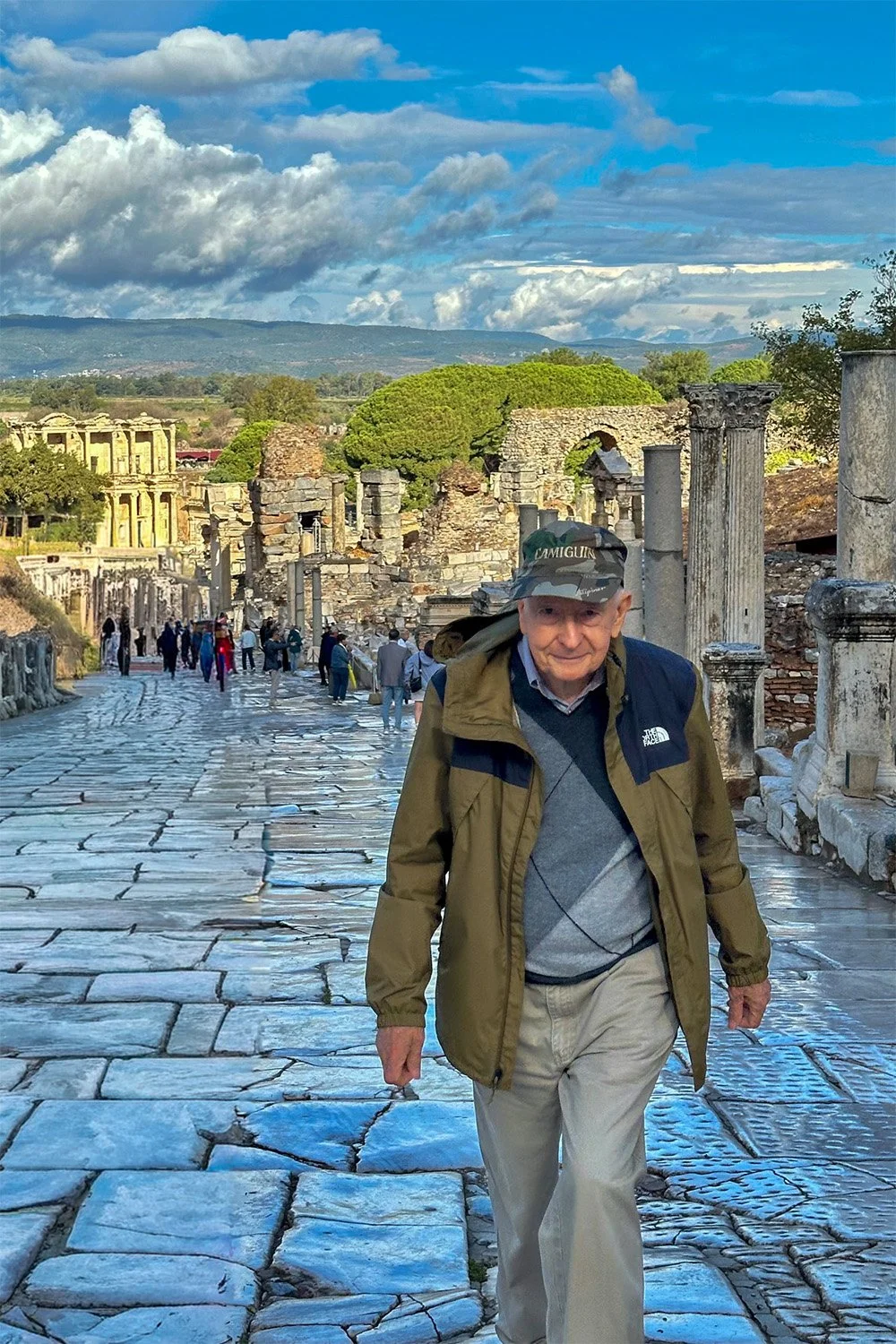
The iconic Library of Celsus facade at Ephesus Ancient City.
We’d noted on our itinerary that Güzelçamlı and Didim were two places that could be worth visiting on the way if we had time. Güzelçamlı is reputed to be a particularly picturesque area with some of the best beaches along this part of the coast, and Didim is billed as a ‘hidden gem’ offering both excellent beaches and Roman ruins including the Temple of Apollo.
We left our hotel in the morning a few minutes before 7.00am and drove straight through to Ephesus, completing the journey from Ürkmez in just over an hour (Google Maps had said it would take 54 minutes). We arrived at the Ephesus car park not long after its official opening time of 8.00am and were the second car to enter.
We are not early risers, but we had made a special effort to leave early this morning because we had read so many reports of how crowded Ephesus is during the day. Many travel bloggers recommended to get there at opening time because it is only in the first hour that you can enjoy walking around Ephesus without battling crowds.
Although we were there right after the advertised opening time, there were already about 20 large buses in the car park. We found out that on that particular morning Ephesus had opened early at 7.00am to allow over 1,000 tourists from a cruise ship docked at Kuşadası to have a privileged early entry.
The damp cruise ship tourists who left shortly after we arrived.
So, whilst the advice to get there early is valid, that doesn’t apply on days when special arrangements are made for cruise ships. Fortunately, the cruise ship tourists were already heading back to their buses (many sodden wet because it had been raining for the best part of an hour) and by the time we made our way into the main area of the ruins around the famed library façade, the crowds were dispersing.
We spent about two hours exploring the ruins (including the terrace houses which require an additional payment) and then headed into the café near the museum for coffee. After that we joined a queue to enter the museum which was somewhat disappointing because it wasn’t much more than an audio-visual display projected onto the internal walls of the building.
By the time we left around 11.00am, the weather had improved and Ephesus was getting extremely crowded. We were glad we had made the effort to get there early because the experience was so much better with fewer people around. The extra payment for the terrace houses is worthwhile as the excavation and restoration work that’s been done on those is quite impressive.
The inside of terraced houses at Ephesus undergoing restoration.
After leaving Ephesus we headed into Selçuk to a coffee shop in the centre of town that we’d seen recommended on Google Maps (the coffee at the Ephesus café wasn’t that great). We drove around the town for quite some time before finding a parking space many blocks from the town centre and walked about a kilometre to the coffee shop. The coffee was good, but everyone inside and outside was smoking. Unfortunately, in Türkiye the health regulations regarding smoking in cafes and restaurants are not well enforced.
Our next stop was Şirince, and it was a lovely drive up into the hills to this fruit growing area. The village of Şirince was originally a Greek village dating back to around the 11th century but was taken over by Turkish settlers after the forced population exchange between Greece and Turkey in 1923. It has an interesting history which you can read about here.
We had read that during the summer season Şirince can get crowded with day trippers from Kuşadası, but on the October weekday that we were there we saw no more than a dozen other visitors. We wandered the cobblestone streets for a while admiring the restored stone houses with their Greek facades and Turkish interiors. Many have been turned into craft shops, cafes and boutique hotels.
The village of Şirince in the hills behind Selçuk.
We had lunch in Şirince at a small family-run restaurant overlooking the valley. It was traditional village food, and we weren’t sure what we were ordering as the proprietor spoke only limited English, but we enjoyed what we were served and it was reasonably priced. Unfortunately, the family cat twice grabbed food off our plates and took it under the table to eat – something that you have to get used to in Turkish restaurants!
Şirince grows a lot of figs, apples, peaches and pomegranates, and these are used to produce fruit wines. As we would be driving for the rest of the day, we resisted the temptation to start sampling the wines, but this was one place to which we could easily return for a couple of days of wine tasting. The atmosphere in the village was quiet and relaxing, and we wished we’d had the time to explore it more fully.
We didn’t have any problem parking in Şirince as there are pay and free parking areas just outside of the village from where it’s only a 5-10 minutes’ walk into the village. There are no cars inside the village.
Şirince is a pedestrian-only village with steep streets.
After lunch we backtracked to Kuşadası planning to stop for a walk along the seafront before heading down the coast to Güzelçamlı. We drove back to the coast to the point where we had left it earlier in the day to go to Ephesus and then cruised through Kuşadası looking for a place to park. The town had a similar feel to Çeşme but was much busier – perhaps because of the presence of at least one cruise ship in the port.
But that was about all we could observe about Kuşadası because we could find nowhere to park – either free or paid. We pulled into a service station on the southern side of Kuşadası to check the route to Güzelçamlı. According to Google Maps, the sidetrip to Güzelçamlı was going to add at least an hour to our journey to Bodrum, and as it was already after 3.00pm, that meant we might not make Bodrum before dark.
So reluctantly we had to drop Güzelçamlı off the itinerary (and Didim as well) to be sure of making it to Bodrum by dark. It was just as well that we did because Google’s travel time of 2 hrs 30 mins turned out to be significantly under-estimated. It actually took us over three hours – partly because we got stuck behind a slow-moving truck on some winding rural roads that Google had recommended as a ‘short cut’ near Milas. If we’d stuck to the main highway, we would probably have done it in just under three hours.
The first hour of the journey was fairly boring along straight stretches of highway D525 over flat farmland but once we reached Lake Bafa it became more scenic. The last section from Güvercinlik into Bodrum was quite a pretty drive too.
Passing Lake Bafa on the borders of Muğla and Aydın provinces.
When we reached Bodrum, Google Maps took us into a dead-end street about a kilometre from the Airbnb that we had booked. We called the Airbnb host, and he gave us some directions to a locality nearby where we could park for the night and which was within walking distance of our accommodation.
Google had been trying to give us directions all the way to our Airbnb, but the streets around there were only wide enough for a motorcycle. We had to drag our suitcases (fortunately they were on wheels) down to the waterfront and then along the harbour promenade and back up the side street where our accommodation was located.
It wasn’t clear when we booked our Airbnb that we couldn’t access it by car. The listing said parking was available nearby, but we had assumed that we could drive to the accommodation, drop our bags off, and then park the car. That was not the case, and we laughed when we saw how narrow the streets were around that part of Bodrum.
Nevertheless, the accommodation was very comfortable and only a few steps from all the waterfront bars and restaurants. After unpacking our bags, we took a stroll along the waterfront which was very pleasant except for some aggressive restaurant proprietors trying to push menus in our faces in their efforts to drum up business in what was a quiet end-of-season period.
The expensive beach restaurants on the Bodrum waterfront.
We eventually decided on a restaurant that was busier than others (usually an indication that the food is good) and sat down at a table back from the water to avoid diners who were smoking. The waiter brought us a menu and after overcoming our initial price shock we ordered our food. The waiter suggested that we complement our meal with one of their ‘signature cocktails’, but at seven times the price that we would pay back home, we politely declined. It was still the most expensive meal that we had on the trip.
Day 3
Our itinerary for our third day did not involve a lot of mileage. We simply wanted to explore the Bodrum peninsula at a leisurely pace after the long drive the previous day. Our plan was to start with the Dibeklihan Culture and Art Village at Ortakent and then head up to the windmills on one of the high points of the peninsula near Dağbelen for what was reputed to be spectacular views.
After that we planned to go over to Torba Beach and then drive on the coastal road along the north of the peninsula through the upmarket resort areas of Göltürkbükü, Gündoğan and Yalikavak. We intended to finish up at Gümüşlük or Turgutreis at the western end of peninsula for the sunset.
We walked to where we had parked our rental car the previous evening. We discovered that other cars had parked behind us overnight and we were completely blocked in. The only person we could see around the parking area was an old woman who had walked out of a pansiyon a short distance away.
The pansiyon near where our car was blocked in on the street.
I asked her if she knew where the driver of the car that was double parked behind us was. I don’t know whether she understood me, but she responded by shouting at us in Turkish in what sounded like a torrent of abuse. She was waving her arms about, and her demeanour was most unfriendly.
I called the proprietor of our Airbnb, and he asked me to put her on the phone, but she refused to speak with him and continued to rant and rave at us. Our Airbnb host could hear all this on the phone so he said he would come over and sort things out. Just then I noticed a small sticker on the bottom of the windscreen of the car that was blocking us that looked like a telephone number, so I asked our host if that could be the telephone number of the driver.
He said that most likely it was because double parking in Türkiye is very common, so many drivers leave their mobile numbers on their windscreens so you can call them if they are blocking you. I gave the number to our host and a few minutes later he called back to say the driver was on his way and would be there in five minutes.
When the driver turned up, he was calm and smiling and quickly backed his car out so that we could leave. The old woman across the street was still grumbling and scowling at us though. I have no idea why she was so upset with us given that the driver was friendly and seemed unconcerned about us having parked there. Maybe she was just tired of tourists.
Part of the Dibeklihan Art and Culture Village complex.
After our delayed departure it took us only 20 minutes to reach the Dibeklihan Culture and Art Village (shown as Dibeklihan Kültür ve Sanat Köyü on Google Maps). We discovered that it wasn’t a real village at all, but a collection of stone buildings built in 2008 to house an ethnography museum, art galleries, Thai and Indian restaurants, a coffee shop and spaces for ceramic workshops, art exhibitions and cultural events.
The complex is architecturally interesting, but nothing was open when we arrived except for the coffee shop and an antique shop. We wandered around for about 10 minutes and took a few photographs. The owner of the antique shop explained that most sections of the complex close in September and don’t open again until the next year’s summer season.
She invited us to have a look at her antiques. She had some pieces that we would have loved to take home but the prices were way beyond our budget. This is a place for serious antique and art collectors, not souvenir hunters. We read later on Dibeklihan’s website that their museum is supposed to be open year-round but it was closed on the day we were there.
After leaving Dibeklihan – somewhat disappointed because it wasn’t what we expected – we headed up to the windmills (known as Yel Değirmenler on Google Maps). These were also a disappointment because whilst the views were nice, they certainly weren’t ‘spectacular’ as many websites described (we were to see far more spectacular views in the coming days).
The one working windmill still standing on the hill above Dağbelen.
There is only one windmill still working (reputed to be 175 years old). The others are only the stone structures without the sails, and in some cases the ruins of windmills. We would have liked to have seen inside the working mill, but it was closed and there was nobody around.
Next stop was Torba Beach which we’d seen on our way into Bodrum the previous afternoon. From the highway it looked to be a nice spot in a pretty cove, but when we got down closer to the beach it didn’t impress so much.
The roads on the eastern side of the cove were clogged with parked cars (perhaps overflow from a nearby theme park with waterslides and dinosaurs) whilst the western side of the cove was almost deserted except for a few people eating at restaurants along the beach.
All of the roads around Torba Beach were narrow, making passing oncoming traffic difficult, but we did manage to find one place to stop not far from the middle of the beach. We walked down to the beach, but it was a stone beach and there was a lot of rubbish and rusted iron sheets strewn around. It definitely wasn’t a “breathtakingly beautiful beach with soft sands” as one tourist site had gushingly described it. We didn’t like it at all.
View from the road at Türkbükü between Torba and Gündoğan.
We then backtracked to Göltürkbükü and headed around the road closest to the coast to Gündoğan. These are much cleaner areas with nice coastal views but, like the eastern side of Torba Beach, they were almost deserted. That made driving easy, despite the narrow roads lined on both sides with the whitewashed walls of holiday villas and apartments.
We stopped for lunch down near the marina at Gündoğan. We were lucky to find a parking spot there, something that in the high season would probably be impossible. We chose a café that had good ratings on Google Maps which turned out to be the only place open. When we saw the price of a burger on the menu at 950 Turkish lira, and coffee at 250 lira, we decided to skip lunch there and move on to Yalikavak where we ended up buying some sandwiches at a service station on the main highway.
Göltürkbükü and Gündoğan are known to be upmarket resort areas and home to many luxury villas and 5-star hotels with $500 per night room rates, so I guess we should have known that the cafes and coffee shops around there would be expensive too. Not a place for budget travellers and if you don’t own a private yacht or in the marina or have the money to charter one, we couldn’t see what else there would be to do there aside from ocean fishing trips.
Fishing boats and yachts in the marina at Gündoğan.
After our sandwich lunch we continued around the coastal road past the Yalikavak Marina but as nice as these areas were, we were getting bored. It all looked the same. So we decided to head back to Bodrum town and visit the castle because we saw on Google Maps that it was open until 5.30pm and the entrance fee was only 20 lira.
We couldn’t find anywhere to park near the castle, so we headed back to where our accommodation was, found a parking spot on a street a little further away than where we had parked the previous night, and then walked to the castle from there. When we arrived, we went to pay our entrance fee, only to be told that for foreigners it was 23 euros. The price on Google Maps was for Turkish citizens only.
As there was only about half an hour left before the castle would be closing – and the Glass Wreck Hall was already closed – we decided to skip the castle visit because there would hardly be time to do more than a quick walk around the ramparts. Instead, we walked around the marina on the western side of the castle as we had only explored the bay on the eastern side the previous evening.
Luxury cruising yachts in the marina near Bodrum Castle.
We ate away from the waterfront that evening and had a good meal of traditional Turkish food at half waterfront prices. We finished up at Tekilacılar Sokağı (Bodrum’s bar street, also known as Banka Sokak) for a nightcap before turning in for the night.
Bodrum is reputed to have more bars per square kilometre than any other place in Türkiye and is regarded as second-only to Istanbul in terms of its nightlife offerings. Whilst most of these places were disco type music establishments, we did see one place advertising traditional Turkish music and belly-dancing, but that didn’t start until 11.00pm, which was too late for us as we needed to make an early start the next day.
Day 4
We left Bodrum at 7.00am as we had about five hours driving ahead of us to Fethiye where we had booked accommodation for the night, as well as a side-trip to Lake Köyceğiz and Iztuzu Beach. Before leaving Bodrum, we decided to make some changes to our Day 4 planned route.
On our original itinerary we had intended to take the inland highway to Gökova Belediyesi and then do a side-trip to Marmaris as well, but after looking at Marmaris on Google Street View the previous evening, it didn’t look much different to Bodrum (but quieter perhaps and more downmarket).
A decorative door in a stone building near Bodrum.
The inland route would have got us to Gökova in about two and a half hours, but it would have meant backtracking along the highway past the Milas-Bodrum Airport which we had driven two days previously, and there didn’t look to be much of interest along that route except for the Ancient City of Stratonikeia.
Having already visited Ephesus, and with plans to visit Hierapolis on our last day, we decided instead to take what looked like a more interesting coastal route to Gökova which would take an hour longer than the inland route, but we would make up that time by not doing the side-trip to Marmaris.
The coastal route would take us past the Bodrum Yalı Çiftlik Public Beach, through a maze of rural roads across to Mazıköy and then onto Çökertme, Türkevleri and Akyaka. We’d checked out parts of the new route on Google Street View and it looked much more scenic.
Indeed, it was, but about an hour into the journey we wondered whether we had made the right decision. The winding rural road had narrowed to almost single lane in places, and we were only seeing other vehicles every 10 minutes or so. It was a pleasant drive through pine forests and rolling hills of olive trees and dry-stone walls, but it was slow as the road was not in good condition along a few stretches.
One of the better stretches of the coastal road to Akyaka.
Occasionally we would see a farmer working in the distance, and every 15-20 minutes or so we would pass through villages of stone houses which we could easily have assumed were deserted if it wasn’t for the pickups and tractors parked alongside some of the buildings. This really was getting off the beaten track!
In many places we could not see the ocean as the road was several kilometres inland, but in other places the road ran along cliffs above the ocean, and we had lovely views across to the Datça Peninsula off to our right. After passing through Oren, the condition of the road improved, but we still saw very little traffic until we reached the outskirts of Akyaka.
We made it through to Akyaka nearly an hour later than Google’s estimated arrival time. We did a quick 10 minutes backtrack up highway D550 to the viewpoint (Sakar Geçidi Manzara on Google Maps) for some magnificent views of the Gulf of Gökova and then headed back down to highway D400 for the 40 mins drive to Köyceğiz.
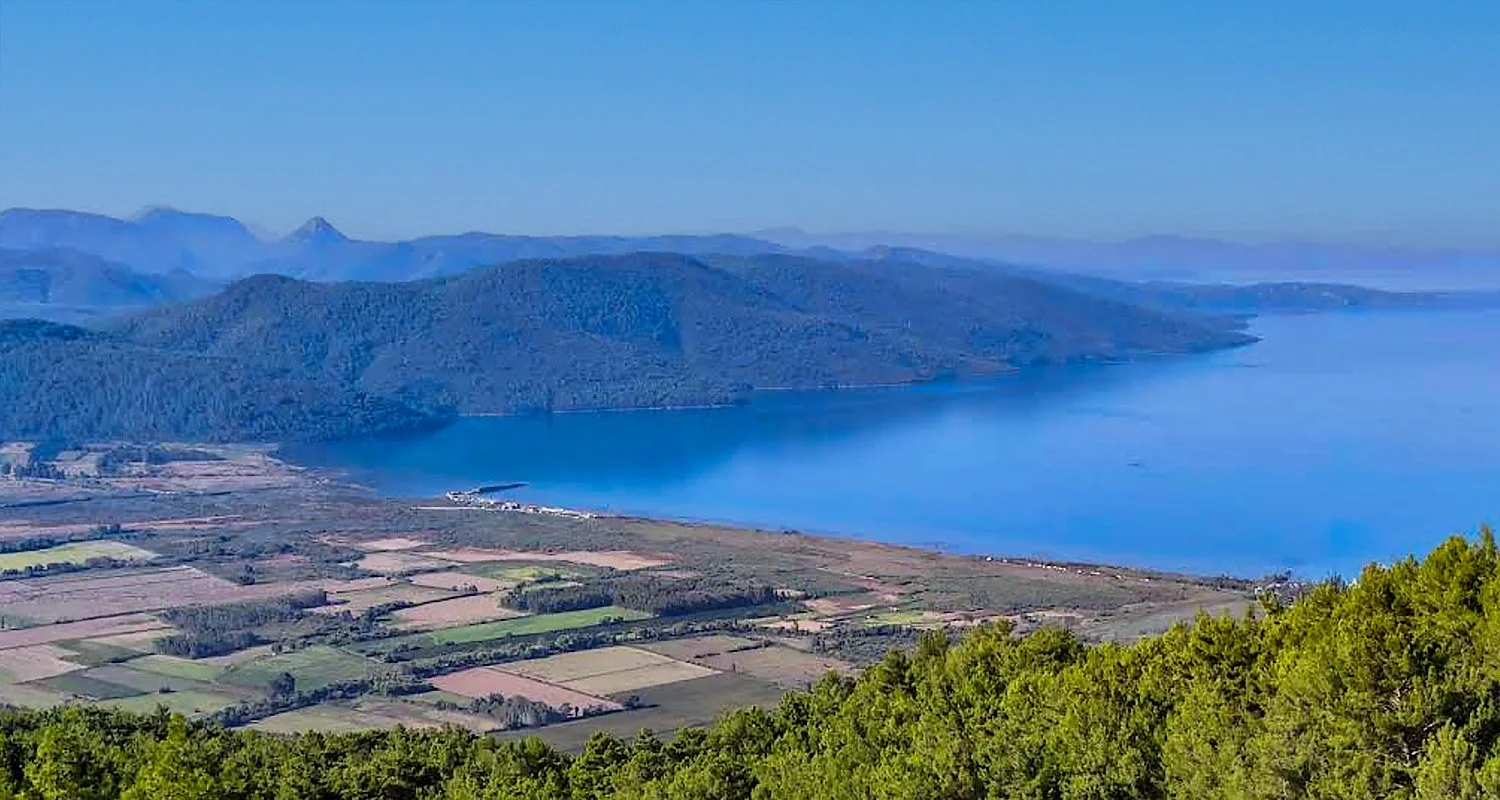
View of the Gulf of Gökova from the lookout on highway D550.
Köyceğiz is a lovely town, and we stopped right by the lake for a superb lunch that was better than anything we had eaten in Bodrum – and half the price. There was plenty of street parking near the lake and it was nice to relax there after such a challenging drive. We could have easily spent a day or two there if we’d had the time.
After lunch we drove down to Dalyan to discover another lovely town. Dalyan is more touristy than Köyceğiz, but nothing like the tourist towns we had visited on the first three days. Dalyan has many tourist shops, restaurants, cafes and bars, but it’s not crowded and until a few years ago would probably have been one of those places that might have been described as a ‘hidden gem’.
Set on the eastern banks of the river that drains Lake Köyceğiz to the ocean, its clean streets and neat riverside parks are overlooked by the well-preserved Lycian tombs carved into the cliffs on the other side of the river. Not many towns have a backdrop as impressive as these.
The town of Dalyan with its backdrop of the Kaunos tombs.
The tombs, which have impressive facades that resemble those of Hellenistic temples, are part of the ancient city of Kaunos which dates back to the 4th century BC. The kings of Kaunos were buried here as well as other high-ranking officials of Lycian society.
We had excellent views of the tombs after boarding one of the river ferry boats that operate between Dalyan and Iztuzu Beach – a relaxing trip that takes about 45 minutes each way through vast beds of reeds that are 2-3 metres high. The ferries are operated by a local cooperative, and the boats vary in style and size, with most carrying around 20 passengers. The fare is 200 lira each way. In 2015 the fare was only 10 lira. Another example of Türkiye’s rampant inflation.
The public ferries terminate at a small jetty on the back of a kilometre-long sand bank near the mouth of the river. From there it’s a short walk to the beach where there are toilets and a kiosk selling drinks and snacks. We headed to the kiosk first to buy some water as we’d drank all we were carrying whilst walking around Dalyan and on the ferry.
The public ferry boats that operate between Dalyan and Iztuzu Beach.
“We’re closed” the guy behind the counter replied after I ordered two bottles of water. The kiosk didn’t look closed at all and there was a wall of fridges behind him with cold drinks on display, and warm bottles on the counter right in front of us. I asked if we could have two of the warm bottles (thinking he might have already locked the cold drink fridges up for the day).
“I said we are closed” he replied angrily. I then politely asked him if there was anywhere else on the beach where we could buy water. “No” he snapped back and turned his back on me. His rudeness was surprising given that Iztuzu Beach is a tourist destination and all we were asking for was water. In most places in Türkiye we found people working in the tourist industry to be friendly, but this unpleasant man was an exception.
Iztuzu Beach looking east from near where the ferries terminate.
Many people who make the ferry trip down to Iztuzu Beach walk to the other end of the beach – a distance of about three kilometres – to visit the Marine Turtles Rehabilitation Centre (Kaplumbağa Hastanesi on Google Maps) and then take a dolmuş (public mini-bus) back to Dalyan. Entrance is free but donations are appreciated as it’s run by volunteers.
Unfortunately, we were running short of time by this stage, and with no water for the walk we decided to hop back on the next ferry to Dalyan. Upon arrival in Dalyan, we walked back to our car which was parked about 10 blocks back from the river and then headed back out to highway D400 to complete our drive to Fethiye.
On the way we made a short detour through Göcek past the Mega Yacht Marina, but it didn’t look much different to the other marina resorts that we had visited except we did see a few vacant parking spots not far back from the water. We didn’t stop though because we wanted to make it to Fethiye before dark.
The waterfront at Fethiye with its many yachts.
Fethiye didn’t impress us at all. Just more stone or grey sand beaches, marinas, waterfront promenades, holiday apartments, tourist shops, restaurants and cafes. I guess people go there because of its proximity to Dalaman Airport and the fact that it is not so pricey as places like Bodrum.
Day 5
Our Day 5 itinerary was one that we knew in advance we would be unlikely to fully accomplish because we had packed so many side-trips into it in an effort to get to Ulupinar by the end of the day to in turn give us time to visit Antalya before heading to Pamukkale.
The itinerary read: “Drive to Ulupinar. On the way visit Kayaköy (abandoned Greek village), Ölüdeniz Beach and the so-called ‘Blue Lagoon’, Patara Sand Dunes, Kalkan Beach, Kas, Demre (Lycian Rock-Cut Tombs of Myra), Finike, Cirali, Olympos hippie village, Yanartaş (Mount Chimaera Eternal Flames). If weather is fine and we arrive before 3.30pm, take ride to top of Mt Tahtali on Olympos Cable Car.”
The abandoned village of Kayaköy, also known as the ‘ghost village’.
We headed off early after a quick breakfast at an excellent coffee shop near our hotel and reached Kayaköy in about 30 minutes. It was a pleasant drive through pine-forested hills once we left the urban area of Fethiye. This is another of those villages that was abandoned during the forced population exchange between Greece and Turkey, but in this case the Turkish settlers from Greece showed no interest in repopulating the village.
From Kayaköy it was only another 20 minutes down to Ölüdeniz Beach and the famed Blue Lagoon. As we drove down the hill towards Ölüdeniz Beach our first reaction was how scenic the setting was, and as we got into the tourist area our second reaction was “Wow, this is party central”. It was by far the busiest spot we had visited on the trip, and I cannot imagine how much busier it could be in the high season.
There was absolutely no chance of finding any parking spots within walking distance of the beach, so we drove along to the Blue Lagoon hoping it would be quieter there. It was, but the only car park was full and every time we tried to stop by the side of the road to take a photograph, someone would appear at the car within seconds asking for 200 lira for parking. It was a case of “no pay, no stop”.
The view back to Ölüdeniz Beach from the first place we could stop.
Sadly, we left Ölüdeniz Beach without any photographs (we did take a few snaps out of the window of the car but nothing of publication quality). We could only manage a distant view of Ölüdeniz Beach from one of the headlands to the south of Ölüdeniz once we had got back onto the coastal road and found a place to stop.
I can understand why Ölüdeniz Beach is such a popular destination for younger travellers. Even 5km south of the beach we could still hear the music from the party galleons sailing in the bay – and this was still before 10am. For older travellers seeking peace and quiet at night, this would definitely not be the place to stay despite its beautiful beach and scenic location.
The beautiful coastal scenery along our Day 5 route.
We continued south along the coast with the road climbing to about 400m above the ocean before it turned inland and continued to climb into rocky mountains to around 1,000m. For the next hour or so we drove on a twisting road that took us through some incredibly beautiful scenery. In that hour only three cars passed us travelling back to the coast and one overtook us when we stopped to take some photographs.
We were enthralled by the rugged beauty of these mountains and the fact that we had this part of the riviera almost to ourselves. Aside from the occasional stone cottage and a couple of luxury glamping resorts perched high above the road, we saw almost no sign of life along this part of the drive. This was shaping up to be one of the best days of our Turkish Riviera road trip.
One of the glamping resorts in this isolated part of the riviera.
Later that evening we checked the accommodation prices for the glamping places thinking we might go back there one day. Most are charging around 120 euros per night which was about three times what we were paying for accommodation on this trip, but I can imagine this appealing to many people looking for somewhere that is an isolated destination, surrounded by nature and with breathtaking views.
But the spectacular views of this rugged landscape were not over yet. As we descended from the mountains towards the village of Boğaziçi, we had a distant view of mountains rising to nearly 3,000 metres on the eastern border of Muğla province abutting the western border of Antalya province. The view took our breath away because it looked like the mountains were snow-capped!
How could there be snow in October? We thought it might be an aberration of the light – some strange cloud formation perhaps. But it really was snow. Apparently, the unusual weather conditions that had caused the heavy rain and flooding in Ürkmez on our first night had dumped an early season dusting of snow on these mountains.
A rare occurrence here: Snow-capped mountains in October.
What a contrast this area was to the resort towns along the coast. We were enjoying this day’s drive immensely, and could have lingered here longer, but we were not even a fifth of the way to our destination, so we continued inland to rejoin highway D400 at Gölbent for the drive down to the Patara Sand Dunes.
We turned off the highway at Adaköy to go down to Patara Beach but before we reached the beach there was a barrier and a ticket booth. We were informed that there was a 15 euros per person entry fee for the beach. We told the person in the booth that we weren’t intending to stay at the beach. We said we were on a road trip, and we only wanted to drive down to view the sand dunes for about 10 minutes.
The ticket clerk said that was not possible unless we paid the entrance fee which was the same for 10 minutes or 10 hours. So, we did a U-turn and left. As beautiful as the Patara Sand Dunes looked in the travel brochures, we weren’t prepared to pay 30 euros for a 10 mins visit. And as we paused by the side of the road to reprogram our Google Maps, we noted we weren’t the only ones doing U-turns at the ticket booth.
Having lived most of my life in countries like Australia, Malaysia, Philippines and Thailand where beach access is always free, paying to go to a beach was something of a culture shock. And as we were to discover later in the day, this was not the only beach along this part of the coast that charges entry fees. We passed two more in the afternoon that had ticket booths.
The roadside restaurant near Patara Beach where we had lunch.
By now it was time for lunch, and we had noticed a roadside restaurant serving traditional food not far back from the ticket booth, so we headed there for what turned out to be a delicious lunch that was half the price of the beach entry fees.
After lunch we headed back to highway D400 and drove down to Kalkan, another resort town on the coast. Kalkan was very quiet compared to Ölüdeniz Beach and looked more to cater for the type of clientele who would be staying places like Kuşadası.
A view of picturesque Kalkan from highway D400.
Kalkan is about a third of the size of Kuşadası and less developed. Its white-washed houses on the arid hillsides rising above the small harbour, and colourful bougainvillea along the paved streets, make it a more picturesque town, but it felt dead. Perhaps in the high season it might feel more alive.
We continued for about another 30 minutes along the coast to Kaş along a good road that hugged the rocky cliffs above the ocean. We stopped in Kaş for coffee and immediately liked the place. It’s a little smaller than Kalkan, and was busier, but we liked the vibes of Kaş. We managed to find a parking spot a few blocks up the hill from the old town and spent about half an hour exploring its picturesque narrow streets.
The narrow cobblestone streets of the old town of Kaş.
We would have loved to have stayed in Kaş longer but by now it was after 3pm and we weren’t even halfway to Ulupinar. It was clear that we weren’t going to see everything that we had listed on our Day 5 itinerary. We decided to drop Demre from the itinerary and head straight to Yanartaş as we really wanted to see the natural flames on Mount Chimaera.
We drove through Finike on the way but that didn’t look much different to Fethiye and certainly didn’t appeal to us. We stopped for fuel at Kumluca and then up over some mountains on a new four-lane highway. We arrived in the car park at the base of the trail up to Yanartaş about half an hour before sunset.
The start of the trail up to the eternal flames at Mt Chimaera.
We paid a modest entrance fee of 60 lira and started the climb up to the eternal flames. It was not an easy climb as the rock-hewn steps were uneven, and in several places we had to clamber over boulders. It’s not a climb that anyone with mobility or heart issues should attempt, but I made it up in about 25 minutes after a couple of brief rest stops.
The Mount Chimaera flames are called eternal because they’ve been burning for thousands of years. They are fed by methane gas escaping from fissures in the rocks – hence the Turkish name, Yanartaş, which means ‘burning rock.’ It’s thought the methane gas was ignited by lightning over 2,500 years ago and the fires have been burning ever since.
Eternally burning flames and tourists at Mount Chimaera.
The fires are not large, but it was a surreal experience to see these eternal flames and the many cats that live on the mountain, using the flames to keep warm at night. There were 20-30 other tourists on the part of the mountain where we were, but it didn’t feel crowded as the flames are quite spread out.
We stayed for about half an hour, taking photographs of the flames and the cats, and then headed back down to the car park in the fading light. As we climbed down, we passed many people coming up with flashlights and headlamps. Yanartaş is open until 10.00pm, with last entry at 9.00pm, but walking around on the rocky mountain slopes at night would require a lot of care.
By the time we got to the bottom of the track, it was pitch dark and we had to use our phone lights to negotiate our way over the rocky terrain back to our car. By this stage we were hungry so decided to stop at Çıralı Beach for dinner. This is a fairly isolated beach surrounded by mountains and with a dozen or so restaurants and more rustic accommodation than what we’d been seeing earlier in the day.
A cat warming itself at one of the eternal flames.
We didn’t see much around Çıralı because it was dark, and we had to drop the Olympos hippie village from our itinerary for the same reason, but this is definitely an area that we could go back to an explore more. It has a more bohemian feel to it than other parts of the Turkish riviera.
We drove to Ulupinar in the dark and checked into our accommodation around 9pm. By this stage we’d had enough experience of driving on Turkish roads that we didn’t find that intimidating, despite the first part of the drive being along a winding mountain road. Once we got back onto to highway D400, it was an easy drive to our accommodation.
Day 6
By now our itinerary was completely shot and we had to decide whether to backtrack and see some of the places that we didn’t have time to visit on Day 5 or proceed to visit Antalya as we had originally planned before commencing the long drive to Pamukkale. We compromised and decided to go back to Olympos and take the cable car up Mt Tahtali and restrict our visit to Antalya to just the western beaches.
The view looking southwest from the summit of Mt Tahtali.
That turned out to be a good decision because we loved the Mt Tahtali experience. The views from the top of the mountain are awesome but we couldn’t spend a lot of time there as we had underestimated how cold it would be at 2,365 metres in October. It was 11°C degrees at the summit and we were only wearing light jackets.
The views going up and down were spectacular too, but you need to be pressed against a window to enjoy them because they pack 80 people into each cable car. The round-trip fare is 41 euros and well worth it if you can get near the front of the queue and get a position by a window.
The northerly view from Mt Tahtali is over barren mountains.
We spent about an hour at the top of the mountain, including 30 minutes in a warm coffee shop, before heading back down where it was a pleasant 24°C. From there we drove up to Kemer (which didn’t impress us at all) and onto Konyaalti Beach – Antalya’s main western beach. That took about an hour and a half, so we stopped there for lunch.
This part of Antalya was much like a larger version of Fethiye or Finike. Whilst we had an enjoyable late lunch at an Asian restaurant, it was expensive and we were pleased that we had decided to drop Antalya off our itinerary. Perhaps if we’d had time to go into Antalya’s old town known as Kaleiçi, we may have had a different impression of Antalya, but it’s a big city and visiting the old town would have added at least another two hours to the trip.
We certainly didn’t have time to visit Alanya as well. That would have required another day. That didn’t concern us because what we could see from YouTube videos of Alanya, it didn’t look to be much different to Fethiye or Finike – the two cities that had ended up on our ‘less than impressed’ list.
Konyaalti Beach is Antalya’s main western beach.
We wanted to be in Pamukkale before dark as we were planning to take a hot air balloon ride at dawn, and Google Maps estimated our travel time on the E87 freeway to be 3 hrs 25 mins, so we knew it would be close to four hours. We stopped for coffee at Korkuteli (where we also had the best cheesecake we’d eaten for many moons) but otherwise drove straight through, only making a quick fuel stop about an hour out of Denizli.
The freeway was excellent with speed limits of 120 or 130 km/h and light traffic. With the coffee and fuel stops it took four and a half hours. It was just getting dark when we checked into our hotel, and we didn’t see many restaurants open when we drove into Pamukkale, so we ended up eating in the hotel restaurant. The food was good and reasonably priced, so no complaints on that score.
We enquired at the hotel’s tour desk about booking a hot air balloon flight for the morning but were warned that it would only be 8°C at dawn the next morning and much colder at the altitude the balloons would fly. We didn’t have any winter clothes with us, and we’d felt uncomfortably cold at 11°C on Mt Tahtali, so we decided to forego the balloon flight and sleep-in until it warmed up.
Day 7
Our plan for today was to spend the morning at Pamukkale visiting the travertine terraces and then the ancient city of Hierapolis which is at the top of the terraces, and after that head back on the freeway to Izmir and visit the old town there before dropping the rental car off at the airport at 6.00pm.
Our first distant view of the Pamukkale travertine terraces.
As it turned out we enjoyed Pamukkale and Hierapolis so much that we ended up spending most of the day there, leaving only at 3.30pm. We had to drop Izmir city off the itinerary and drive directly to the airport which fortunately is on the eastern side of the city.
After an excellent hotel breakfast in the morning, we checked out to drive the kilometre or so to the closest entrance to the travertine terraces. As we were checking out, the proprietor told us about what he described as a government-backed ‘scam’ at the ticket office.
He said guests had reported buying the 30 euros entry ticket, only to later discover that they had been charged 40 euros on their credit or debit card. Usually people don’t realise the overcharge immediately because although the entry price is quoted in euros, the charge is put through in Turkish lira.
It was a crisp but sunny morning with paragliders in the air.
He told us that when guests did realise they had been overcharged and brought that to the attention of the ticket office clerk, they would be advised that the additional charge was for the Hierapolis audio guide earbuds that had been handed to them with the ticket. He said that whilst the audio guide itself is informative, it is only useful if you intend to spend the whole day at Hierapolis. And you are better off using your own earbuds because the ones provided with the audio guide are poor quality.
Most visitors don’t use the audio guide, he said, but the ticket office tries to force visitors to buy them whether they want them or not. He advised us to specifically ask for an entrance ticket without the audio guide, and if we are overcharged, threaten to report them to the tourist police. He said that usually results in them giving a refund. We thanked him for his advice and drove to a parking area at the base of the travertine terraces not far from the ticket office.
As we were walking from the car to the ticket office, a man pulled up on a motorbike and told us we were going to the wrong entrance. He said it is difficult to get to the top of the terraces from there. He advised us to instead take a shuttle to the top and walk down to the terraces from there. I asked him where the shuttle was and how much it costs.
The pools on the western side of the terraces were dry in October.
He didn’t answer my questions, instead just telling us to come with him and he would show us. I asked him again about the shuttle price and where it was, but he wouldn’t tell us. That raised red flags in my mind about another possible scam, so we just said, “no thank you,” and continued walking.
No sooner was he out of sight another man on a motorbike pulled up and gave us the same spiel. But again, he wouldn’t tell us where the shuttle was (“just follow me,” he said) or the price, so we were convinced these were scammers preying on unsuspecting tourists.
We reached the ticket office a few minutes later and following our hotel proprietor’s advice, we asked for two entrance tickets without the earbuds. The clerk issued the tickets on which the price of 30 euros was printed but still handed the earbuds to us after passing over the debit card receipt.
Beginning the long climb from the bottom entrance.
I checked what had been charged in Turkish lira and it was over 4,000 lira, so she had clearly charged us an extra 20 euros for the earbuds. I told her we didn’t want the earbuds, and she tried to insist that we had to pay for them. I stood my ground and reminded her that I had specifically asked for entry tickets without the earbuds and refused to move from the ticket window.
I didn’t have to threaten to go to the tourist police because she begrudgingly cancelled my debit card charge and then put the correct charge through for the entry tickets. We learned later reading reviews on TripAdvisor that this happens to almost every foreigner entering Pamukkale aside from those on prepaid small group tours who normally have guides with them.
The unpleasant experience at the ticket office was soon forgotten as we approached the entry to the bottom terraces. We had to remove our shoes and place them in the plastic bags that we had brought with us. And then we started our climb of the incredible Pamukkale travertine terraces.
Some of the pools have constructed walls making walking easier.
We could see only a dozen or so other people on the lower terraces when we entered (although we could see more in the distance at the top) so it didn’t feel crowded. We took our time because some sections of the terraces were slippery whilst others were rough and the limestone was hard on the bare feet.
As we progressed slowly up the terraces we had to wade through pools of water which were almost freezing in places. But we didn’t mind because it was an outstandingly beautiful landscape and something that we had never experienced before. We stopped frequently to take photographs and as we got higher, we stopped many times just to admire the extraordinary views.
The quiet mid-level terraces look like snowfields in places.
At one point about halfway up we sat on a ledge below once of the terrace walls. From there we couldn’t see the tourists at the top, only a few people below us climbing the route that we had taken. That was almost dreamlike because it felt like we were on snowfields surrounded by white calcium carbonate waterfalls frozen in time.
As we resumed our climb, we saw more and more tourists arriving at the top of the terraces but around us it was still not crowded. We were so glad that we hadn’t listened to the touts on motorbikes earlier because climbing from the bottom is truly the best way to experience the travertine terraces.
Most visitors to the Pamukkale travertine terraces start at the top and walk down only a couple of levels. But those top terraces and pools are dirty because of the thousands of tourists that enter them every day. Others enter from the bottom but don’t persevere with the climb because it’s too hard on their feet. The vast majority of visitors never get to experience the pristine terraces and pools halfway up as we did.
The terraces near the top are dirty and crowded with tourists.
We took nearly two hours to reach the top. If we’d hurried, we could have done it in 45 minutes, but we took it slowly, wanting to savour every moment of this unique experience. We were enjoying our visit here far more than we expected.
Eventually we made it onto the upper terraces, and we had to push our way through the tourist crowds to reach the concrete walkway that led to the coffee shop. We didn’t have high expectations for the coffee in such a touristy location, but it was surprisingly good.
We spent the rest of time there exploring the Hierapolis ruins, which are much more spread out than Ephesus, but with a large Roman amphitheatre that is better preserved than the one we had seen at Ephesus. From the top of the amphitheatre there are impressive views over the Çürüksu Valley and surrounding countryside.
Hierapolis has sweeping views over the Çürüksu Valley.
We didn’t get to see all of Hierapolis because we under-estimated how large it was. We thought we could explore it on foot like we did at Ephesus, but after clocking up over 10,000 steps by 2.00pm, we realised we should have rented one of the electric golf buggies that they have available there.
We could have easily spent the rest of the day at Hierapolis, but we had to move on to reach the airport in Izmir by 6.00pm. It was around 2.15pm when we enquired at one of the shuttle booths as to the quickest way down. We were told there were two options: Walk down the road on the eastern side of the terraces or take a golf buggy shuttle to the northern entrance and then another shuttle down to Pamukkale village from there.
We checked Google maps and saw that that the road down the eastern side was about three times the distance we had walked when climbing the terraces, so we elected to take the shuttle option. We had to wait a while for a shuttle to arrive from the north entrance before we were able to get a ride back, and then when we got to the north entrance, we could not find any shuttles down to the village.
The museum at Hierapolis is inside one of the ancient structures.
It turned out that the guy in the shuttle booth was referring to the dolmuş from Karahayit and not a shuttle operated by the Hierapolis authority. A man on the gate at the north entrance told us to wait on the other side of the road and hail the next dolmuş coming down the hill.
Well, the next dolmuş didn’t arrive for 40 minutes and we were starting to panic about whether we would make it to the airport in time. When it did arrive it was nearly full, so we were lucky to get on. Then we discovered that the dolmuş was going to the village of Develi first and then back up the hill to near where we had boarded, before going down to Pamukkale.
When we got back to our car it was 3.30pm and Google Maps said it would take 2hrs 30mins to reach the airport. Fortunately, traffic was light and it was a six-lane freeway for much of the way, and for several long sections the speed limit was 140km/h, so we had to drive as fast as we could to get there on time. We didn’t stop and on a few downhill stretches hit 160km/h. We arrived spot on 6.00pm and that was the only time that Google Maps had given us an accurate travel time in Türkiye.
The author on the travertine terraces at Pamukkale.
We hadn’t eaten lunch at Pamukkale so after checking in, we had an early dinner at one of the airport restaurants before boarding our flight to Istanbul. It had been an eventful day and a memorable end to our seven-day Turkish Riviera road trip.
Summary of Lessons Learned
Seven days is not enough time to see all the Turkish Riviera by road. 10 days should be a minimum. 14 days would be better.
Travel times on Google Maps are under-estimated unless you are prepared to exceed the speed limits.
Parking is difficult in many places and pay parking is expensive.
The most popular tourist spots are not the best. They are crowded and expensive.
Entry fees to major attractions are expensive for foreigners. In our case, those entry fees cost us double what we spent on accommodation.
Is a Turkish Riviera road trip worth it? Definitely yes. With a car you get to see some beautiful places away from the tourist crowds.
All images: © David Astley
Where We Stayed on the Trip
ÜRKMEZ: Our first two nights were in an apartment hotel. I’m not going to mention the name of it because it was terrible. The room was nothing like the photos on the booking website (we booked a double room but the one we were given had two uncomfortable single beds and two fold-up beds). The sheets were grubby and there was no hot water. We demanded to be moved to another room. That wasn’t difficult because we were the only guests staying there. The room to which we were moved was in an adjacent building, and that was better and more spacious, but the furniture was old and tired. The owner was pleasant and helpful, but it’s just not a place I would recommend.
BODRUM: The Airbnb we stayed at in Bodrum was called Bella Mila Pansiyon. It’s a 7-room boutique hotel and I believe it can only be booked through Airbnb or the hotel’s own website. It was clean, comfortable, and great value for money given its location just a few steps from the waterfront. Highly recommended for those looking for a good mid-range property.
FETHIYE: We stayed at the adults-only Scape Hotel Fethiye based on Google reviews that said the beds were comfortable and many guests commenting that it was one of the cleanest hotels at which they had stayed in Türkiye. It lived up to its reputation and our expectations.
ULUPINAR: We chose a place called Trinitys Forest Bungalows because we love places that are advertised as ‘nature retreats’. We weren’t disappointed (other than the fact we couldn’t stay longer) as the comfortable, clean and spacious timber bungalows were surrounded by pomegranate and citrus fruit trees against a backdrop of pines and distant mountains.
PAMUKKALE: After studying all the varied reviews on the hotel options in Pamukkale prior to our trip, we settled on booking the Venus Suite Hotel. It was a good choice. The rooms are not large, but they are clean and well-maintained, and the bed was comfortable. We had an excellent dinner in the restaurant, and the breakfast buffet was nothing short of outstanding. It was very good value for money.